Tuesday, September 29, 2026
Home Blog Page 111

Brad Garlinghouse says Bitcoin at $200,000 ‘is not unreasonable’

0


Key Takeaways

  • Ripple CEO Brad Garlinghouse suggests Bitcoin could reach $200,000 due to US crypto-friendly policies.
  • Ripple is settling its SEC litigation for $50 million, facilitating their growth and acquisitions.

Share this article

Ripple CEO Brad Garlinghouse said Bitcoin’s $200,000 price target is achievable as institutional interest rises and US regulators shift toward a more crypto-friendly approach.

“I think $200,00 is not unreasonable,” said Garlinghouse when asked about his Bitcoin price target during an interview with Fox Business Network’s The Claman Countdown on Friday. “I wouldn’t predict XRP. It’s too close to home.”

CoinGecko data shows Bitcoin at approximately $83,500, reflecting a 3% increase over the past day. However, the leading digital asset is still 23% lower than its peak value reached on January 20.

Garlinghouse said that he avoids short-term Bitcoin predictions and is focused on long-term macro trends. The CEO of Ripple is confident that macro tailwinds and the reversal of US regulatory hostility will continue to drive value in the crypto space.

“I think about what are the macro trends playing out for the crypto industry, for the XRP ecosystem,” said Garlinghouse. “XRP has been the best-performing major crypto in the last 90 days. We think about it as, what does that look like over the next three years? I’m very optimistic.”

Garlinghouse believes people are underestimating the impact of the US economy on the crypto market. He noted that the economic powerhouse has transitioned from “headwinds, hostility” to “tailwinds,” yet the market hasn’t fully grasped the positive impact of this regulatory shift.

“The largest asset managers in the world go from relatively frozen out or hostile to now a friendly market. This has sensible regulation that is thinking about pro-innovation here at home,” he said.

Garlinghouse agrees that crypto acts as a hedge against inflation and global currency instability, though short-term movements are volatile.

“The long-term value here is going to be very clear. It (crypto) is a hedge against inflation. It is a dynamic where the more utility we drive in the crypto markets, the more we’re going to see value accrete to that market,” he said.

ETFs as a safer, institutionalized gateway into crypto markets

This week, Teucrium launched the 2x Long Daily XRP ETF, the first-ever leveraged XRP ETF in the US. The product saw debut trading volume of $5 million, placing it in the top 5% of all new ETF launches.

On the spot ETF market, multiple applications for XRP ETFs have been filed in the US, though none have been approved yet. Garlinghouse said an XRP ETF would represent a safer, more institutional gateway into the crypto market.

He previously predicted that XRP ETFs would debut in the second half of this year. JPMorgan and Standard Chartered estimate XRP ETFs could attract $8 billion in inflows in the first year if they are approved.

Discussing Ripple’s recent $1.25 billion acquisition of Hidden Road, Garlinghouse said the firm would not have made the deal a year ago due to hostile regulatory conditions under the Biden administration.

The move comes as the company expands its workforce to approximately 1,100 employees. He said the acquisition could enable Wall Street giants to access crypto via traditional infrastructure, according to him.

“This allows even larger institutions like BlackRock, like the biggest Wall Street financial institutions, to come into this market in a way they understand with a safer prime broker to help clear transactions and a bigger balance sheet to do that. It’s good for the whole industry,” he said.

Under Trump, Ripple has seen a clear policy shift favoring crypto innovation. Garlinghouse credited David Sacks, Scott Bessent, and newly confirmed SEC chair Paul Atkins for creating a more crypto-friendly regulatory environment.

Garlinghouse noted that stablecoin legislation and market structure bills have gained momentum in Capitol Hill. He expects federal stablecoin legislation and market structure reform to pass soon, helping firms like Ripple, Circle, and Tether.

Launched under a New York trust license, Ripple’s RLUSD stablecoin has exceeded $250 million in market cap and is approaching $300 million.

Share this article


BlackRock draws $3 billion in digital asset inflows in Q1, AUM reaches $11.6 trillion

0


Key Takeaways

  • BlackRock attracted $3 billion in digital asset product inflows in the first quarter of 2025.
  • Digital assets represent a small portion of BlackRock’s business, accounting for 0.5% of total assets under management.

Share this article

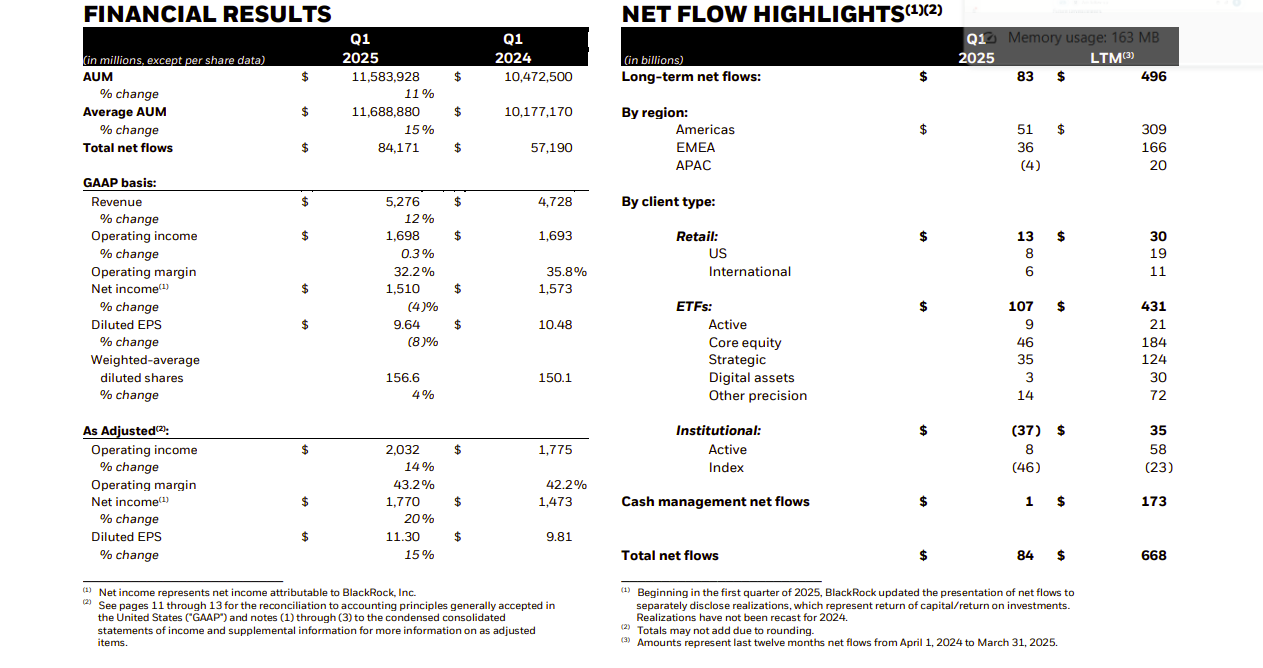
Investors poured around $3 billion into BlackRock’s digital asset products in Q1 2025, contributing to $84 billion in total net inflows for the quarter, according to the firm’s first-quarter earnings release on April 11.

BlackRock’s iShares ETF platform brought in a strong $107 billion in net inflows during Q1 2025. However, the firm’s total net inflows came in lower at $84 billion, as outflows in other segments—notably a $45.5 billion pullback from institutional index funds—offset the ETF gains.

BlackRock’s digital assets under management stood at over $50 billion at the end of Q1, up from $17.5 billion a year ago, which represents a 187% increase year-over-year. This surge dwarfed the growth rate of other asset classes within the firm’s portfolio, such as equities, which was up 8% YoY to $5.7 trillion.

The first quarter also brought notable volatility. Even though digital assets attracted over $3 billion in net inflows, market depreciation reduced their value by over $8 billion.

As of March 31, the global asset manager oversees approximately $11.6 trillion worth of client assets.

Digital assets make up just 1% of BlackRock’s total AUM, with their $3 billion net inflows accounting for 2.8% of total ETF inflows in Q1 2025. For comparison, private market investments brought in $9.3 billion during the same period.

Digital asset-related investment advisory and admin fees reached $34 million in Q1, less than 1% of BlackRock’s total $4.1 billion in long-term revenue as of March 31.

That figure aligns with the segment’s AUM share but underscores the low-fee structure typical of digital offerings.

For example, the iShares Bitcoin Trust (IBIT), BlackRock’s flagship crypto ETF launched in early 2024, operates at a competitive 0.25% fee post-waiver.

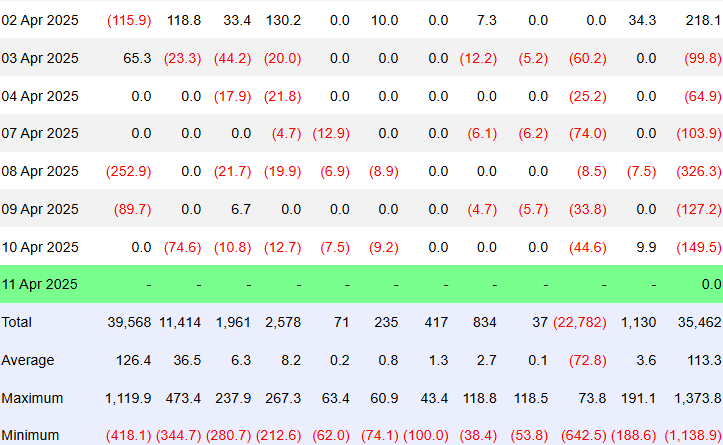
The report comes as US-listed spot Bitcoin ETFs saw their sixth straight day of net outflows, with $149 million in redemptions yesterday, according to Farside Investors.

The withdrawals were led by Fidelity’s FBTC and Grayscale’s GBTC, amidst a broader market movement where investors sought safer assets such as gold and cash, influenced by escalating US-China tariff disputes and market volatility tied to US policy changes.

Share this article


World Liberty Financial moves $775K to wallet used for altcoin purchases

0


Key Takeaways

  • World Liberty Financial transferred $775,000 in USDC for altcoin investment on Thursday.
  • The project holds a diverse portfolio and is expanding its blockchain collaborations.

Share this article

World Liberty Financial (WLFI) on Thursday transferred $775,000 in USDC from its main wallet to a secondary wallet primarily used for purchasing altcoins, according to data tracked by Arkham Intelligence.

The transfer comes after the project acquired over 3.54 million Mantle (MNT) on March 23. The week prior, WLFI had added $4 million worth of MNT and AVAX tokens to its portfolio.

In addition to MNT and AVAX, the project holds nine other digital assets including Ethereum (ETH), Wrapped Bitcoin (WBTC), Tron (TRX), Chainlink (LINK), Aave (AAVE), Ethena (ENA), MOVE (MOVE), Ondo (ONDO), and Sei (SEI).

World Liberty Financial recently established a strategic collaboration with Sui blockchain, aiming to integrate Sui’s technology into its ecosystem and explore next-generation blockchain applications focused on decentralized finance.

The project, endorsed by President Trump, plans to add Sui tokens to its “Macro Strategy” reserve as part of the partnership.

WLFI is launching USD1, a stablecoin for institutions and sovereign investors that will be redeemable one-to-one for US dollars. The team also conducted test transfers on its new stablecoin.

The stablecoin, backed by US government treasuries, dollar deposits, and cash equivalents, will launch on Ethereum and Binance Smart Chain, with BitGo providing custody services and third-party accounting firm audits planned.

Share this article


Charles Hoskinson sees Bitcoin hitting $250K as Big Tech embraces crypto

0


Key Takeaways

  • Charles Hoskinson predicts Bitcoin could hit $250,000 by 2025 due to Big Tech adoption and regulatory progress.
  • Crypto asset ownership has increased by 13% year-on-year, supporting strong price predictions for Bitcoin.

Share this article

Bitcoin is poised for a dramatic rally to $250,000 this year, as tech giants move into crypto, regulations solidify, and central banks shift gears, said Charles Hoskinson, founder of the Cardano blockchain, in a podcast interview with CNBC this week.

Bitcoin traded around $81,800 at press time, down roughly 12% year-to-date, per TradingView.

The largest digital asset has seen heightened volatility over the past week, driven by President Trump’s sweeping tariffs, which have weighed heavily on global equity markets.

While Bitcoin has shown some signs of decoupling, it has largely tracked tech stocks.

After dipping below $75,000 earlier this week, Bitcoin rebounded above $82,000 on Wednesday after Trump announced a temporary tariff reduction to 10% for most countries during a 90-day negotiation window. US stock markets have also bounced back following the news.

Hoskinson does not think these tariffs will escalate into a prolonged global trade war with widespread negative consequences.

“What will happen is that the tariff stuff will be a dud, and that people will realize that the world is willing to negotiate, and it’s really just US versus China,” he said.

Hoskinson predicts the global economy will adjust to a ‘new normal,’ after which the Federal Reserve is likely to cut interest rates, making capital cheaper. That means more “fast, cheap money” could flow into risk assets, like crypto.

Cardano’s founder is optimistic about new US laws, especially the pending stablecoin legislation and the Digital Asset Market Structure and Investor Protection Act. He believes these could provide the clarity needed for institutional adoption.

Hoskinson sees tech giants like Apple, Microsoft, and Amazon entering the crypto space — particularly through stablecoins. He suggests that they could adopt stablecoins for international worker payments or microtransactions.

The co-founder of Ethereum also points to steady growth in users and geopolitical shifts as other drivers of Bitcoin demand.

He believes the world is shifting from a rules-based international order to a “great powers conflict” era. In that environment, crypto becomes a hedge against failing trust in institutions and treaties.

“[The crypto market] will stall for probably the next three to five months, and then you’ll have a huge wave of speculative interest come, probably [in] August or September, into the markets, and that’ll carry through probably another 6 to 12 months,” Hoskinson said.

Share this article


Bitcoin jumps 8% after Trump announces 90-day tariff pause for all countries but China

0


Key Takeaways

  • Bitcoin surged by 8% due to Trump’s 90-day tariff pause for all countries except China, which now faces a 125% tariff.
  • Major tech stocks, including Tesla and Nvidia, also saw significant gains.

Share this article

Bitcoin jumped 8% to $82K today after President Donald Trump announced a 90-day pause on tariffs for all countries except China, triggering a broad rally across financial markets.

Trump’s statement on Truth Social raised tariffs on Chinese imports to 125% effective immediately, while easing pressure on other countries with a 90-day pause.

He cited that over 75 countries had contacted US officials recently to discuss trade and currency matters, implementing a reduced reciprocal tariff of 10% during the 90-day period.

“Based on the lack of respect that China has shown to the world’s markets,” Trump wrote in a Truth Social post, “I am hereby raising the tariff charged to China by the United States of America to 125%, effective immediately.” Trump added, “I have authorized a 90-day pause on tariffs for all other countries, and a substantially lowered reciprocal tariff during this period, of 10%, also effective immediately.”

US Secretary of Commerce Howard Lutnick confirmed his presence during the message’s drafting, stating on X,

“Scott Bessent and I sat with the President while he wrote one of the most extraordinary Truth posts of his Presidency. The world is ready to work with President Trump to fix global trade, and China has chosen the opposite direction.”

Treasury Secretary Scott Bessent issued a stern message at a White House press conference, warning other nations not to retaliate and emphasizing that any country willing to negotiate with the United States would be heard and potentially rewarded.

The announcement sparked a broad market rally. The S&P 500 rose 9%, while the Nasdaq gained 10%. Among tech stocks, Tesla surged 14%, Nvidia 12%, Apple 11%, Microsoft, Meta, and Amazon each rose 8%, and Google added 6%.

Share this article


Teucrium XRP ETF sees $5M volume, outpaces leveraged Solana ETF

0


Key Takeaways

  • The new leveraged XRP ETF by Teucrium, symbol XXRP, achieved $5M volume on debut.
  • The ETF offers 200% daily exposure to XRP’s price and is intended for short-term trading.

Share this article

The first US leveraged XRP ETF, Teucrium’s 2x Long Daily XRP ETF, was off to a strong start with around $5 million in day-one trading volume — a figure that places it in the top 5% of all new ETF launches, according to Bloomberg ETF analyst Eric Balchunas.

The fund, trading under the ticker XXRP, drew roughly four times the debut activity of Volatility Shares’ 2x Solana ETF (SOLT), Balchunas noted.

The SOLT fund launched on March 20 alongside the Volatility Shares Solana ETF (SOLZ) as one of the first Solana futures ETFs in the US.

The 2x Long Daily XRP ETF, launched by Teucrium Investment Advisors on April 8, aims to offer double the daily returns of XRP using swap agreements.

Reference rates for the swaps now include several European Exchange Traded Products due to the absence of suitable US-listed spot XRP ETFs.

The company, known for its commodity ETFs, is expanding its crypto offerings, following its previous Bitcoin futures ETF launch.

“A terrific, very successful launch”

The leveraged ETF is Teucrium’s most successful ETF launch to date, said Sal Gilbertie, CEO of Teucrium, in a Tuesday interview with Crypto Prime’s Nate Geraci.

“It’s been a terrific, very successful launch — our most successful launch day to date for any fund we’ve ever done,” said Gilbertie. “There was overwhelming excitement… I think a lot because we were overlooked.”

Teucrium filed for the product shortly after the previous SEC administration stepped down, and with the standard 75-day window having elapsed, the fund launched at the first available opportunity.

“We filed as soon as we could after the old SEC regime left… we launched today,” Gilbertie said. “I think it’s almost at a couple hundred thousand shares.”

The ETF currently gains exposure to XRP through swaps based on European XRP ETPs, though it has the flexibility to hold other XRP-linked instruments, including futures when available, to optimize efficiency and costs.

Importantly, the product is not designed for buy-and-hold investors, Gilbertie added.

“This is absolutely a short-term trading tool — ideally for one day,” Gilbertie said. “Because of the reset and the math… if that asset goes up very slowly or sideways or down, you will lose money.”

Still, for aggressive traders, the appeal is there.

“It’s pretty hard to get leverage [on XRP], and these 2X products… make it easy,” he said. “Ordinary people with their Robinhood account can sit there and trade one share with leverage.”

The launch comes amid what Gilbertie describes as a more crypto-friendly regulatory environment.

“Prior to the new SEC, the old SEC was an impediment. They crushed innovation, they were an enemy of cryptocurrencies,” he said, noting that under new leadership, the review process for XXRP was relatively smooth.

“They didn’t look for an impediment… they simply made sure that we were adhering to the rules and regulations,” he said.

Teucrium eyes an inverse XRP ETF

Teucrium, which manages about $320 million across 12 ETFs, has already filed for an inverse XRP ETF called the Teucrium 2x Short Daily XRP ETF, according to its prospectus materials.

Leveraged inverse ETFs would allow investors to potentially profit as XRP prices decline. However, Gilbertie said the firm is holding off on launching until it gauges investors’ appetite.

Teucrium also left the door open to future crypto-related products.

“We’re an ETF company… we’re willing to do any ETF that we think is going to provide an extra tool for investors,” he said.

On crypto’s broader role in a portfolio, Gilbertie drew a clear distinction between Bitcoin and other assets.

“I think there’s Bitcoin and there’s everything else,” he said. “Bitcoin is digital gold — it should be in your portfolio to stabilize it.”

As for assets like XRP, Ether, or Solana, he said they resemble technology platforms.

“They’re systems, they’re technological systems… they should be priced like technology,” he said. “And when Ripple goes public… my guess is they’re going to be valued as technology stocks.”

Share this article


XRP could rocket over 500% and outrank Ethereum by 2028: Standard Chartered

0


Key Takeaways

  • Standard Chartered forecasts XRP could reach $12.5 by 2028, a 550% increase from current levels.
  • XRP’s market cap is expected to surpass Ethereum’s, becoming the second-largest non-stablecoin digital asset.

Share this article

XRP could surge to $12.5 and overtake Ethereum as the second-largest crypto asset by market cap before Trump’s second term wraps up, according to a new report by Geoffrey Kendrick, Standard Chartered’s global head of digital assets research.

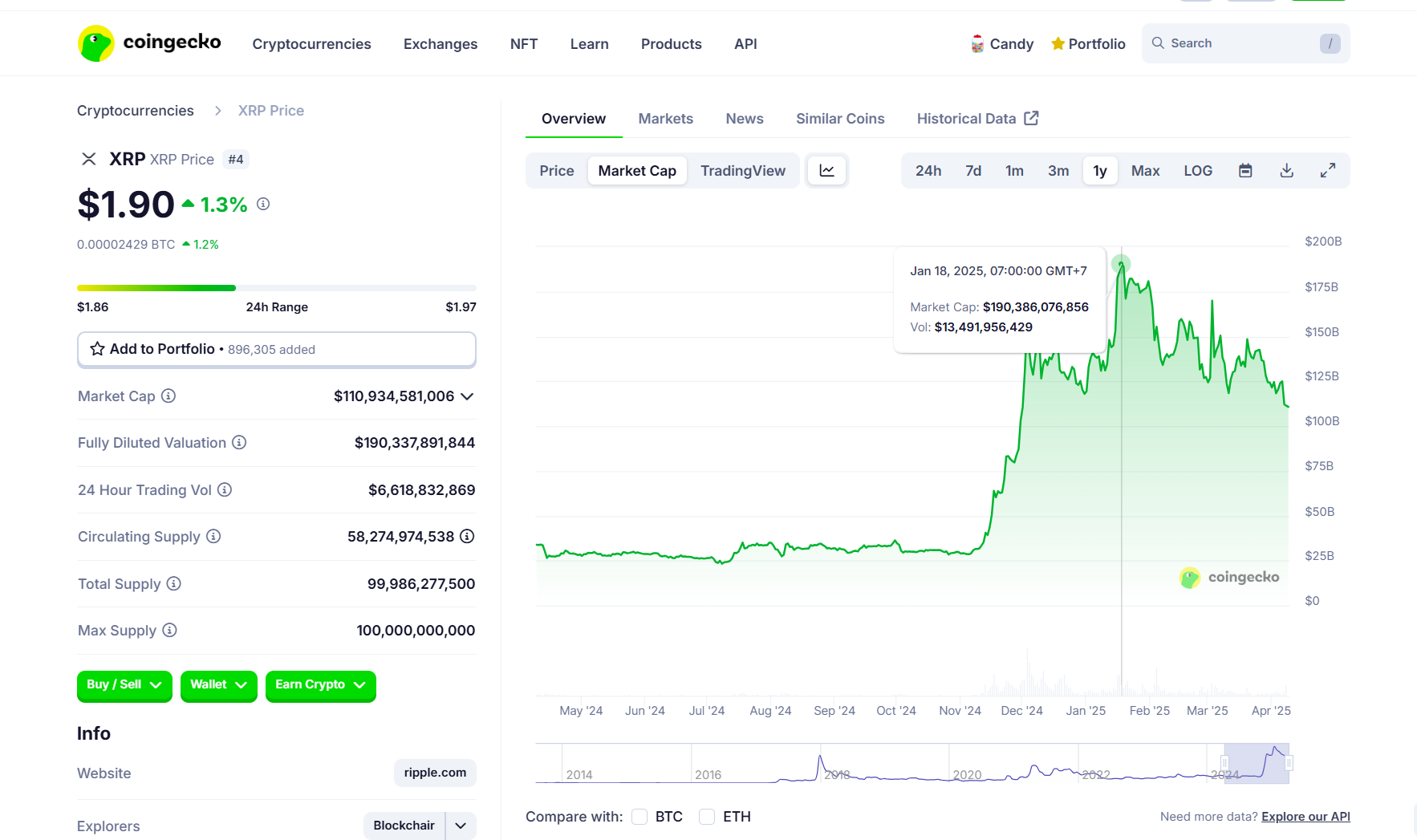
With XRP now trading at $1.9 according to CoinGecko data, reaching $12.5 would represent a surge of over 550%.

“By the end of 2028, we see XRP’s market cap overtaking Ethereum’s,” Kendrick noted.

XRP’s market cap is over $110 billion per CoinGecko, positioning it as the fourth-largest crypto asset. This places it behind Bitcoin, Ether, and Tether. Currently, Ether’s market cap sits at around $183 billion.

XRP’s market cap previously peaked at $190 billion in January, and it has also, at times, surpassed Tether to claim the third-ranking spot.

Kendrick’s forecast is based on several factors, including expected regulatory developments and institutional adoption. According to the analyst, a key positive catalyst for XRP’s price growth is the recent resolution between Ripple and the SEC.

Last month, Ripple CEO Brad Garlinghouse said that the securities regulator had dropped its lawsuit against the blockchain company. Ripple has agreed to pay $50 million as part of the settlement, which does not require the firm to admit to any wrongdoing.

The SEC’s decision reflects a shift in regulatory approach under the current administration. Prior to Ripple, the agency had already withdrawn from several high-profile crypto enforcement cases.

XRP ETFs could attract up to $8 billion in first 12 months if approved

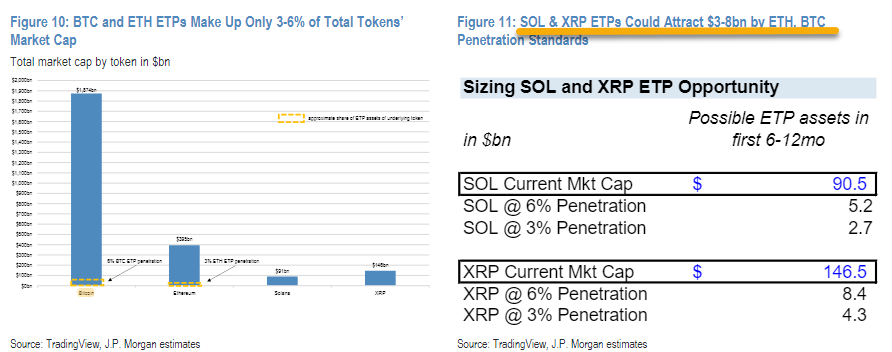
Kendrick also forecasts SEC approval for spot XRP ETFs in the third quarter of 2025, which he estimates could attract $4-8 billion in inflows within the first year. This projection falls in line with JPMorgan’s estimate.

The bank, in its January analysis, also anticipated first-year inflows for potential XRP spot ETFs to be in the range of $4 billion to $8 billion. JPMorgan’s forecast was based on the market penetration rates observed with existing Bitcoin and Ethereum ETFs.

Source: Matthew Sigel

Ripple’s CEO previously predicted XRP ETFs would make their market debut in the second half of 2025.

Regarding XRP’s use case in payments, Kendrick believes its cross-border payment functionality aligns with growing digital asset usage trends, similar to stablecoins, which he notes have seen 50% annual transaction volume growth and are projected to increase tenfold over four years.

Kendrick believes the XRP Ledger (XRPL), XRP’s foundational blockchain, functions as a “payments chain” with a strong trajectory to become a “tokenization chain.”

In support of this view, the analyst compares XRPL to Stellar, a blockchain with comparable architecture that has achieved success in tokenization. Franklin Templeton initially launched its OnChain US Government Money Fund on Stellar.

Kendrick projects XRP to reach $5.5 by year-end, rising to $8 in 2026, and hitting $12.5 in 2028. These projections are based on the assumption that Bitcoin will reach $500,000 within the same timeframe.

Even though the analyst is bullish on XRP, he does not ignore existing challenges the project faces, including a smaller developer ecosystem than its competitors and a low fee model.

Still, he believes that the positive drivers he has outlined could overpower these barriers.

The analyst continues to see strong potential in Bitcoin and Avalanche, but he’s less enthusiastic about Ether, labeling it an “identified loser.”

Share this article