Friday, November 13, 2026
Home Blog Page 112

BNB could jump over 360% to $2,775 by 2028, Standard Chartered predicts

0


Key Takeaways

  • BNB could reach $2,775 by 2028, which is a fourfold increase from its current price.
  • BNB’s trading patterns have closely tracked Bitcoin and Ethereum since May 2021.

Share this article

Binance Coin (BNB) could surge to $2,775 by the end of 2028, which represents more than a fourfold increase from its current price of around $600, according to a Standard Chartered research report released today.

The native token of Binance’s BNB Chain has mirrored the performance of Bitcoin and Ethereum combined since May 2021, both in terms of returns and volatility, notes Geoff Kendrick, head of digital assets research at Standard Chartered.

Kendrick says BNB’s value is still anchored to Binance’s dominance. As long as the exchange stays on top, the analyst doesn’t expect much change in BNB’s fundamentals. He also sees potential for the token to act as a digital asset benchmark.

BNB Chain primarily focuses on decentralized exchanges, lending protocols, and liquid staking, making it a “more concentrated and ‘old-fashioned’ smart contract platform than rivals such as Ethereum and Avalanche,” according to Kendrick.

BNB showed resilience during recent market selloffs

BNB maintained a strong position in April despite a broader market downturn that sent many altcoins tumbling.

The asset, currently ranked as the fifth-largest crypto by market cap, is trading less than 25% below its all-time high, but still outperforming other altcoins, some of which have dropped as much as 98%.

BNB Chain continues to lead in decentralized application (dApp) adoption, with 5,686 dApps supported, according to DappRadar. In comparison, Ethereum supports 4,988 dApps and Polygon 2,406.

In terms of DeFi activity, BNB Chain ranks fourth in total value locked (TVL), with approximately $5.8 billion, behind Ethereum, Solana, and Bitcoin, per DefiLlama.

On the institutional front, Wall Street is starting to pay attention to BNB. Major fund manager VanEck recently filed a registration statement with the SEC to launch the VanEck BNB ETF, which would be the first US-registered ETF designed to directly track the spot price of BNB.

Pending SEC and exchange approvals, the ETF may also offer staking features, enabling investors to earn BNB rewards on top of price exposure.

Share this article


Bitcoin outperforms stocks during market selloff, but fails to decouple fully: VanEck

0


Key Takeaways

  • Bitcoin gained 13% in April despite a broader market selloff.
  • Ethereum’s dominance in smart contract fees significantly decreased as users migrated to other networks.

Share this article

Bitcoin showed flashes of independence from equities in April, renewing hopes that it’s evolving into a true macro hedge. However, VanEck’s recent data tell a different story.

In a monthly recap published on Monday, analysts at VanEck say that the flagship crypto asset still trades closely with traditional markets, as it quickly re-synced with major indices after a brief divergence.

Bitcoin briefly showed signs of decoupling from US equities during the week ending April 6, when former President Trump announced new tariff measures that rattled global markets. While equities and gold declined, Bitcoin climbed from $81,500 to over $84,500 at week’s end, hinting at a potential shift toward independent price action.

This divergence fueled hopes that Bitcoin might break away from traditional risk asset behavior and push toward new highs. However, the momentum did not last long, and the asset soon resumed trading in line with equity markets.

Offering more context in this area, VanEck—drawing on data from VanEck Research and Artemis XYZ—notes that Bitcoin has not meaningfully decoupled from the stock market.

Although the 30-day moving average correlation between BTC and the S&P 500 briefly dipped below 0.25 in early April, it quickly rebounded to around 0.55 by the end of the month.

Still, Bitcoin outperformed the major stock indices during the month. It gained 13%, while the Nasdaq Composite fell 1% and the S&P 500 posted only a slight increase.

Perhaps most notably, Bitcoin’s volatility declined by 4% in April, even as volatility in equity markets doubled amid rising geopolitical and trade tensions.

Structural tailwinds are building

According to VanEck, despite the fact that Bitcoin still behaves like a risk asset in the short term, structural tailwinds, including aggressive corporate BTC accumulation, may be setting the stage for long-term divergence.

Analysts suggest that as individuals, corporations, and central banks increasingly view Bitcoin as a sovereign, uncorrelated store-of-value, its long-term behavior could break free from that of traditional risk assets.

Russia and Venezuela, which have already begun embracing Bitcoin’s utility in international trade, are early examples of this transformation, according to analysts.

Corporate-level Bitcoin accumulation was active in April. To recap, Strategy added 25,400 BTC to its holdings, while Metaplanet and Semler Scientific also made significant purchases.

A key highlight of the month was the launch of a new venture, XXI (Twenty One), formed by Softbank, Tether, and Cantor Fitzgerald, with the goal of acquiring over $3 billion worth of Bitcoin.

This signals Bitcoin’s growing role on corporate balance sheets, as institutional exposure shifts from speculative bets to long-term strategic positioning.

Crypto stumbles as Bitcoin holds steady

Bitcoin dodged the tariff fallout, but altcoins were not lucky.

Layer 1 networks led the decline, with Ethereum, Solana, and Sui all posting heavy drawdowns from their January highs, falling between 66% and 68%, according to VanEck. The MarketVector Smart Contract Leaders Index (MVSCLE) dropped 5% in April and is now down 34% year-to-date.

The slump followed a global equity selloff triggered by new trade tariffs, compounded by unlock fatigue and heavy losses in speculative sectors like DeFi AI, DeSci, and AI Agents. Meme coin trading volume also collapsed by 93% between January and March.

Yet some chains managed to buck the trend, including Sui, Solana, and Stacks, according to VanEck.

Solana rose 16%, lifted by network upgrades and growing institutional treasury interest. Ethereum, meanwhile, slipped another 3%, underperforming its peers as fee erosion and layer 2 competition continued.

Solana’s April was quiet but constructive. The network released SIMD-0207, a compute upgrade that sets the stage for future throughput gains. The Solana Foundation also began phasing out underperforming validators reliant on delegation, aiming to prioritize those offering ecosystem value.

With roughly 18% of staked SOL managed through the Foundation, validator dynamics remain a key part of the chain’s governance. While some question meme coin sustainability, Solana’s unmatched throughput continued to dominate trading activity. In April, meme coins accounted for 95% of all DEX activity on the chain, excluding SOL and stablecoins.

Sui’s strength goes beyond its price. In April, its daily DEX volumes jumped 45%, placing it among the most active chains. It entered the top 10 in smart contract platform revenue and posted the highest stablecoin turnover ratio at 716%. Core developer Mysten Labs earned praise for product velocity and responsiveness in an increasingly crowded layer 1 sector.

Ethereum, by contrast, faces mounting pressure. Its share of layer 1 fee revenue slid to around 14%, down from 74% two years ago. Developers proposed major changes, including a shift to RISC-V architecture for faster zk-proofs, a 100x gas limit increase via EIP-9698, and parallel transaction execution under EIP-9580.

But Ethereum’s layer 2s continued to siphon users and activity. Flashbots’ deployment on Base and Optimism cut confirmation times to 200 milliseconds, while Arbitrum introduced gas payments in non-ETH tokens, further undermining ETH’s role. The core dilemma remains: Layer 2s rely on Ethereum’s security while eroding its fee base.

Meanwhile, Tron and Hyperliquid took the top spots in average daily blockchain revenue, earning more than both Solana and Ethereum.

Tron’s dominance in stablecoin transfers and Hyperliquid’s niche in perpetual trading helped them generate $1.7 million and $1.4 million daily, respectively, according to VanEck.

Speculative energy continued to fade. Meme coins, which once drove volumes across chains, saw trading activity and sentiment plunge. The MarketVector Meme Coin Index has fallen 48% year-to-date, though meme coins still made up 35% of Solana’s DEX activity in April.

Share this article


Trump says crypto survives the crash better than most assets

0


Key Takeaways

  • President Trump stated that crypto assets withstand market crashes better than other assets.
  • The TRUMP token surged over 70% after announcing exclusive dining incentives for its top holders.

Share this article

Trump has reinforced his pro-crypto stance, saying crypto assets have remained resilient during market downturns and are now widely embraced. The president has stated that the US must lead in digital asset innovation or risk falling behind countries like China.

“I want crypto,” Trump said in an interview with NBC News’ Meet the Press this week. The president was asked how he responds to people who express concern about the possibility of him profiting from the presidency.

“I think crypto is important because if we don’t do it, China is going to,” he said. “It’s new. It’s very popular. It’s very hot.” He added that during market downturns, crypto “stayed much stronger than other aspects of the market.”

Trump noted that crypto is too important to ignore, pointing to the sheer scale of adoption as a driving force behind his pro-crypto stance. He also accused the Biden administration of initially cracking down on crypto but later softening its stance for political gain.

Pressed on whether he stands to profit from the Official Trump token (TRUMP), the president said he is “not profiting from anything” and stressed that his backing of crypto began well before the presidential campaign.

“I haven’t even looked,” Trump said, adding that “if I own stock in something, and I do a good job, and the stock market goes up, I guess I’m profiting.”

Trump said he had contributed his entire presidential salary to the government. When asked whether he would contribute any crypto-related earnings, he responded that he had never considered it.

“Should I contribute all of my real estate that I’ve owned for many years if it goes up a little bit because I’m president and doing a good job? I don’t think so,” he said.

The president added that he plans to continue contributing his salary during his current term.

The TRUMP token, which once reached a market capitalization of nearly $15 billion, has experienced a steep decline following President Trump’s inauguration. At press time, its market cap stood at approximately $2 billion, per CoinMarketCap.

Last week, the token surged more than 70% after news broke that President Trump would host an exclusive dinner for the top TRUMP token holders. Scheduled for May 22 at Trump National Golf Club, the event will be limited to the top 220 wallet holders.

The announcement has sparked bipartisan concern.

Senators Elizabeth Warren and Adam Schiff have called for an ethics investigation, citing potential “pay to play” practices and the risk of personal enrichment through the sale of presidential access.

Even some of Trump’s allies have expressed unease. Senator Cynthia Lummis, a vocal supporter of Trump and a prominent Bitcoin advocate, voiced her discomfort.

“This is my president that we’re talking about, but I am willing to say that this gives me pause,” Lummis said, according to CNBC.

Share this article


Trump urges Fed to lower rates, but strong jobs data makes a cut in June less likely

0


Key Takeaways

  • President Trump is urging the Federal Reserve to cut interest rates despite strong employment data.
  • The Federal Reserve is unlikely to lower rates in June due to stable hiring activity.

Share this article

President Trump on Friday renewed pressure on the Fed to cut interest rates, but the robust April employment data that followed has lowered the odds of a June rate cut, according to Nick Timiraos, often referred to as the “Fed’s mouthpiece” at the Wall Street Journal.

The next Fed policy meeting is scheduled for May 6–7, 2025. Economists broadly expect the central bank to keep the federal funds rate unchanged in its current range of 4.25% to 4.5% during this meeting.

This means that attention is shifting to the following meeting on June 18. According to Timiraos, only one more jobs report will be released before that meeting, leaving limited time for economic conditions to deteriorate enough to warrant a rate cut.

The Fed relies heavily on monthly labor data to gauge whether the economy is weakening. Since April’s report was stronger than expected, it reduces the urgency of any immediate monetary policy easing.

According to the US Bureau of Labor Statistics, non-farm payrolls rose by 177,000 in April, beating market expectations. The unemployment rate held steady at 4.2%, continuing a narrow range that’s been in place since May 2024.

Job gains were most notable in sectors such as health care, transportation and warehousing, financial activities, and social assistance, while federal government employment declined.

Fed officials have emphasized that a decision to lower interest rates would likely require clear evidence of rising unemployment or weakening labor demand.

So far, the new data show few signs of declining hiring activity, giving the central bank justification to maintain its wait-and-see stance, despite uncertainties, including the potential economic effects of recently reimposed tariffs.

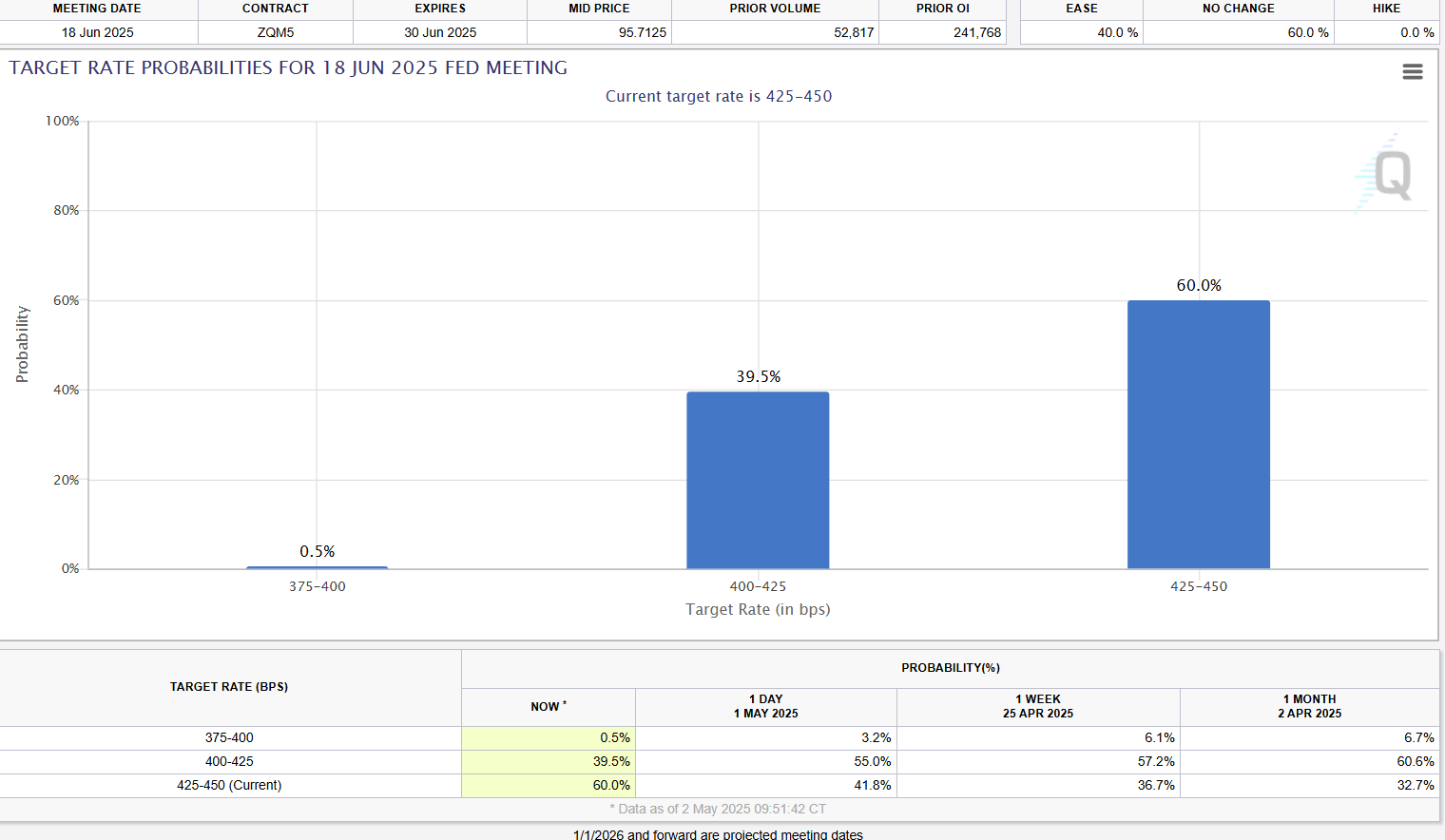
Following the release of the April jobs report, market expectations for a June rate cut fell from roughly 58% to 40%, according to day-to-day shifts tracked by the CME FedWatch tool. Investors now see about a 60% chance that the Fed will hold rates steady in June.

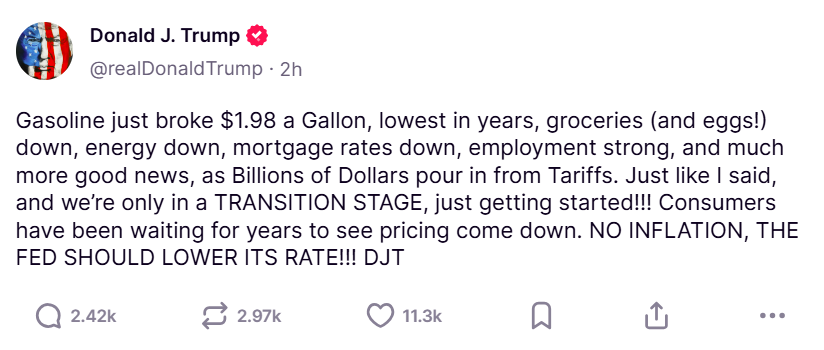
In his statement urging the Fed to act, Trump claimed there is “no inflation,” arguing that consumers are finally experiencing long-awaited price relief.

He pointed to declining gasoline prices, lower grocery and energy costs, falling mortgage rates, and strong employment figures as signs that the economy is stabilizing.

With inflation no longer a threat, Trump insisted, the Fed should act swiftly to cut interest rates to support continued economic growth.

Share this article


Coinbase to delist Movement’s MOVE token amid market-making controversy

0


Key Takeaways

  • Coinbase will suspend MOVE token trading on May 15 after a listing review.
  • The Movement project faces controversy after a scandal involving market manipulation.

Share this article

Coinbase announced Thursday that it will disable trading of Movement’s MOVE token on May 15, as controversy deepens around the high-profile layer 2 blockchain project.

The exchange said in a statement on X that it has already shifted MOVE order books to limit-only mode.

Coinbase did not explicitly cite a reason for the suspension. However, the company noted that the decision followed a routine listing standards review, which found that MOVE no longer met Coinbase’s requirements.

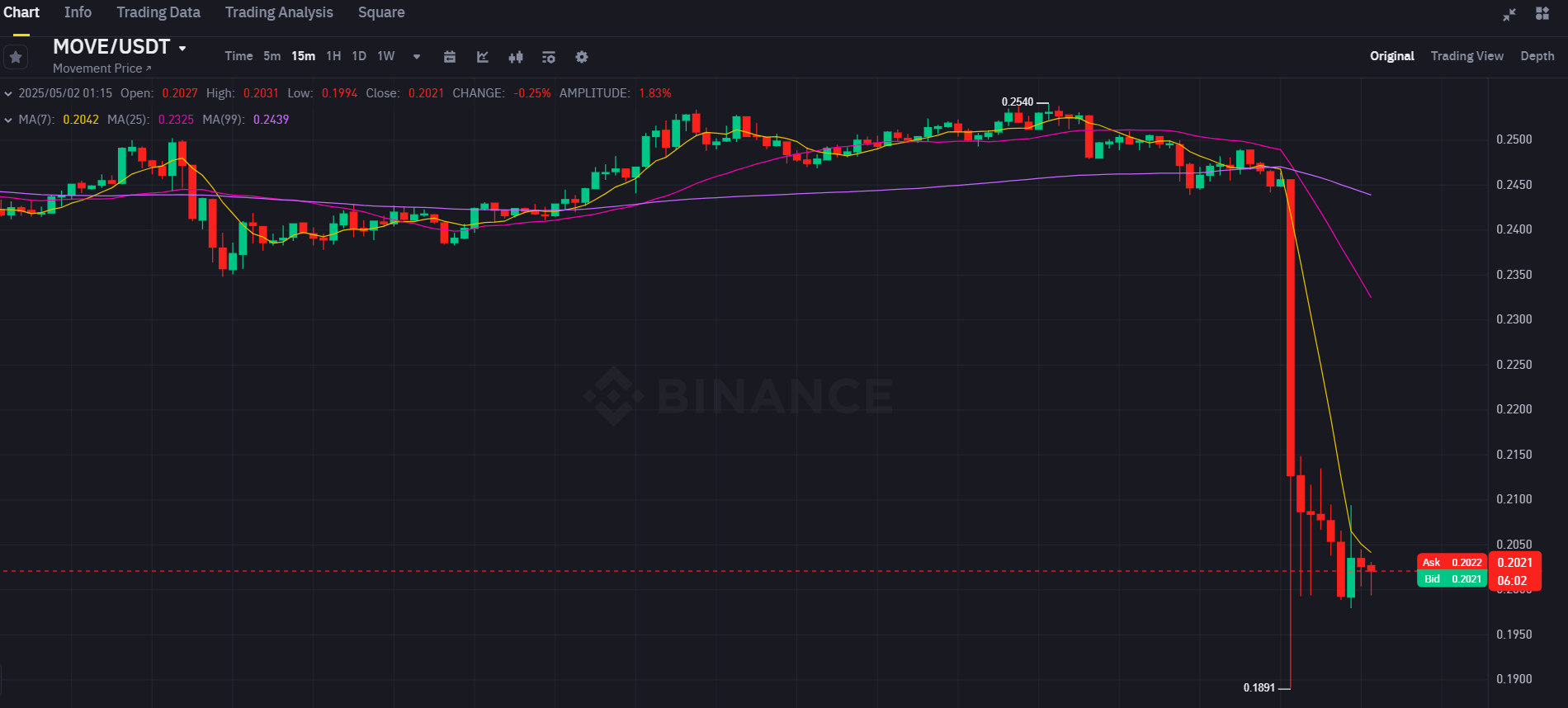
The token dropped 20% to $0.18 following the announcement—its lowest point since launch—according to Binance data. At press time, MOVE saw a modest rebound to $0.20.

The Movement blockchain, which launched its mainnet beta and native token last December, has faced growing scrutiny since March when Binance identified and froze the profits of a market maker allegedly liquidating large quantities of MOVE tokens.

In response, the Movement Network Foundation cut ties with the market maker and announced a $38 million USDT buyback program to establish the Movement Strategic Reserve.

Movement Labs and the Movement Network later confirmed a third-party investigation into the matter, after Binance removed the market maker for misconduct, Blockworks reported last month.

A new report from CoinDesk this week sheds more light on the controversy. The release revealed that Movement Labs was allegedly misled into signing a market-making agreement that gave a middleman, Rentech, control over 66 million MOVE tokens.

The deal was said to have enabled a $38 million selloff, triggering sharp price drops and accusations of manipulation.

Internal documents showed that Rentech acted on both sides of the deal—as an agent of the Movement Foundation and a subsidiary of Web3Port—raising conflict-of-interest concerns.

The fallout also exposed internal divisions, as Movement’s legal counsel initially objected to the deal but was overruled, according to CoinDesk. Movement is investigating whether co-founder Rushi Manche or advisors like Sam Thapaliya played a deeper role than originally disclosed.

Share this article


XRP spot ETF has 85% chance of approval this year, say Bloomberg analysts

0


Key Takeaways

  • Bloomberg raises XRP ETF approval prediction to 85% for 2025.
  • Litecoin and Solana ETFs have a 90% chance of approval.

Share this article

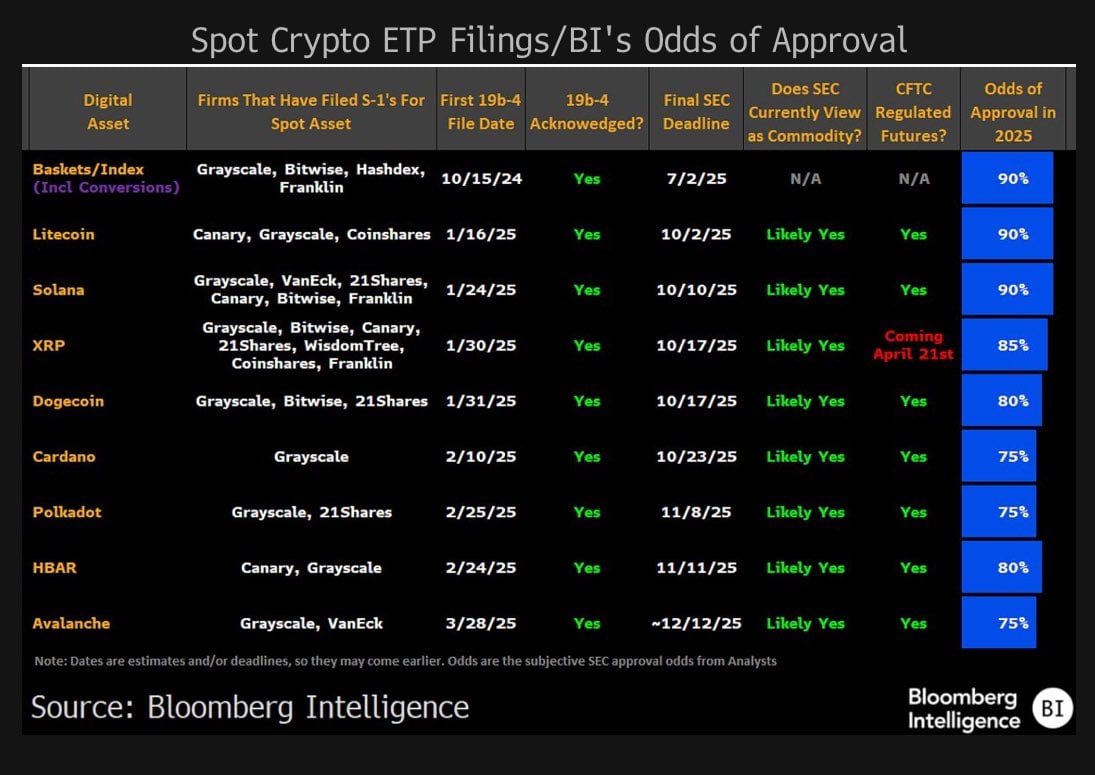
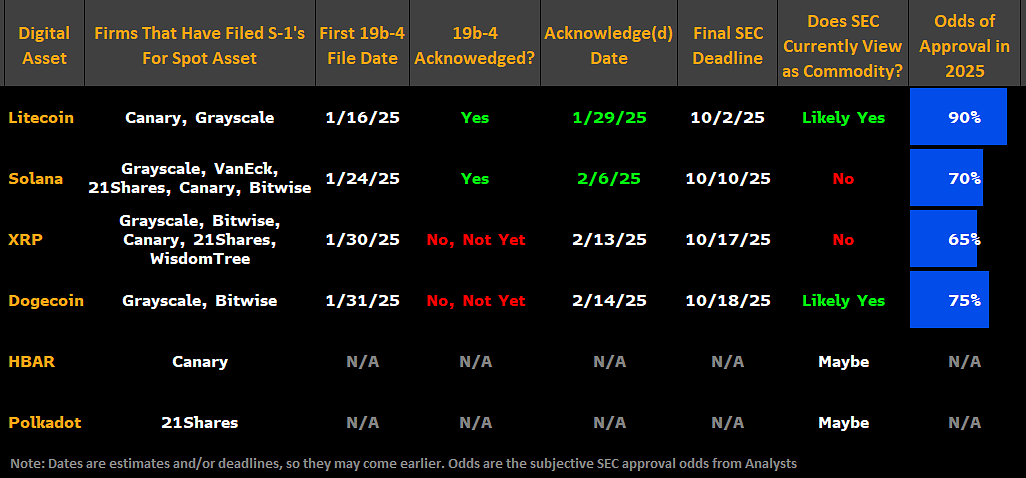
The likelihood of a spot XRP ETF launching in 2025 has increased, according to the latest update from Bloomberg Intelligence. Analysts now estimate an 85% chance that a spot XRP product will gain approval from the SEC, up sharply from 65% in their February outlook.

ETF analysts Eric Balchunas and James Seyffart have also increased approval odds for other digital asset-backed funds, with products tracking Litecoin and Solana leading the pack.

Source: Eric Balchunas

Spot ETFs for Litecoin and Solana are given a 90% likelihood of approval by Bloomberg. Litecoin has especially benefited from the CFTC’s classification of LTC as a commodity.

Solana’s approval probability has jumped from 70% to 90%, with the asset attracting multiple ETF filings and institutional interest driven by its DeFi and NFT ecosystems.

Source: James Seyffart

Other assets are also gaining momentum. Dogecoin and Hedera ETFs are assigned an 80% likelihood of approval.

The Cardano ETF, filed only by Grayscale so far, carries an estimated 75% chance of approval.

Avalanche, one of the latest assets to be filed for, is likewise at 75%, with a final SEC decision expected around December 12. Polkadot ETFs are tracking at the same 75% odds.

The SEC recently delayed decisions on several applications, including Franklin Templeton’s spot XRP and Solana ETFs, Grayscale’s HBAR ETF, Bitwise’s Dogecoin ETF, and Ethereum staking ETFs from Franklin and Fidelity.

These funds join a growing list of proposed crypto products currently awaiting regulatory approval.

Most altcoin ETF decisions are expected between Q3 and Q4 of 2025. While the SEC could reject applications over market manipulation concerns or insufficient investor protections, ETF experts believe denial is less likely given futures market development, legal progress, and bipartisan interest in the crypto market structure.

Share this article


ProShares may debut leveraged, short XRP futures ETFs as soon as this week

0


Key Takeaways

  • ProShares plans to launch three XRP futures-based ETFs, including leveraged and inverse options.
  • The SEC has not raised objections to these funds, allowing them to proceed to market.

Share this article

ProShares, the top issuer of leveraged and inverse exchange-traded funds, may debut three futures ETFs tied to XRP, Ripple’s native crypto asset, as soon as April 30, according to a post-effective amended prospectus filed on April 15.

The proposed products include the Short XRP ETF, offering investors the opportunity to profit from declines in the price of XRP; the Ultra XRP ETF, delivering approximately twice the daily return of XRP’s price movements; and the UltraShort XRP ETF, aimed at providing approximately twice the inverse (-2x) of XRP’s daily performance.

ProShares, which initially filed for its XRP futures ETFs in January, stated in the April prospectus that its filing is expected to become effective on Wednesday, April 30.

The filing was made under a procedural mechanism that permits the products to launch without requiring further substantive review or explicit reapproval from the SEC, provided no objections are raised before the effective date.

However, while the amendment would allow the funds to become effective on that date, actual trading may not begin immediately, depending on exchange readiness and other operational factors.

Once the debut is confirmed, ProShares’ XRP futures ETFs will join Teucrium Investment Advisors, the first fund manager to launch a US-listed XRP ETF.

Teucrium’s fund, called the 2x Long Daily XRP ETF, aims to deliver returns that are double the daily return of XRP through swap agreements.

Teucrium’s launch came amid increasing investor demand for XRP following Donald Trump’s election victory, which directly contributed to a wave of regulatory developments favorable to the crypto industry, including the legal outcome between Ripple Labs and the SEC.

Pending spot XRP ETF decision

The SEC has delayed its decision on multiple spot XRP ETF applications, including those from major firms like Grayscale, Bitwise, and WisdomTree.

However, the delay is viewed as a normal part of the agency’s review process for crypto spot ETFs — not limited to XRP-linked products. Other ETFs tied to altcoins such as Solana, Dogecoin, and Litecoin are also currently pending.

ETF experts remain optimistic that the SEC will greenlight spot crypto ETFs as soon as this year, with Litecoin ETFs possibly being the first to receive approval.

Analysts’ confidence in XRP ETF approval has also grown, particularly following Paul Atkins’ appointment as SEC Chairman.

Earlier this week, CME Group announced plans to launch XRP futures, signaling a move towards potential spot ETF approval after the legal battle between the SEC and Ripple Labs officially concludes.

XRP is trading around $2.27, up nearly 9% over the past week, per TradingView.

Share this article