Tuesday, September 29, 2026
Home Blog Page 110

Gold, Bitcoin surge after Trump says ‘he who has the gold makes the rules’

0


Key Takeaways

  • Gold reached a record $3,384, and Bitcoin surged to $87,500 following Trump’s statement.
  • A synchronized rally between Gold and Bitcoin suggests potential market uncertainty and a weaker US Dollar.

Share this article

Gold and Bitcoin, commonly referred to as ‘digital gold,’ climbed higher during early Asian trading after Trump reignited attention to these top assets.

In a post on Truth Social, the president declared, “THE GOLDEN RULE OF NEGOTIATING AND SUCCESS: HE WHO HAS THE GOLD MAKES THE RULES.”

The statement, which touched on the age-old link between wealth and power, sparked a strong market reaction.

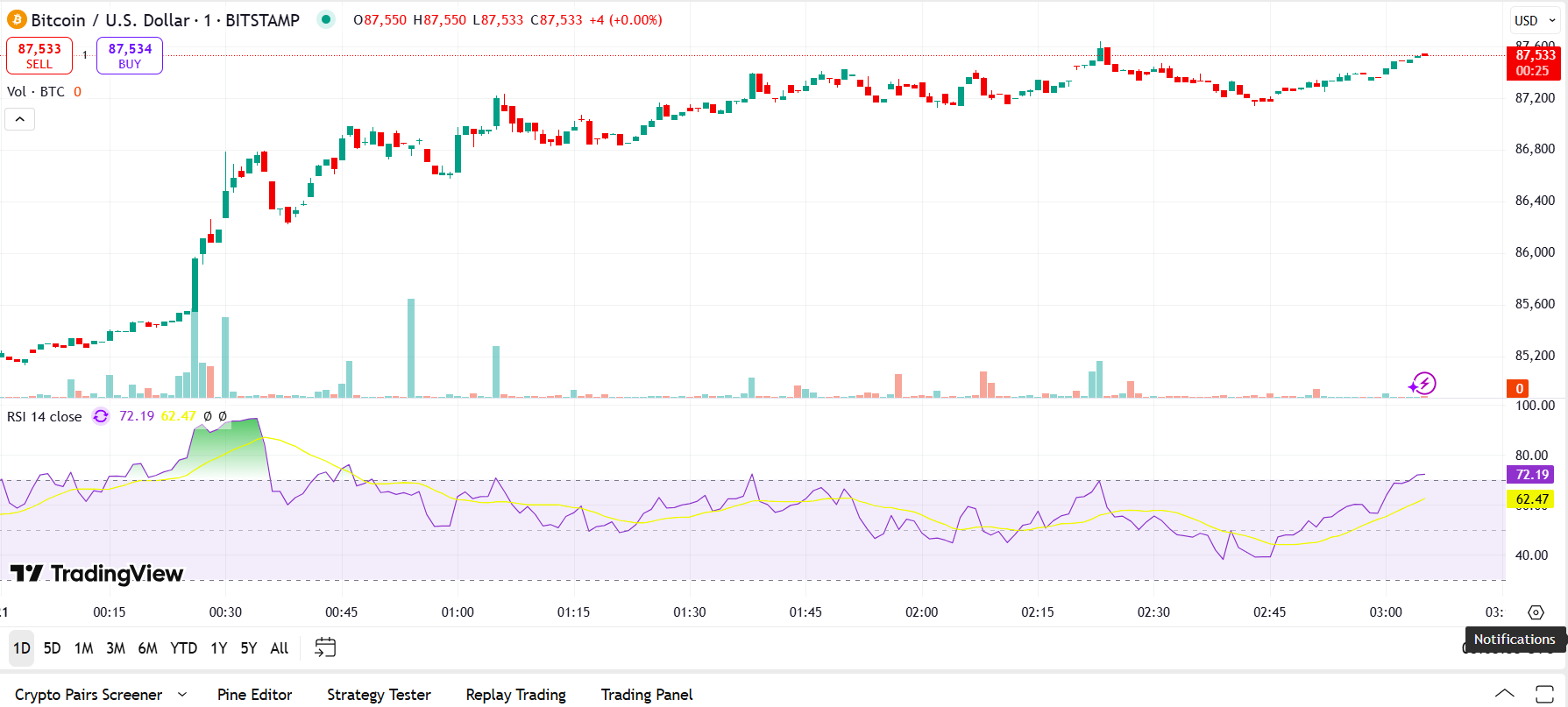
Gold hit a record $3,385, gaining nearly 2% in 24 hours, according to TradingView. Bitcoin also rallied, rising about 3% to $87,500. The token is up 4.5% over the past week.
Trump’s weekend comment wasn’t out of character, given the fact that he had made similar remarks before. Although it may seem tied to recent gains in Bitcoin and gold, analysts believe the real momentum comes from ongoing US-China tensions and growing economic uncertainty.

Commenting on the rare synchronized rally of gold and Bitcoin, The Kobeissi Letter said it signals a growing consensus among investors that uncertainty is building and the US dollar may be headed lower.

“Gold has hit its 55th all-time high in 12 months, and Bitcoin is officially joining the run, now above $87,000. The narrative in both Gold and Bitcoin is aligning for the first time in years: Gold and Bitcoin are telling us that a weaker US Dollar and more uncertainty are on the way,” The Kobeissi Letter stated.

The US dollar index plunged to a three-year low in early Asian trading on Monday. According to ZeroHedge, the sharp decline was driven by mounting market fears following comments from National Economic Council Director Kevin Hassett, who indicated that President Trump is still considering ways to remove Fed Chairman Jerome Powell.

The prospect of Trump exerting more direct control over monetary policy, or continuing his public attacks on the Fed, has unsettled traders. As a result, investors moved aggressively to sell the dollar, the analyst suggested.

That makes Bitcoin’s behavior during this dollar collapse remarkable. Historically, when the dollar weakens, Bitcoin’s price often falls as well, as both assets can be seen as competing safe-haven investments.

However, Bitcoin did not follow the usual pattern, signaling a “regime shift.”

Market observers suggest this deviation could indicate Bitcoin’s evolving role as a store of value, potentially separating it from tech sector volatility, though analysts caution it’s premature to confirm a definitive decoupling from risk-on assets.

Franklin Templeton Digital Assets reported last week that Bitcoin shows a stronger correlation with tech stocks rather than gold.

Despite the narrative of Bitcoin as ‘digital gold,’ data over the past three years demonstrate a correlation coefficient with gold rarely exceeding 0.3, indicating that the two assets typically move independently of each other.

In contrast, Bitcoin’s correlation with tech equities has reached as high as 0.7, affirming its alignment more with the tech sector than with traditional safe-haven assets.

Share this article


Mantra CEO says team is finalizing burn program details, buyback is well underway

0


Key Takeaways

  • Mantra is finalizing a token burn program for the OM token.
  • OM token has faced significant price decline due to large liquidations.

Share this article

John Patrick Mullin, Mantra’s co-founder and CEO, has stated that the team is finalizing its token burn program and actively working on a buyback plan. Both efforts come in the wake of the OM token’s recent collapse.

“The burn program details are in the final stages, and will be shared in the near future. Buyback program also well underway. We are working around the clock for the Sherpas/OMies,” Mullin wrote on X on Friday.

OM, the native token of the MANTRA ecosystem, saw a steep price decline on April 13, plummeting over 90% to $0.37 in a matter of hours.

Following the large-scale liquidation that wiped out around $5 billion in OM’s market value, OM recovered to above $1 but again retraced. The token surged as much as 14% on Friday after Mullin’s latest update.

Ever since the incident, the project team has repeatedly asserted that they did not make any OM sales during the token’s sudden collapse.

In some of his early statements post-event, Mullin claimed reckless forced liquidations on centralized exchanges triggered the 90% drop in the OM token’s value.

In an official statement released on April 16, Mantra’s internal investigation confirmed forced liquidation of OM collateral during low-volume trading hours as the main cause.

All OM team allocations remain locked, and most market activity involves legacy ERC-20 tokens in public circulation, according to the team.

In a bid to rewin community trust, Mantra plans to launch a buyback and burn program, release a live tokenomics dashboard, and work with exchanges to provide more transparency.

Mullin has also publicly committed to burning his personal token allocation as part of the recovery effort.

Mullin has also suggested a decentralized vote to decide on the burning of 300 million team tokens in response to some concerns about the burning program’s impact on long-term team motivation.

Mantra allocated 300 million OM tokens, nearly 17% of its supply, to the team and core contributors. Locked until staged releases between April 2027 and October 2029, the stash is now valued at over $200 million, down from around $1.8 billion before the recent price crash.

At the time of writing, OM traded at $0.68, down approximately 88% from its pre-collapse point of $6, according to CoinGecko data.

Share this article


Asia’s first XRP investment fund launches with Ripple as early backer

0


Key Takeaways

  • Asia’s first XRP tracker fund launched by HashKey Capital with Ripple as an early investor.
  • The fund will offer institutional investors exposure to XRP without direct ownership challenges.

Share this article

HashKey Capital, part of HashKey Group’s leading digital asset financial network, is introducing Asia’s first investment product linked to XRP, now the third-largest crypto asset by market cap.

The fund, also known as the HashKey XRP Tracker Fund, is designed for professional investors who want regulated exposure to XRP without the hassle of managing ownership, custody, or trading, the team shared in an announcement on X.

Ripple is backing the fund as both an early and anchor investor. According to HashKey Capital, Ripple’s involvement is instrumental in bridging traditional finance and Web3 innovation.

Through the new offering, the team aims to provide a critical on-ramp for institutions seeking seamless access to blockchain-based financial services.

The HashKey XRP Tracker Fund allows subscriptions and redemptions in cash and in kind every month. It joins HashKey Capital’s growing list of crypto investment products, including Bitcoin (3008.HK) and Ethereum (3009.HK) ETFs.

Discussing the launch, Vivien Wong, Partner, Liquid Funds at HashKey Capital, said that XRP has established itself as a powerhouse in cross-border payments, enabling faster and cheaper transactions compared to traditional networks like SWIFT.

Its blockchain, the XRP Ledger, is also a growing hub for tokenization of real-world assets (RWAs). This reinforces XRP’s utility and appeal to financial institutions and enterprises worldwide.

“XRP stands out as one of the most innovative cryptocurrencies in today’s market, attracting global enterprises who use it to transact, tokenize, and store value,” said Wong. “With the first XRP Tracker Fund available in the region, we simplify access to XRP, catering to the demand for investment opportunities in the very best digital assets.”

CF Benchmark, known for launching ETF products in the US and Asia Pacific, will serve as the fund’s benchmark provider.

“Institutional investors are eager to access regulated products around the world, and this is exactly what the HashKey XRP Tracker Fund will deliver in the Asia-Pacific region,” said Fiona Murray, Managing Director APAC at Ripple.

While currently structured as a private tracker fund available to professional investors, HashKey Capital hinted that the fund could transition into a full-fledged exchange-traded fund (ETF) within the next one to two years, pending regulatory approvals.

Beyond the Tracker Fund, HashKey Capital and Ripple are exploring a wide range of joint initiatives, the asset manager said. These include developing new investment products, cross-border decentralized finance (DeFi) solutions, and tokenization strategies.

Hashkey Capital added that the two entities are in talks about the launch of a money market fund tokenized on the XRP Ledger.

XRP-based investment products gain ground

The launch of the HashKey XRP Tracker Fund comes as investment products linked to XRP are gaining traction around the world.

Brazil has become the world’s first country to approve a spot XRP ETF, the Hashdex Nasdaq XRP Index Fund, which will be listed on the B3 stock exchange. The Hashdex-managed fund will directly hold XRP, providing investors with regulated and transparent exposure to the major crypto asset.

In the US, multiple applications for spot XRP ETFs are under SEC review, and industry experts are optimistic about their eventual approval.

Earlier this month, Teucrium kicked off the first US-listed leveraged XRP ETF, which saw strong debut trading volumes. The product is intended for short-term trading and does not directly hold XRP; instead, it uses swaps referencing European XRP ETPs.

Share this article


Nasdaq-listed Janover purchases $10.5 million worth of Solana after stock soars to record high

0


Key Takeaways

  • Janover purchased 80,567 Solana tokens worth $10.5 million, increasing its total Solana holdings to 163,651 SOL.
  • The company plans to operate Solana validators to stake assets and generate network security rewards.

Share this article

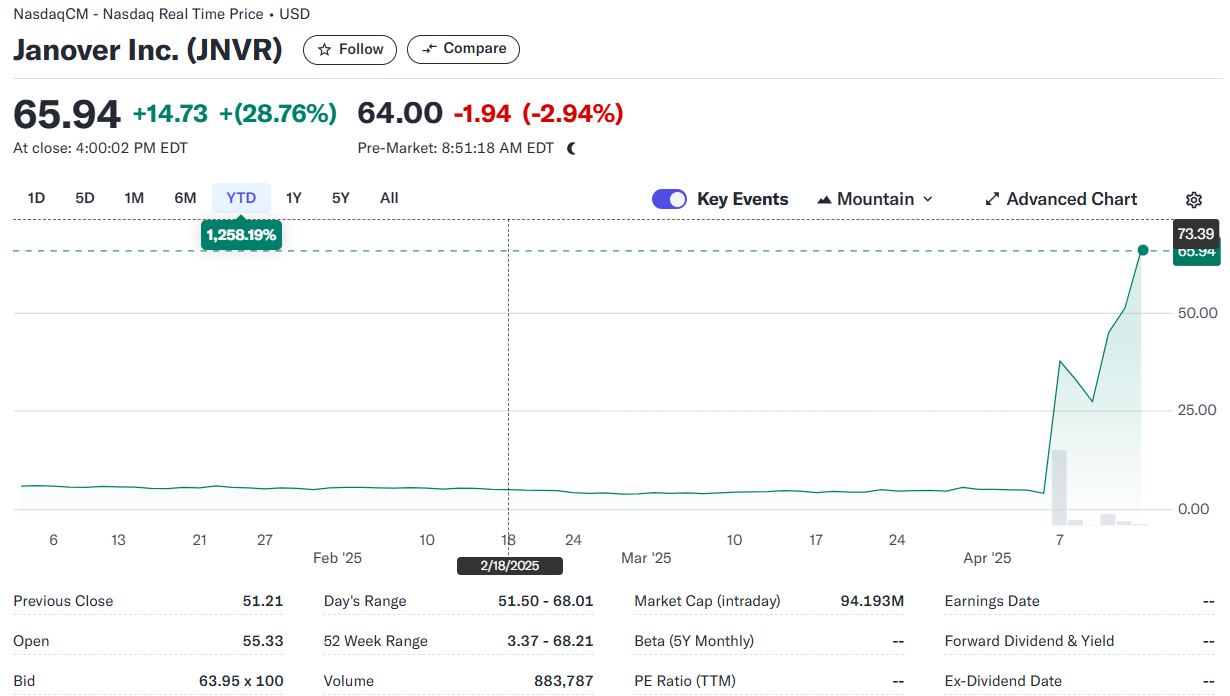
Software company Janover announced Tuesday that it had acquired 80,567 Solana (SOL) for approximately $10.5 million.

This marked the firm’s third SOL buy under its digital treasury plan, and it was revealed after its stock hit an all-time high of nearly $66 at market close Monday, per Yahoo Finance data.

Shares edged lower ahead of the market open today, but they’re still up more than 1,200% so far this year.

The new acquisition boosts Janover’s SOL stash to around 163,651 units, worth approximately $21 million. The purchase was funded through the company’s recently completed $42 million financing round.

Janover plans to immediately begin staking its newly acquired SOL to generate revenue while supporting the Solana network.

The move follows Janover’s recent leadership change, with a team of former Kraken executives acquiring majority ownership of the firm. Under new leadership, the company is focused on bridging the gap between traditional finance and decentralized finance.

Earlier this month, Janover’s board approved a new treasury policy, authorizing long-term accumulation of crypto assets starting with Solana.

Janover also plans to operate one or more Solana validators, enabling it to stake its treasury assets, participate in network security, and earn rewards. The staking revenue will be reinvested to acquire more SOL.

“Speed and clarity of execution are central to our model,” said Parker White, COO & CIO at Janover, in a statement upon the company’s first purchase. “We plan to continue building our SOL position as we scale our strategy — and we believe today’s market conditions offered a compelling opportunity to take our first step.”

The Nasdaq-listed firm also plans to change its name to DeFi Development Corporation and revise its ticker symbol.

Apart from Bitcoin, global companies are also exploring integrating other major digital assets into their strategic reserves.

Worksport, a company specializing in the design and manufacturing of truck accessories, announced last December that it had started adopting XRP, alongside Bitcoin, as treasury assets.

SOL was trading at around $132 at press time, up nearly 24% in the past week, according to TradingView.

The digital asset has fallen approximately 30% year-to-date amid a market-wide pullback triggered by US tariff policy.

Share this article


JPMorgan CEO Jamie Dimon offloads over 130,000 shares worth $31.5 million

0


Key Takeaways

  • Jamie Dimon sold 133,639 JPMorgan shares worth $31.5 million in April.
  • Earlier this year, Dimon sold $233 million of company stock.

Share this article

A new SEC filing reveals that JPMorgan Chase CEO Jamie Dimon offloaded 133,639 shares, valued at approximately $31.5 million.

The transaction, executed at an average price of $235 per share on April 14, leaves Dimon with direct ownership of 1.32 million shares. He maintains additional indirect holdings through family trusts, 401(k) accounts, grantor retained annuity trusts (GRATs), and a limited liability company.

At JPMorgan Chase, Dimon was historically seen as a long-term holder, making major purchases in 2007, 2009, 2012, and 2016 — typically during periods of market uncertainty. However, since last year, he has shifted to selling.

In 2024, Dimon sold about 1 million shares in total, executed in two transactions. In February 2024, he sold approximately 821,778 shares worth around $150 million. Two months later, in April, he sold the remaining 178,222 shares, worth about $33 million.

In February, Dimon sold another $233 million worth of company stock, equivalent to more than 11% of his holdings.

Dimon’s stock sale comes as JPMorgan Chase is off to a strong start this year. Last week, the Wall Street giant reported better-than-expected profits in the first quarter.

However, despite the strong numbers, the bank is still very cautious about the economic outlook amid trade tensions.

The return of Donald Trump to the presidency initially boosted business confidence, but that optimism was shaken when his administration introduced steep new tariffs on many countries.

However, these tariffs have been temporarily paused. These back-and-forth moves have added to market instability.

Dimon noted last week that middle-market clients are scaling back investments and deals due to market uncertainty.

JPMorgan, the largest US bank by assets, has maintained a strong lead over its peers throughout Dimon’s nearly 20-year tenure.

Dimon has signaled that succession planning is in motion. Last May, he indicated that his tenure was “not five years anymore,” prompting speculation he could step down by 2025 or 2026.

However, Dimon plans to stay on as CEO for the next few years, with a possible transition to chairman later.

Share this article


MANTRA’s OM token crashes over 90%, team rejects dumping claims

0


Key Takeaways

  • The OM token from MANTRA crashed by 90% on Sunday.
  • The crash allegedly wiped out over $10 billion in market capitalization, with claims that the team held 90% of supply.

Share this article

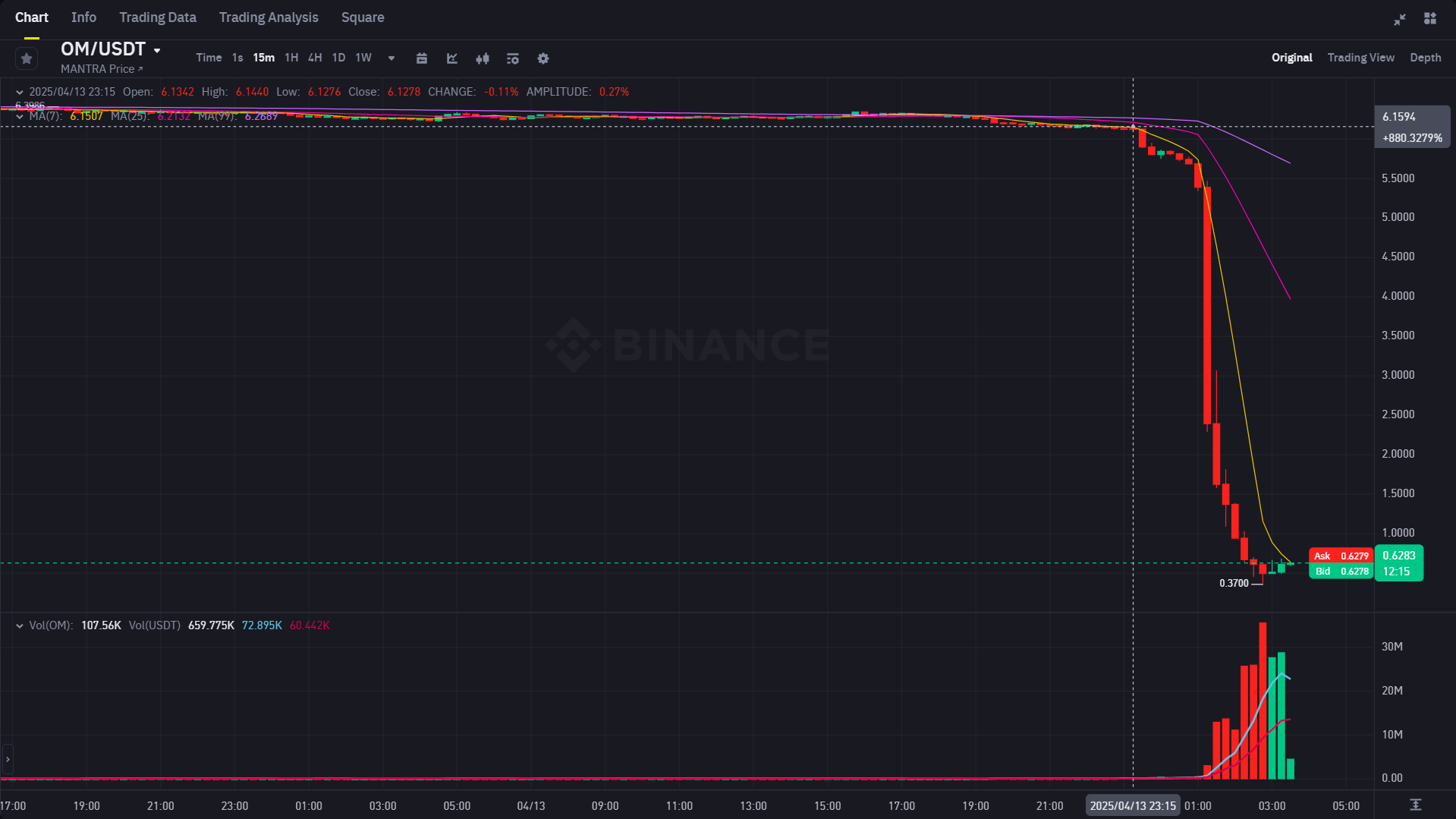
OM, the native token of the MANTRA ecosystem, nosedived as much as 90% in just four hours, erasing billions in its market value, according to data tracked on Binance.

OM’s price crashed from above $6 to $0.37 on April 13, wiping out nearly all of its gains since its meteoric rise from $0.0158 in January 2024. The token reached a peak at $9 earlier this year.

OM crashes 90%

At the time of reporting, OM traded at above $0.6, down approximately 93% from its all-time high.

Although the reason for the steep drop is not yet confirmed, speculation points to the project team potentially unloading their tokens.

MANTRA denies involvement, pointing to massive forced liquidation

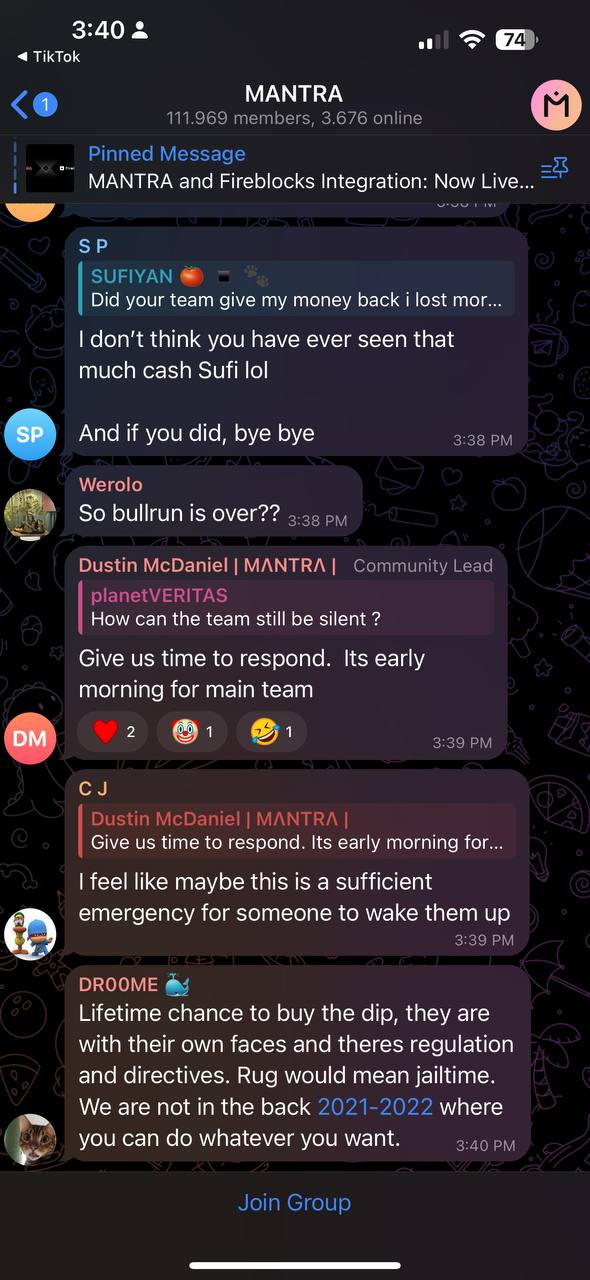
Dustin McDaniel, MANTRA’s community lead, addressed on the project’s Telegram channel that the core team is aware of the community’s concerns and is working on a response. The project’s Telegram group is currently closed to new members.

Dustin McDaniel 1

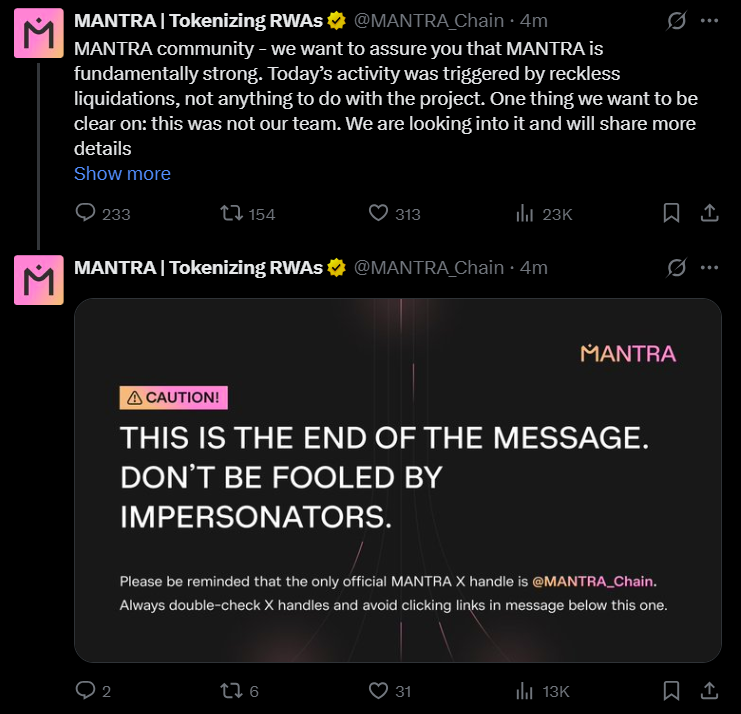
MANTRA has denied involvement in the OM token’s 90% crash, blaming “reckless liquidations” for the sudden drop. In an official statement, the team said the sell-off was not triggered internally and pledged to share more details soon.

MANTRA

During an X Spaces session following OM’s collapse, MANTRA co-founder John Patrick Mullin called the situation “unprecedented,” citing massive forced liquidation on an undisclosed exchange.

“I literally woke up about 30 minutes ago into this,” Mullin said. “It’s honestly unprecedented and we’re still figuring out exactly what’s going on, but I can tell you, we’re still here and we’re gonna sort it out.”

“From my understanding, it seems like there was a massive force liquidation on an exchange over the weekend,” Mullin said. “I won’t name the exchange yet, because we’re starting to get exactly why they did what they did.”

He explained that the exchange “took over a bunch of different positions and completely just closed them out,” though the reasons behind that move are still under investigation.

MANTRA is a key player in the real-world asset (RWA) tokenization space. The project has gained attention through partnerships with Google Cloud and Dubai’s DAMAC Group.

Share this article


MANTRA co-founder says forced liquidations triggered OM token’s 90% crash

0


Key Takeaways

  • OM token crashed 90% due to forced liquidations by centralized exchanges, said MANTRA’s co-founder.
  • MANTRA denies involvement from MANTRA team or investors in the price drop.

Share this article

John Patrick Mullin, the co-founder and CEO of MANTRA, addressed the OM token’s abrupt 90% price decline on Sunday, stating that “reckless forced closures” on CEXs caused the drop, rather than alleged internal activity by the project team.

“The timing and depth of the crash suggest that a very sudden closure of account positions was initiated without sufficient warning or notice,” Mullin said in a statement to the community a few hours after the crash surfaced.

While not naming any specific platform, the entrepreneur argued that the issue was the possibly unchecked and “reckless” actions of the CEXs where OM was being traded.

“That this happened during low-liquidity hours on a Sunday evening UTC (early morning Asia time) points to a degree of negligence at best, or possibly intentional market positioning taken by centralized exchanges,” he stated.

Mullin noted that these exchanges “continue to exercise enormously high levels of discretion,” and warned that when such powers are used without oversight, “dislocations like what recently happened can and will occur, hurting both projects and investors alike.”

The OM token, which peaked at $9 earlier this year, fell from $6.3 to as low as $0.37 on April 13. At the time of writing, the token has slightly recovered above $1.

MANTRA was accused of offloading their bag. However, Mullin denied those claims, stressing that “this dislocation was not caused by the team, the MANTRA Chain Association, its core advisors, or MANTRA’s investors.”

Mullin added that all team and investor tokens are still locked according to their publicly disclosed vesting schedules. He also claimed that the OM token’s fundamental tokenomics remain unchanged.

MANTRA, which recently became the first DeFi protocol licensed by Dubai’s Virtual Assets Regulatory Authority (VARA), plans to host a community discussion on X to address the recent incident.

The explanation didn’t ease concerns in the crypto community. Many still felt the statement lacked transparency. In a follow-up post, Mullin said that the team is working on compiling details of the situation.

Previously, several altcoins suffered sharp declines on Binance, including Act I: The AI Prophecy, which dropped 50%, DeXe, which fell 38%, and dForce, down 19%. The declines came after Binance revised margin requirements, which could increase liquidation risks for undercollateralized positions.

Share this article