Saturday, March 21, 2026
Home Blog Page 9

JPMorgan warns oil could surge to $120 if Iran war disrupts Gulf supply

0


Prolonged Gulf disruptions could choke supply, driving oil prices to unprecedented highs.

Strategists at JPMorgan estimate that Brent crude could reach as high as $120 per barrel if disruptions from an escalating Middle East conflict last more than three weeks, exhausting Gulf storage capacity and forcing output shut-ins that tighten global supply.

In a note led by commodities research head Natasha Kaneva, the JPMorgan team says prices will depend on the scale and duration of supply losses, the speed at which replacement barrels or strategic reserves can be mobilized, and whether shipping through key routes such as the Strait of Hormuz remains constrained by security risks and surging insurance costs.

Though the strait has not formally closed, shipping has slowed as insurance costs spike and safety concerns mount.

JPMorgan estimates that Gulf producers dependent on Hormuz, including Saudi Arabia, the UAE, Iraq, Kuwait, Iran, Qatar, and Oman, have about 343 million barrels of onshore storage, enough to sustain around 22 days of output if exports are stranded.

If disruptions exceed three weeks, producers may be forced to curb production, tightening global supply and pushing Brent into the $100–$120 range.

The bank also notes that past regime changes in medium-to-large oil-producing countries have resulted in average price increases of 76% from onset to peak.

Global oil markets reacted strongly after military strikes by the US and Israel against Iran intensified tensions across the Middle East.

Oil prices surged on Monday, with Brent crude rising above $80 during trading before settling near $77, while stock futures declined.

Energy companies like Exxon and Chevron saw gains, as higher oil prices tend to boost profits, alongside defense contractors such as Lockheed Martin and Northrop Grumman.

Bitcoin tops $70K, XRP, Ether rise as traders shrug off Middle East tensions

0


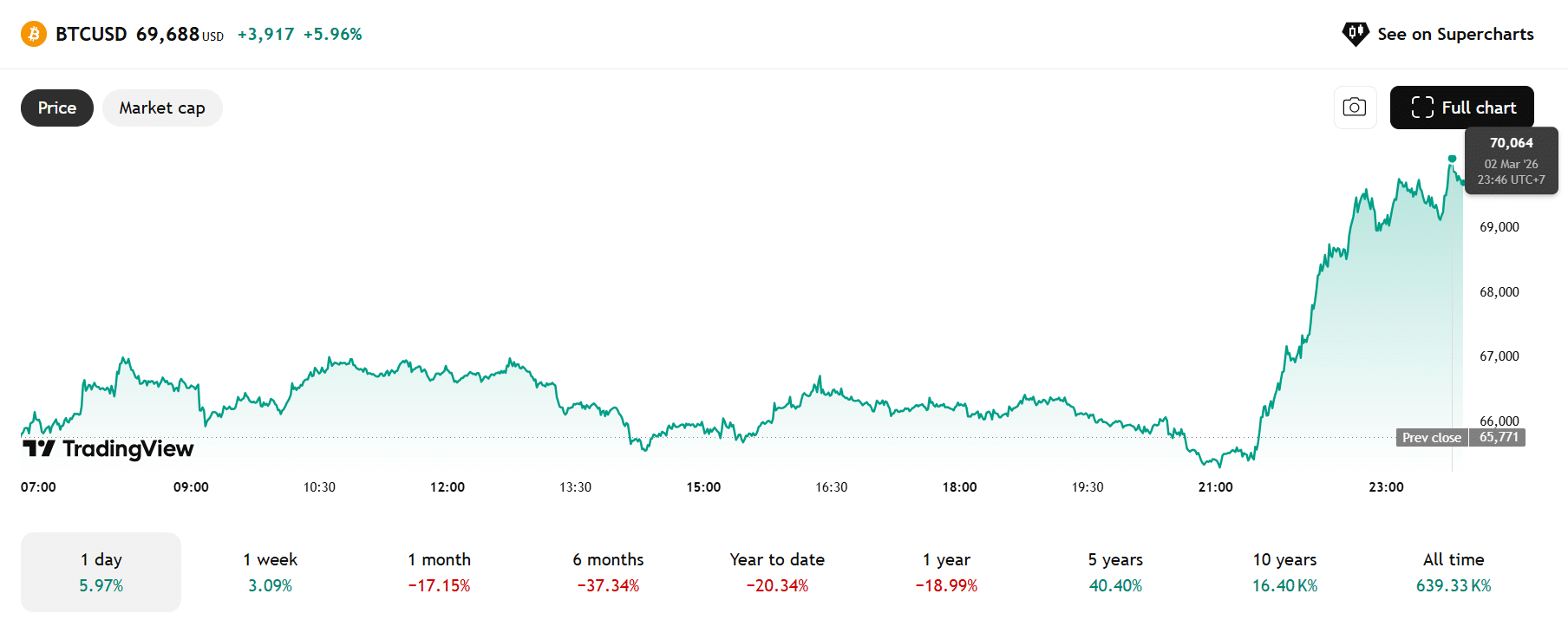
Bitcoin rose 6% on Monday, surpassing the $70,000 level and leading a market-wide rally that pushed Ethereum, BNB, and XRP higher.

Gains came despite intensifying tensions between the US and Iran.

In a CNN interview this morning, Trump suggested that Washington has yet to unleash its full campaign against Iranian targets.

The price of Bitcoin briefly fell to $63,000 on Saturday following reports of US-Israeli military action against Iran. By Sunday, sentiment shifted after confirmation of Iran’s supreme leader’s death, and Bitcoin rallied above $67,000.

The crypto asset was trading at $69,200 at press time, up 3.5% in the past 24 hours, per TradingView.

Over the same period, Ether climbed 2% to $2,000, BNB gained about 3% to $649, and XRP rose 1.5% to $1.4. Among the top 100 crypto assets, NEAR and MORPHO led the advance, each posting double-digit percentage gains.

The total crypto market capitalization surged 4% to $2.4 trillion.

Discussing the geopolitical backdrop, BitMEX co-founder Arthur Hayes suggested that prolonged US military engagement could increase the likelihood of the Fed easing, which he believes would be supportive of higher Bitcoin prices.

“The longer Trump engages in the extremely costly activity of Iranian nation-building, the higher the likelihood the Fed lowers the price and increases the quantity of money,” Hayes wrote in a Monday blog post.

The veteran trader pointed to historical precedent, noting that the central bank eased monetary conditions following major US military engagements in the Middle East dating back to the 1990 Gulf War.

However, Hayes cautioned that the prudent strategy is to “wait and see,” advising investors to deploy capital only after the Fed cuts rates or expands liquidity to support war-related fiscal pressures.

The Fed’s response will ultimately hinge on inflation dynamics, oil prices, and overall financial stability. If oil prices surge and inflation reaccelerates, policymakers could face constraints in easing policy despite geopolitical turmoil.


Iran crypto outflows surge 700% after US-Israel strikes as capital flees offshore

0


Crypto analytics firm Elliptic detected a significant spike in digital asset withdrawals from Nobitex, Iran’s dominant crypto exchange serving more than 11 million users, in the immediate aftermath of initial US-Israel military strikes on Iranian territory.

The London-based blockchain intelligence company said the surge in outflows last Saturday may indicate capital flight. Outgoing transaction volumes spiked by 700% within minutes of the first strikes.

Elliptic said the data suggests Iranian users converted rials into digital assets and moved funds to external wallets beyond the reach of conventional banking oversight.

Nobitex handled $7.2B in crypto transactions in 2025, establishing itself as a cornerstone of Iran’s digital asset infrastructure. The platform has faced scrutiny over alleged financial ties to the Islamic Revolutionary Guard Corps.

In January, Elliptic reported evidence suggesting Iran’s central bank utilized the exchange to prop up the country’s weakening currency.

Early tracing of recent withdrawals shows funds flowing toward foreign trading platforms that have historically absorbed substantial volumes originating from Iran.

The pattern mirrors previous episodes this year. The most pronounced earlier spike occurred on January 9, coinciding with mass protests and a government-imposed internet shutdown. Withdrawal activity declined during the blackout but persisted at reduced levels, suggesting some users maintained access to their holdings despite the platform going offline.

Two subsequent surges aligned with fresh US sanctions announcements targeting Tehran, reinforcing observations that digital assets serve as a potential route around financial restrictions.


Crypto funds snap five-week outflow streak, drawing $1B amid Bitcoin whale accumulation

0


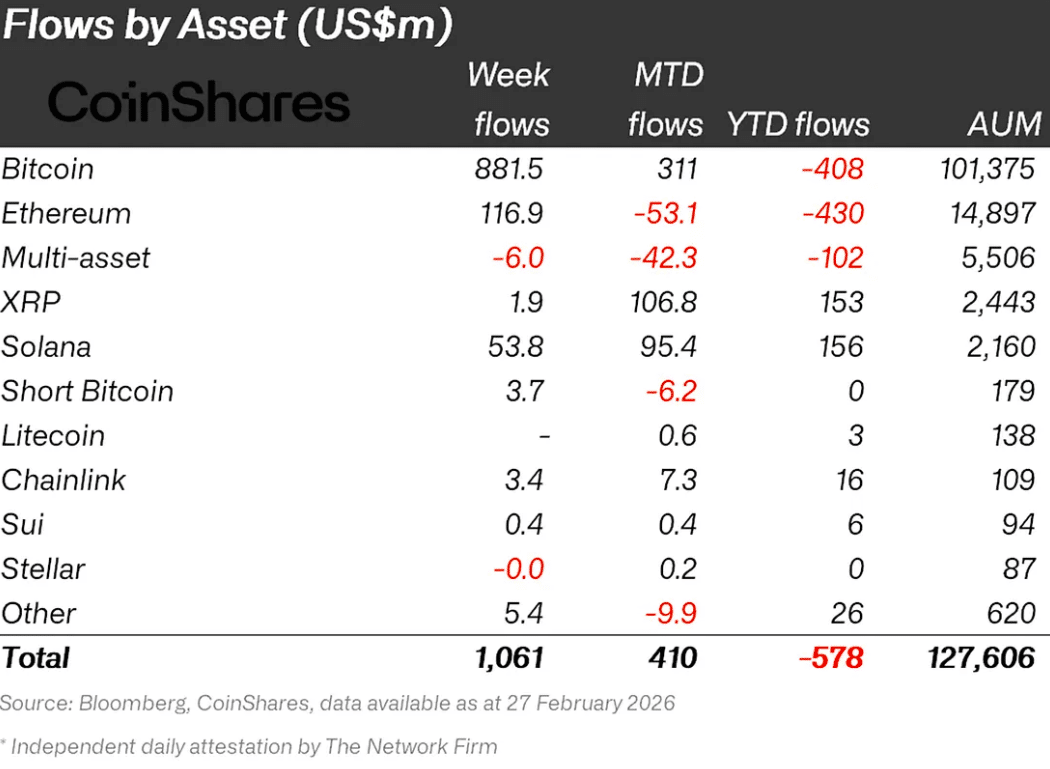
Digital asset investment products posted their first inflows in five weeks, pulling in more than $1 billion after a $4 billion run of outflows, CoinShares reported Monday.

Analysts suggested that the turnaround might have been driven less by macro catalysts and more by market dynamics, including prior price weakness, technical resets, and renewed accumulation by large Bitcoin holders.

Bitcoin led the rebound, attracting around $881 million in new capital.

Ethereum, the second-largest crypto asset, posted $117 million in inflows, its strongest weekly performance since mid-January.

Both assets nonetheless remain in net outflow territory in 2026.

Investors pumped approximately $54 million into Solana funds last week. Solana continued to lead altcoins on a year-to-date basis, reflecting sustained interest in higher-beta opportunities.

Chainlink, an oracle network that feeds external data to smart contracts, added $3.4 million.

Regionally, flows were broadly positive, led by the US, with continued inflows across Canada and parts of Europe.

The resurgence in whale accumulation, alongside renewed institutional buying, suggests investors are increasingly focused on identifying entry points following recent market weakness, pointing to potential transitions from distribution to early-stage accumulation.

Modest inflows into short-Bitcoin products suggest that while some investors are positioning for upside, others are maintaining hedges against further volatility.


Bitcoin tumbles after Israel launches strike on Iran, triggering $100M in longs liquidated in 15 minutes

0


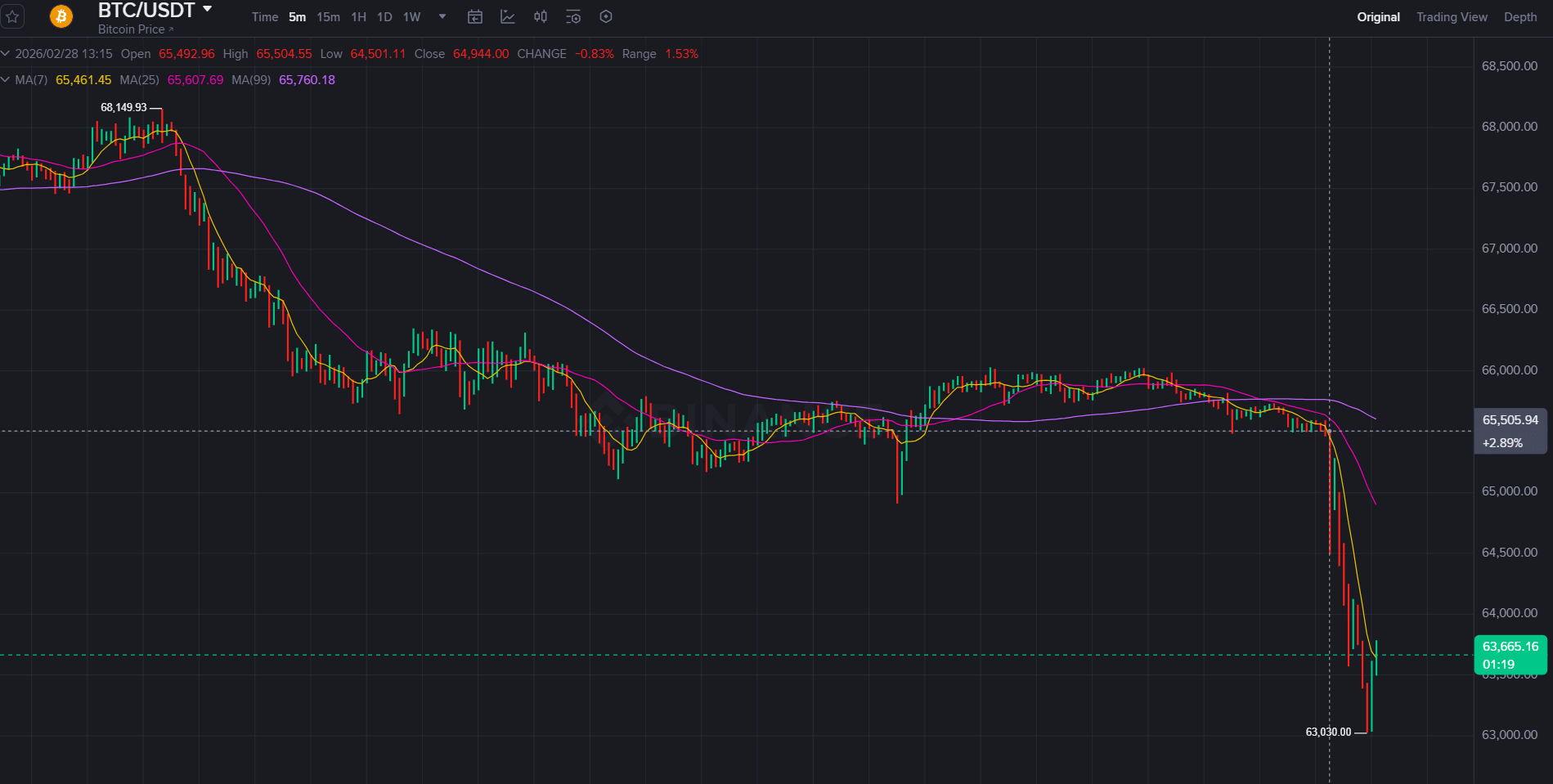
Bitcoin plunged immediately after news of Israel’s preventative strike on Iran spread, rattling global markets and triggering a swift retreat from crypto assets.

The leading digital asset fell nearly 4% from about $65,500 to $63,000 amid the sudden flare-up in the Middle East conflict. It was trading at around $63,600 at press time, down 6% in the last 24 hours.

Bitcoin tumbles after Israel launches strike on Iran

Within minutes of the headlines breaking, roughly $100 million in long positions were liquidated across major exchanges, according to derivatives data.

Israel announced the operation against Iran early Saturday, which was followed by explosions in Tehran.

Defence Minister Israel Katz said the action was aimed at removing looming threats and that a state of emergency had been declared. The Israel Defense Forces warned of possible retaliatory missile launches and activated sirens across the country, instructing residents to stay close to shelters.

Restrictions were introduced at schools, workplaces, and public gatherings in anticipation of further escalation.

American forces were reported to be participating in or coordinating with Israel. The level of involvement remains unclear, however.

Geopolitical instability has historically influenced Bitcoin’s price movements. In April 2024, Bitcoin crashed following a missile strike by Israel on Iran.

Other past events, such as the US-China trade war or the Russia-Ukraine conflict, have shown increased market uncertainty during geopolitical crises. Despite short-term volatility, the crypto market has often demonstrated a pattern of recovery after major sell-offs.


Precious metals rebound to monthly highs as crypto and stocks stall

0


Precious metals rebound toward monthly highs as Bitcoin ranges near $65K and major indexes retreat.

Gold climbed more than 1% on the day and nearly 8% since mid February, extending its recovery as crypto and equity markets cool.

The metal approached $5,250 earlier today, heading toward a seventh straight monthly gain. Gold previously reached an all-time high near $5,600 in late January amid escalating geopolitical tensions between the US and Iran, sparked by Iran’s protest crackdown, US threats of intervention, and military buildup, which fueled safe-haven demand.

After peaking in January, metals pulled back sharply as February began. Gold fell more than 21% from its high to around $4,400, while silver dropped nearly 46% from $121 to $64. Both have since rebounded. Silver rose more than 6% on the day to around $94 and is up over 28% since mid February, setting a new monthly high.

Spot platinum gained 3.5% to $2,352 an ounce, while palladium edged up 0.1% to $1,785, with both metals tracking toward monthly advances.

The rebound in metals contrasts with stagnation in digital assets and equities. Bitcoin has ranged between $65,000 and $70,000 throughout February after briefly dropping below $60,000 earlier in the month. At press time, Bitcoin traded near $65,500, down 2.8% on the day.

US equities also remained under pressure. The S&P 500 fell 0.8%, while the Nasdaq declined 1.1%, weighed down by weakness in mega-cap tech stocks.

Nvidia shares have dropped roughly 9% since Wednesday, falling below $180 despite reporting earnings that beat expectations. The weakness has extended across mega-cap tech names including Meta, Amazon and Alphabet, with investors growing concerned about the scale of planned AI capital expenditures. These spending plans are projected to reach north of $770 billion in 2026.


Norway’s sovereign wealth fund posts $248 billion profit in 2025

0


Norway’s sovereign wealth fund, the Government Pension Fund Global, one of the world’s largest state-owned investment vehicles, generated $248 billion in profit in 2025, lifting its market value to roughly $2.2 trillion.

The massive profit was driven by gains in American technology and financial stocks, with strong contributions from US companies, including major stakes in NVIDIA, Apple, and Microsoft.

CEO Nicolai Tangen said AI optimism, rate cuts, and solid corporate earnings supported returns, while the fund also grew renewable infrastructure, fixed income, and real estate investments.

Managed by Norges Bank Investment Management (NBIM), the fund invests in equities, bonds, property, and renewable energy infrastructure on behalf of the Norwegian public. It now holds stakes in over 7,200 companies across 60 countries.

NBIM’s portfolio gives the sovereign wealth fund indirect exposure to Bitcoin, though it represents a tiny fraction of its total assets.

According to K33’s Head of Research, Vetle Lunde, the fund’s indirect Bitcoin exposure climbed 149% in 2025, driven by its stakes in Strategy, MARA, Metaplanet, Coinbase, and Block.

NBIM’s crypto exposure is almost entirely to Bitcoin, with no major holdings in other crypto-focused firms.