Wednesday, September 30, 2026
Home Blog Page 18

Oil and gold rally as Iran locks down key oil route to US and Israeli allies

0


Oil markets continued to rally on Friday morning amid renewed strain in the Middle East.

Iran’s Islamic Revolutionary Guard Corps (IRGC), a key instrument of Iran’s military and regional strategy, declared that any movement through the Strait of Hormuz by vessels tied to US and Israeli allies would face a forceful response, state media FARS reported.

The group said its navy had already intercepted and redirected three container ships attempting to pass through the corridor.

The move raised concerns about prolonged interruptions on a crucial oil route.

Brent and other crude prices rose on the potential supply squeeze, pushing prices higher despite recent attempts to keep markets steady.

Brent crude, the global benchmark, hit around $111 a barrel, while WTI, the US benchmark, topped $98, according to the latest data.

Elsewhere, gold is also gaining, pushing above $4,500, per TradingView.

Crypto markets

Crypto markets are under renewed pressure, with volatility on the rise. Bitcoin, which had already dipped below $67,000 earlier, extended its decline to $65,730.

Investor sentiment continues to deteriorate, as the Crypto Fear and Greed Index remains in the “extreme fear” zone. The market value has fallen 4% to $2.35 trillion.

Weakness spread across altcoins as well. Ether slid 5% to below $1,980, while BNB and XRP each recorded losses exceeding 3% over the last 24 hours.

The strait and what flows through it

The Strait of Hormuz normally handles roughly 20.5 million barrels of crude oil and condensate per day, approximately one-fifth of global supply.

Since US and Israeli military strikes against Iranian infrastructure commenced on February 28, 2026, under what the Pentagon has dubbed Operation Epic Fury, that flow has been severely disrupted.

While Iran recently signaled “non-hostile” ships may pass, most major shipping lines remain suspended, keeping the blockage largely in place.

The disruption is nearly five times larger in volume terms than the 1973 Arab Oil Embargo, making it the most severe supply shock in modern energy history.

Brent crude stood at roughly $73 per barrel on February 27, the day before hostilities began. Within three weeks, it rocketed to a market peak of approximately $115 per barrel.

Dubai crude, a benchmark closely watched by Asian refiners, hit an unprecedented $137 per barrel during the height of the initial market panic in mid-March.

Oil prices overall are up over 40% compared with pre-war levels, a punishing increase that has forced multiple governments in Asia and Europe to impose fuel rationing and other emergency conservation measures.

Disclosure: This article was edited by Vivian Nguyen. For more information on how we create and review content, see our Editorial Policy.


Tech stocks lead Friday selloff as crypto breaks lower and gold and silver spike

0


Technology stocks fell Friday as a broader market selloff intensified, with geopolitical tensions between the US and Iran, rising Treasury yields, and mounting concerns over AI spending all weighing on sentiment.

The Magnificent Seven led the decline. Microsoft has been the weakest performer in recent weeks, down about 24% year to date and roughly 2% on Friday. Meta dropped around 4.3% on the day and is down about 18% this year, while Nvidia slipped 1.9% Friday and is off roughly 11% year to date.

Alphabet fell about 2.4% on the day and is down near 12% this year, Tesla dropped roughly 3% and is down around 17% year to date, and Amazon declined about 3.2% Friday with losses near 11% this year. Apple has been the most resilient, down about 7% year to date and only slightly lower on the day.

The broader market also weakened. The S&P 500 fell about 1.3% on Friday and is down roughly 6.5% year to date, while the Nasdaq Composite dropped 1.8% on the day and nearly 15% this year. Treasury yields hovering near 4.5% are tightening financial conditions and raising the hurdle for risk assets.

Crypto, which had held up relatively well through early March, joined the selloff. Bitcoin fell below $66,000, Ethereum dropped under $2,000, and broader altcoins moved lower, reflecting a shift toward a more risk off environment across asset classes.

At the same time, traditional safe haven assets moved higher. Gold rose about 2.5% to near $4,500, while silver gained roughly 2% to around $70. Despite the rally, both metals remain in a broader downtrend, suggesting the move is more a short term reaction to geopolitical risk than a structural shift.

Geopolitics remain a key driver. Iran has threatened to disrupt traffic through the Strait of Hormuz, a critical route for global oil supply, while conflicting signals between US and Iranian officials on potential negotiations have added uncertainty. The risk of escalation has pushed energy prices higher and reinforced inflation concerns.

Investors are also increasingly questioning whether aggressive AI spending will translate into returns. Companies including Meta, Microsoft, and Amazon are expected to ramp capital expenditures into 2026, raising concerns that the return on investment may take longer to materialize.

Cost pressures are already showing up in workforce decisions. Meta this week cut around 700 employees as part of ongoing restructuring tied to its AI push, while Amazon has previously announced plans to reduce its workforce by about 16,000 roles.

One relative outlier has been Apple. Analysts point to its strategy of leaning on partnerships with OpenAI and Google for AI capabilities rather than building fully in house, helping limit near term spending pressure and supporting its relative performance.

Disclosure: This article was edited by Estefano Gomez. For more information on how we create and review content, see our Editorial Policy.


BlackRock sends $181 million in Bitcoin, Ether to Coinbase amid crypto sell-off

0


BlackRock deposited $181 million in digital assets on Coinbase Prime today during a slump in crypto markets that pushed Bitcoin and altcoins lower.

According to Arkham Intel data, 612 BTC, worth around $41 million, and 68,567 Ethereum, worth approximately $140 million, were transferred from a wallet owned by the leading asset manager.

While BlackRock’s transfers may not involve selling and could be part of a dip-buying strategy, they have caught notice amid mixed demand for exchange-traded products and ongoing geopolitical uncertainty.

The deposit took place amid a sharp crypto market retreat, with Bitcoin sliding from above $68,000 to approximately $66,300 and Ether dipping to $1,982, below the $2,000 mark, per CoinGecko.

Total market capitalization fell 3% over 24 hours to $2.4 trillion.

Flows into and out of BlackRock’s spot crypto ETFs

The iShares Bitcoin Trust (IBIT) attracted roughly $117 million in outflows in the last three days, but those losses were more than offset by $161 million in inflows recorded on Monday alone, leaving net inflows for the week at $44 million, according to data tracked by Farside Investors.

Cumulative net inflows into IBIT since its January 2024 launch have nonetheless topped $63 billion.

On the Ether side, BlackRock’s iShares Ethereum Trust (ETHA) suffered approximately $214 million in withdrawals this week, a steep figure that contrasts with consistent inflows into the recently launched iShares Staked Ethereum Trust (ETHB), which offers holders an annualized staking reward.

Disclosure: This article was edited by Vivian Nguyen. For more information on how we create and review content, see our Editorial Policy.


Bitcoin slides under $69K as oil spikes on conflicting US Iran signals

0


Bitcoin fell below $69,000 on Thursday morning as escalating tensions between the US and Iran weighed on global markets and pushed investors toward defensive positioning.

The move followed a sharp jump in oil prices, with Brent crude rising more than 5% to briefly hit $108 per barrel before easing to around $105. The surge came as Washington and Tehran offered conflicting accounts on whether peace talks are underway, adding uncertainty around the trajectory of the conflict.

The US has maintained that negotiations to end the war are continuing, while Iran has denied that any talks are taking place. At the same time, attacks across Israel, Iran, and Lebanon remain ongoing, reinforcing concerns that the situation could escalate further.

Bitcoin dropped nearly 4% on the day, falling as low as $68,500 before stabilizing near $68,900 at press time. The broader crypto market followed, with Ethereum declining around 5% to $2,050, Solana down 5% to $87, and XRP falling roughly 4% to $1.36.

Total crypto market capitalization fell about 3.3% to around $2.4 trillion, reflecting widespread selling across digital assets as macro risk intensified.

Traditional markets also weakened. The S&P 500 fell around 1%, while the Nasdaq dropped 1.45% by midday Thursday as investors reduced exposure to risk assets amid the lack of progress on de escalation efforts.

Safe haven flows showed mixed signals. While oil surged, precious metals moved lower, with gold down roughly 2.5% and silver falling close to 5%, extending their recent downtrend after earlier rallies this year.

Crypto-related equities also declined alongside digital assets. Robinhood, Coinbase, Circle, and Strategy each fell between 4% and 5%, reflecting continued sensitivity to crypto market volatility and broader risk sentiment.

Disclosure: This article was edited by Estefano Gomez. For more information on how we create and review content, see our Editorial Policy.


Franklin Templeton launches tokenized ETFs trading 24/7 in crypto wallets

0


The stock market closes at 4 PM Eastern. Your crypto wallet does not. Franklin Templeton just decided to side with the wallet.

The investment giant, which manages roughly $1.68 trillion in assets, has rolled out tokenized ETFs that can be traded 24 hours a day, seven days a week, directly within crypto wallets. It’s the kind of move that sounds like a fintech startup pitch deck — except this time it’s coming from a firm that’s been around since 1947.

What Franklin Templeton actually built

Here’s the thing. Traditional ETFs are tethered to market hours. You want to buy shares of an S&P 500 fund at 2 AM on a Saturday because you just read something alarming? Tough luck, wait until Monday morning.

Franklin Templeton’s tokenized ETFs eliminate that constraint entirely. By representing fund shares as tokens on a blockchain, investors can trade them at any hour, from any compatible crypto wallet, without waiting for exchanges to open.

This isn’t the firm’s first foray into blockchain-native finance. Franklin Templeton launched its Benji Technology Platform back in 2021, which hosted the first US-registered money market fund to live on a blockchain — the Franklin OnChain US Government Money Fund, known by its ticker FOBXX.

That fund has since grown to $557 million in assets by February 2026. Not exactly pocket change.

The firm has also been aggressive on the crypto ETF front more broadly. Its Franklin Crypto Index ETF (EZPZ), which allocates about 77% to Bitcoin with the rest spread across other digital assets, has attracted serious institutional attention. And the XRPZ ETF, which launched in November 2025, pulled in $225.83 million in just its first two months of trading.

In English: Franklin Templeton isn’t dabbling in crypto. It’s building an entire parallel infrastructure.

Why this matters more than it sounds

The ability to trade tokenized securities around the clock might seem like a convenience feature. It’s actually a structural shift in how capital markets could function.

Traditional finance operates on a patchwork of clearing houses, settlement windows, and market hours that were designed decades ago. Blockchain-based trading collapses all of that into something much closer to real-time. Settlement that used to take two business days can happen in minutes.

For institutional investors, this changes the math on liquidity risk. If you can exit a position at any time rather than waiting for a market to open — potentially during a crisis — that’s a fundamentally different risk profile.

And institutions are paying attention. According to recent survey data, 73% of institutional investors plan to increase their digital asset allocations in 2026. That’s not a fringe group of crypto-curious hedge funds. That’s the mainstream starting to lean in.

Franklin Templeton has also partnered with Binance to allow tokenized fund shares to be used as collateral for institutional trades. Think about what that means: shares of a regulated US money market fund, living on a blockchain, being posted as collateral on a crypto exchange. Five years ago, that sentence would have read like science fiction.

The regulatory backdrop

None of this happens in a vacuum. The regulatory environment has shifted meaningfully over the past year, and that shift is a big part of why firms like Franklin Templeton feel comfortable making these moves.

The GENIUS Act, passed in July 2025, established clear requirements for stablecoin issuers, including a mandate for 100% reserves. That legislation gave the broader tokenized asset ecosystem a regulatory floor to build on. It signaled that Washington wasn’t going to try to ban its way out of crypto — it was going to regulate it.

The SEC’s classification of XRP as a commodity, placing it alongside Bitcoin and Ethereum in that category, provided additional clarity. For asset managers launching products like XRPZ, knowing the regulatory classification of the underlying asset isn’t a moving target is worth quite a lot.

Stablecoin transaction volume hit an estimated $62 trillion in 2025. That figure — roughly three times the annual GDP of the United States — suggests the infrastructure for on-chain financial activity isn’t just theoretical. It’s already handling real volume at scale.

The combination of regulatory clarity and proven infrastructure is exactly the environment that draws in the Franklin Templetons of the world. They don’t move until the road is paved, but once it is, they move fast.

What this means for investors

Look, the immediate practical impact for a retail investor is straightforward: more flexibility in when and how you trade certain fund products. That alone is useful but not revolutionary.

The bigger story is about what happens next. When a $1.68 trillion asset manager starts treating blockchain rails as a primary distribution channel rather than an experiment, competitors notice. BlackRock has already been moving in this direction with its own tokenized fund products. Fidelity has made similar noises. The race to tokenize traditional financial products is no longer a race — it’s a stampede.

For the crypto-native crowd, this represents something of a double-edged sword. On one hand, institutional adoption brings legitimacy, liquidity, and generally more stable market conditions. On the other hand, it also brings the same players and dynamics that many crypto enthusiasts were trying to escape in the first place. The decentralized dream gets a little more centralized every time a Wall Street firm sets up shop on-chain.

There are risks worth watching. Bitcoin, for context, hit an all-time high of roughly $126,198 in October 2025 but was trading around $70,599 by March 2026 — a decline of about 44%. Tokenized ETFs don’t insulate anyone from underlying asset volatility. They just make it easier to access that volatility at 3 AM.

The collateralization angle with Binance also introduces counterparty considerations. Regulated fund shares being used as collateral on a crypto exchange creates new interconnections between traditional and decentralized finance. Those connections can be efficient in good times and fragile in bad ones. Anyone who watched 2022’s cascade of crypto collapses knows how quickly contagion can spread through interconnected systems.

Still, the direction of travel is clear. The walls between traditional finance and crypto markets are getting thinner by the quarter. Franklin Templeton’s latest move doesn’t just illustrate that trend — it accelerates it.

Bottom line: Franklin Templeton putting tokenized ETFs in crypto wallets with 24/7 trading isn’t a gimmick. It’s a $1.68 trillion asset manager betting that the future of fund distribution runs on blockchain rails. Whether that future arrives smoothly or messily, the bet has been placed — and the rest of Wall Street is watching closely.

Disclosure: This article was edited by Estefano Gomez. For more information on how we create and review content, see our Editorial Policy.


Bitwise CIO Matt Hougan says Circle could reach $75B by 2030 despite recent selloff

0


Bitwise CIO Matt Hougan said Circle could reach a valuation of roughly $75 billion by 2030, laying out a long-term framework that focuses on stablecoin adoption rather than short-term regulatory noise.

In his weekly memo, Hougan framed Circle’s value around three variables: the size of the stablecoin market, USDC’s market share, and the company’s long-term margins. Using what he described as conservative assumptions, he modeled a $1.9 trillion stablecoin market by the end of the decade, with Circle maintaining a 25% share and generating a 0.8% margin after distribution costs.

That scenario would translate into approximately $3.8 billion in revenue and $2.7 billion in net income, which Hougan said could support a valuation near $75 billion using standard equity multiples.

The memo comes after Circle shares fell more than 20% on Tuesday. The drop followed reports that lawmakers are considering provisions in the CLARITY Act that could limit yield-like incentives on stablecoin balances. Those incentives have been a key driver of USDC distribution through partners. As of Wednesday morning, the stock was up about 2% on the day, trading near $103.

Hougan did not directly comment on the price drop or the legislative details. Instead, he emphasized that stablecoin adoption is driven primarily by utility, including faster payments, global accessibility, and integration with financial systems, rather than yield.

He also pointed to Circle’s positioning in regulated markets, noting that USDC holds roughly a quarter of the total stablecoin supply and a significantly larger share in compliant onshore markets. That positioning could become more valuable if regulation pushes capital toward regulated issuers.

Disclosure: This article was edited by Estefano Gomez. For more information on how we create and review content, see our Editorial Policy.


Bitcoin rally hits wall as Iran clowns US talks

0


Bitcoin’s push toward $72,000 stalled after Iran rebuffed ceasefire chatter, insisting that no talks have occurred since the war began in late February, state media FARS reported Wednesday.

These comments directly oppose President Donald Trump’s claim on Monday that diplomatic talks were underway.

Citing the discussions’ positive tone, Trump announced a five-day pause on any military strikes against Iran’s power and energy facilities while negotiations continue to move forward.

Despite offers from regional and international mediators, Iran said it would continue its military defenses.

Bullish momentum faltered as Iran shot down reports of talks with the US.

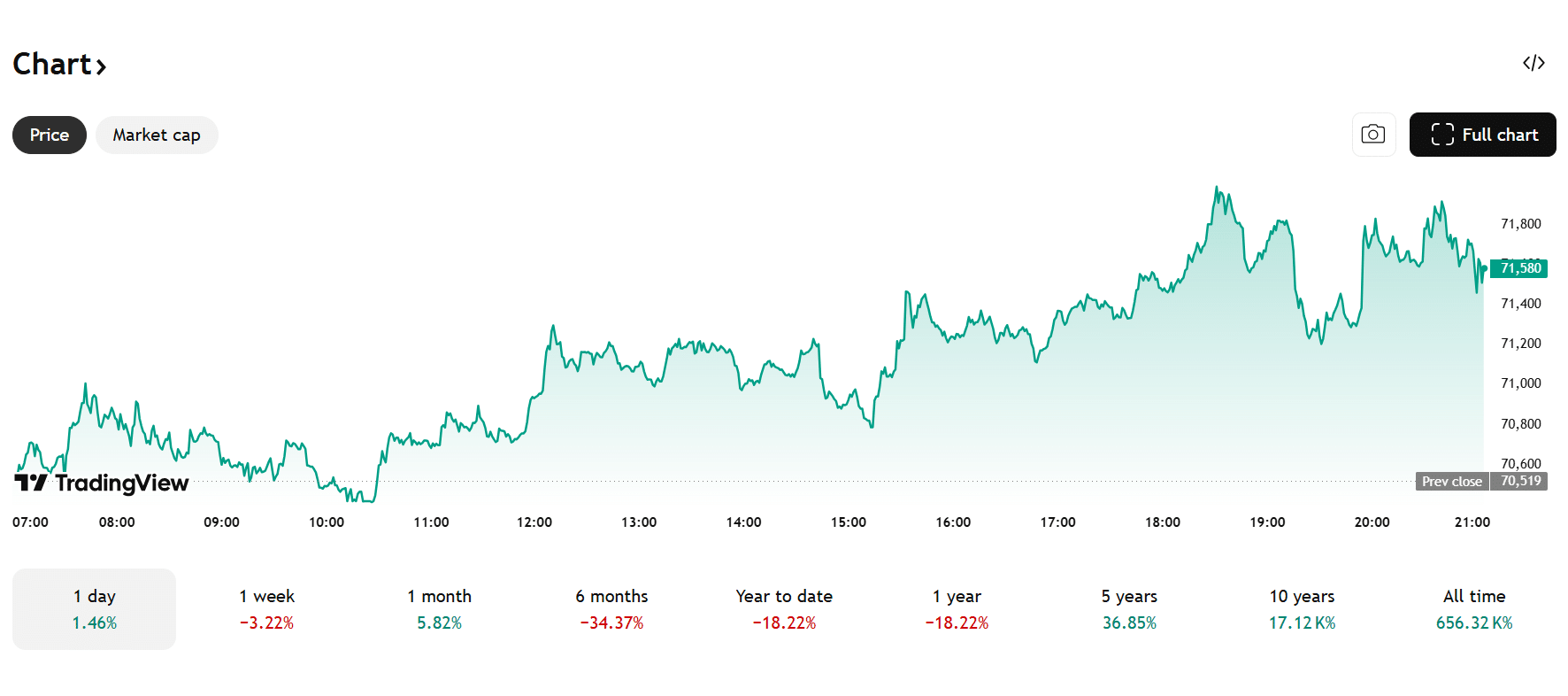
According to TradingView, Bitcoin reversed on Wednesday after climbing to nearly $72,000 in early trading. The digital asset traded at $71,580 at press time, up about 1.5% in the last 24 hours.

Geopolitical uncertainty and a weak macro outlook are weighing on markets.

Lookonchain data shows a whale opened a massive 40x short on 1,000 BTC and a 20x long position on Brent crude ahead of market open. Both positions initially went into the red, and the trader later switched to a long.

Another whale is also betting on a crypto rally. In the past few hours, the trader “0x049b” opened 20x long positions on 9,256 ETH and 282 BTC.

What to expect next

Iran’s refusal to engage in ceasefire talks and the potential instability of the US military pause leave BTC vulnerable to downside testing, particularly around $70,000.

If geopolitical tensions escalate or macro conditions weaken, Bitcoin may fall toward the $68,000–$70,000 zone.

Conversely, any progress in diplomacy or a lift in risk appetite could push the market back up toward $74,000.

Disclosure: This article was edited by Vivian Nguyen. For more information on how we create and review content, see our Editorial Policy.