Wednesday, September 30, 2026
Home Blog Page 17

Oil reversal and crowded shorts keep crypto traders on edge

0


Crude oil just pulled a classic bait-and-switch. WTI surged on geopolitical tensions, then promptly gave back nearly $3 a barrel, erasing the kind of fear premium that usually sends inflation hawks into a frenzy.

In theory, cheaper oil means less inflation pressure, which means the Fed has more room to cut rates, which means risk assets should rally. Crypto didn’t get the memo. Bitcoin hovered near $67K, Ethereum slipped below $2,100, and the Fear and Greed Index sat at 12, firmly in “Extreme Fear” territory. The culprit: a derivatives market loaded with shorts and long-term holders who seem more interested in selling than hodling.

The oil whiplash and what it means for macro

Geopolitical risk premiums in oil markets are notoriously fickle. Tensions flare, crude spikes, traders price in worst-case scenarios, and then reality sets in. That’s roughly what happened here, with WTI giving back its gains in a move that took the edge off inflation expectations.

For crypto, oil prices matter more than most traders want to admit. Cheaper crude feeds into lower headline CPI prints, which gives the Federal Reserve political cover to ease monetary policy. Looser money has historically been rocket fuel for Bitcoin and the broader crypto market.

But here’s the thing. The oil drop alone isn’t enough to shift the macro narrative meaningfully. Core inflation, the metric the Fed actually obsesses over, strips out energy prices entirely. So while the WTI decline is a mild positive for sentiment, it doesn’t fundamentally change the rate outlook in the near term.

Think of it like getting a parking spot at the mall. Nice, but it doesn’t mean they have what you came for.

Crowded shorts and overhead supply

The more pressing issue for crypto is what’s happening in derivatives markets. Short positioning has become notably heavy across major exchanges, creating what traders call a “crowded short” environment. In English: a lot of people are betting prices will fall, and they’ve put real money behind that bet.

Crowded shorts are a double-edged sword. On one hand, they reflect genuine bearish conviction. When sophisticated derivatives traders pile into shorts, it’s usually because they see deteriorating on-chain metrics or unfavorable macro conditions. That signal shouldn’t be dismissed.

On the other hand, extreme short positioning sets the stage for violent squeezes. If prices tick up even modestly, short sellers are forced to buy back their positions to limit losses, which pushes prices higher, which forces more shorts to cover. It’s a feedback loop that can produce sharp, fast rallies that look completely disconnected from fundamentals.

Right now, neither side has blinked. Bitcoin is stuck in a range where overhead supply from long-term holders acts as a ceiling, while the threat of a short squeeze prevents a clean breakdown. It’s a standoff, and standoffs in crypto rarely resolve quietly.

Analysts point to on-chain data showing long-term holders, wallets that have held BTC for more than 155 days, actively distributing their coins. This is the group that typically accumulates during bear markets and sells into strength. The fact that they’re selling now suggests they view current prices as a reasonable exit point rather than the start of another leg higher.

By the numbers: how bad is the damage

The scoreboard isn’t pretty. Bitcoin dropped 2.4% over 24 hours and 2.7% over the past week, settling near the $67K level. Ethereum fared worse, falling 3.7% in a day and sliding below $2,100.

Solana took the hardest hit among major assets, dropping 6.5% in 24 hours and dipping toward $80. XRP was relatively stable by comparison, settling near $1.30.

The Fear and Greed Index reading of 12 puts the market squarely in “Extreme Fear,” a level that typically coincides with capitulation events. For context, last week the index sat at 10. So sentiment has improved slightly, though calling a move from 10 to 12 an “improvement” is like celebrating that your fever dropped from 104 to 103.

One curious bright spot: algorithmic stablecoins surged 37.1% over the past week, making them the top-performing category by a wide margin. Whether that reflects genuine demand or speculative froth in a niche sector is an open question, but it’s worth noting that money is flowing somewhere even in a fearful market.

What this means for investors

The setup here is more nuanced than it looks on the surface. Extreme fear readings have historically been better entry points than exit points for Bitcoin. The last time the Fear and Greed Index lingered in the low teens for an extended period, it preceded a significant rally within 30 to 90 days.

But past performance isn’t a guarantee, and the current environment has some wrinkles that previous fear cycles didn’t. Long-term holder distribution is a real headwind. When the so-called “smart money” is selling, it creates persistent overhead supply that absorbs buying pressure before it can translate into meaningful price appreciation.

The crowded short dynamic adds a layer of unpredictability. If a catalyst emerges, whether it’s a favorable CPI print, an ETF flow surprise, or even a geopolitical de-escalation, the resulting short squeeze could be outsized relative to the catalyst itself. Traders positioned for downside would scramble to cover, and the move could happen in hours rather than days.

Conversely, if shorts are proven right and prices break below key support levels, the liquidation cascade could work in the other direction. Leveraged longs get wiped out, adding to selling pressure in a market already low on conviction.

The oil story adds a background variable that most crypto-native traders underweight. Energy prices feed into consumer sentiment, corporate margins, and central bank decision-making. A sustained decline in crude could gradually shift the macro environment in crypto’s favor, but that’s a slow-burn thesis, not a trading signal.

Ethereum’s underperformance relative to Bitcoin is also worth watching. A 3.7% daily decline versus Bitcoin’s 2.4% suggests that risk appetite is contracting toward the top of the market cap spectrum. When ETH underperforms BTC, altcoins tend to bleed harder, which is exactly what Solana’s 6.5% drop confirms.

The bottom line

Oil’s reversal removed one headwind, but it didn’t remove the ones that actually matter for crypto right now. Heavy short positioning, long-term holder selling, and extreme fear make for a market that could snap violently in either direction. The boring but honest read: this is a wait-and-see environment where position sizing matters more than direction. Traders who survive the standoff will be the ones who didn’t overcommit to a thesis before the market picked a side.

Disclosure: This article was edited by Estefano Gomez. For more information on how we create and review content, see our Editorial Policy.


Geopolitical chess match fuels a broad risk asset rally as markets bet on resolution

0


Here’s a sentence you don’t read every day: a potential military flashpoint in the Persian Gulf is somehow making markets go up.

Iran claims it controls the Strait of Hormuz, the narrow chokepoint through which roughly 20% of the world’s oil passes daily. President Trump says he won’t discuss a ceasefire until it reopens. With a presidential address to the nation expected tonight, Wall Street and crypto markets alike are placing a very specific bet: that this is posturing, not prelude.

The numbers tell the story

The S&P 500 has climbed roughly 4% since Monday. The Nasdaq, heavy with tech names that tend to amplify broader market moves, jumped nearly 6% over the same stretch.

Crypto followed the playbook. Bitcoin pushed near $69K, up about 2.7% in the last 24 hours. Ethereum climbed toward $2,100, gaining 3.6%. Solana rose to around $84, adding 3.0%. XRP traded near $1.35.

Look, these aren’t small moves for a week that started with headlines about naval standoffs and oil supply disruptions. The market is reading this situation and concluding that the adults will find a way to the negotiating table. Whether that confidence is warranted is a different question entirely.

What makes this rally particularly notable is the backdrop. The Fear and Greed Index sits at 8, which Alternative.me classifies as “Extreme Fear.” Last week it was 14. Also Extreme Fear. In English: sentiment is in the basement, yet prices are climbing the stairs. That divergence is the kind of thing that either resolves with a sharp sentiment recovery or a painful price correction back down to match the mood.

Bitcoin’s weekly chart still shows a 4.1% decline, meaning this rally is really just clawing back recent losses rather than breaking new ground. Context matters. A 2.7% daily gain sounds impressive until you realize the asset was down nearly twice that over the preceding days.

Why Hormuz matters to your portfolio

The Strait of Hormuz is essentially a 21-mile-wide bottleneck between Iran and Oman. About 17 million barrels of oil flow through it every single day. When someone threatens to close it, energy markets panic, and that panic cascades into everything else.

Iran has played this card before. During the 1980s “Tanker War,” both Iran and Iraq attacked commercial shipping in the Gulf. In 2019, Iran seized a British-flagged tanker. Each time, the threat alone was enough to spike oil prices and rattle global markets.

This time, though, the dynamic is different. Trump’s framing, that diplomatic talks are conditional on the strait staying open, creates a binary outcome that markets can actually price. Either Iran cooperates and talks begin, which is bullish. Or Iran escalates and the strait narrows or closes, which would send oil soaring and risk assets tumbling. Traders are betting heavily on door number one.

The presidential address tonight adds another variable. Markets historically react well to the mere promise of clarity, even before the actual content is known. The fact that Trump is addressing the nation suggests some form of resolution framework, or at least that’s the hopeful interpretation driving today’s bid.

What this means for crypto investors

Here’s the thing about crypto rallying alongside equities on geopolitical news: it completely undermines the “digital gold” narrative that Bitcoin maximalists love to tout. If Bitcoin were truly an uncorrelated safe haven, it would rally when stocks fall on war fears, not ride shotgun with the Nasdaq.

The correlation between Bitcoin and the S&P 500 has been stubbornly persistent throughout 2025. When risk is on, crypto goes up. When risk is off, crypto goes down, often harder. This week is just the latest confirmation.

One bright spot in the data: algorithmic stablecoins were the top-performing category over seven days, surging 39.9%. That’s a niche corner of the market, but it suggests capital is rotating into yield-generating strategies during the uncertainty. Investors who can’t stomach the volatility of majors are apparently parking funds where they can earn returns without directional exposure.

The extreme fear reading on the sentiment index deserves serious attention. Historically, readings below 10 have preceded significant rallies in crypto, simply because there’s almost no one left to sell. The March 2020 COVID crash bottomed with a Fear and Greed reading of 8. The June 2022 Terra/Luna aftermath saw similar levels before a multi-month relief rally.

That doesn’t mean a bottom is guaranteed here. The geopolitical situation is genuinely fluid, and a single inflammatory statement from Tehran or Washington could reverse the week’s gains in hours. The Strait of Hormuz isn’t a Fed meeting where outcomes can be modeled with reasonable probability. It’s a real-world conflict with real-world unpredictability.

Investors should also consider what happens after Trump’s address. If the speech delivers concrete steps toward de-escalation, the rally likely extends and fear gauges normalize. If it’s vague or aggressive, the market could give back everything it gained this week and then some. The asymmetry of outcomes here favors caution over conviction.

For those watching specific levels, Bitcoin’s $69K area has been a significant zone of interest going back to its 2021 cycle high. Reclaiming and holding above it would signal genuine strength. Failing there, as it has several times in recent months, would suggest the rally is just a short squeeze dressed up in geopolitical clothing.

Bottom line: Markets are pricing in a peaceful resolution to a standoff that hasn’t actually been resolved yet. That optimism has lifted everything from the S&P 500 to Solana. But with fear sentiment still at extreme levels and a presidential address that could go either way, this rally is built on hope rather than hard evidence. Hope is a fine trading thesis right up until it isn’t.

Disclosure: This article was edited by Estefano Gomez. For more information on how we create and review content, see our Editorial Policy.


SpaceX may cut Robinhood and SoFi from IPO as E*Trade leads talks

0


Morgan Stanley’s E*Trade is in talks to take the lead in selling SpaceX IPO shares to everyday US investors, giving the brokerage an early advantage over Robinhood and SoFi in one of the most closely watched listings of 2026.

Reuters reported Monday that SpaceX is considering routing a meaningful share of its smaller ticket retail allocation through E*Trade, though the talks are still private and not final. Fidelity is also seeking a role in the distribution.

The retail fight matters because SpaceX is discussing an unusually large allocation for individuals. Reuters reported last week that Elon Musk is considering reserving up to 30% of the IPO for retail investors, roughly three times the level typically seen in major US listings. Even so, a significant portion of that pool would still likely go to wealthy private banking clients, leaving the smaller self-directed slice as the prize brokerages are competing to capture.

A lead role would be a notable win for E*Trade as Morgan Stanley leans on its in-house platform to deepen its retail footprint. Morgan Stanley bought E*Trade for about $13 billion in 2020, and Reuters said the bank is expected to use the same playbook here by keeping more of the retail allocation within its own network. That would leave Robinhood and SoFi, both of which have become common distribution channels in splashy IPOs, at risk of being cut out or given only a limited role.

SpaceX has discussed a 2026 IPO that could raise as much as $75 billion and value the company at around $1.75 trillion. If it proceeds, the listing would rank among the largest public offerings ever and could test whether Elon Musk’s retail-driven approach reshapes participation in blockbuster IPOs.

Disclosure: This article was edited by Estefano Gomez. For more information on how we create and review content, see our Editorial Policy.


Elon Musk animates Bitcoin waifu after viral fan art request

0


Elon Musk got the crypto community buzzing after turning a static Bitcoin-inspired anime illustration into a short animated clip.

The whole thing started early this morning when an X user asked Musk to animate an image of an anime girl wearing a Bitcoin-themed outfit, set against the iconic orange Bitcoin symbol.

The request was posted as a comment on one of Musk’s posts, which drew roughly 5,600 comments, and he later responded by posting a brief video showing the character in motion, transforming the artwork into an animated scene.

The clip, made by Grok, quickly gained traction, with users across the platform praising the unexpected interaction.

The user used the event to promote his meme coin called ANIME, sending its market capitalization as high as $3.4 million before it dropped back to around $2.2 million, per GeckoTerminal.

According to data tracked by Lookonchain, one “lucky” trader reaped huge rewards following Musk’s post.

About a year ago, the trader spent just 1.1 SOL to buy ANIME. Today, after Musk’s clip sent the token soaring, he sold all his ANIME stash for $19,500 in SOL, scoring a 211-fold gain.

Disclosure: This article was edited by Vivian Nguyen. For more information on how we create and review content, see our Editorial Policy.


Trump’s Iran diplomacy post jolts crypto markets higher as equities wobble

0


Donald Trump posted about “serious discussions” with Iran’s new regime on Truth Social Monday, and crypto markets responded the way crypto markets do — by going up while everything else went sideways.

Bitcoin jumped 2.2% in 24 hours to approach $68K, Ethereum surged 4.4% past $2,070, and Solana gained 3.4% toward $84. Meanwhile, equities wobbled like a shopping cart with a bad wheel, unsure whether to price in diplomacy or escalation.

The post that moved markets

Here’s the thing about Trump’s Truth Social dispatches: they’ve become their own asset class of volatility. Monday’s entry was a masterclass in mixed signals.

The post claimed productive engagement with Iran’s new regime, framing it as a diplomatic opening. But Trump being Trump, it came packaged with an explicit threat to obliterate Iran’s energy infrastructure if negotiations stall.

Carrot and stick, except the stick is a cruise missile aimed at oil refineries.

For traditional markets, this kind of ambiguity is poison. Equity traders have to model both scenarios — a deal that eases Middle East tensions and a confrontation that disrupts global energy supply chains. The result was predictable indecision, with major indices struggling to find direction.

Crypto, operating on a different emotional frequency entirely, chose optimism. Or at least chose to buy the dip that had been building for the prior week. Bitcoin’s 24-hour gain of 2.2% looks modest until you consider it came after a brutal 5.1% decline over the preceding seven days. The bounce felt less like conviction and more like a market catching its breath.

The numbers behind the bounce

Let’s put some context around these moves. Bitcoin near $68K represents a recovery from what had been an uncomfortable slide. At $68K, BTC sits roughly 8% below its all-time high — close enough to smell it, far enough to be annoying.

Ethereum’s 4.4% daily gain was the standout performer among the majors, pushing above $2,070. That’s a notable move for an asset that has spent much of 2025 underperforming Bitcoin on a relative basis. ETH catching a stronger bid than BTC on a geopolitical catalyst is worth watching — it could signal renewed risk appetite further out on the curve.

Solana climbed roughly 3.4% to approach $84, while XRP held steady near $1.34. Across the broader market, algorithmic stablecoins had the best week of any category, gaining 21.8% over seven days — a stat that says more about rotation into niche narratives than any macro thesis.

But here’s the number that should give everyone pause: the Fear and Greed Index sits at 8. That’s “Extreme Fear” territory, and it’s been parked there for at least a week. In English: despite Monday’s green candles, the broader market mood remains deeply pessimistic. The last time sentiment was this grim for this long, it coincided with either a major bottom or the prelude to further pain. Historically, readings below 10 have been rare, occurring during events like the FTX collapse in November 2022 and the COVID crash in March 2020.

A single-day bounce on a geopolitical headline doesn’t cure that kind of structural anxiety.

Why crypto reacted differently than stocks

The divergence between crypto and equities on this news is actually the most interesting part of the story. Traditional markets have to care about oil prices, defense spending, and the second-order effects of Middle Eastern diplomacy. Crypto doesn’t — or at least pretends not to.

What crypto does care about is dollar weakness, liquidity expectations, and risk-on sentiment. And here’s where Trump’s Iran post gets interesting for digital assets specifically. If diplomacy succeeds, it could ease global tensions that have been supporting dollar strength and energy prices. A weaker dollar and lower oil historically correlate with crypto rallies. If diplomacy fails and conflict escalates, the resulting chaos could drive a flight to alternatives — including Bitcoin, which some investors still view as a hedge against geopolitical instability.

In other words, crypto found a way to be bullish on both outcomes. Whether that logic holds up beyond a 24-hour trading window is another question entirely.

There’s also the liquidity angle. Geopolitical uncertainty often pushes central banks toward more accommodative policy. Traders may be front-running the idea that escalation in the Middle East — or even the threat of it — makes interest rate cuts more likely. More liquidity means more fuel for risk assets, and crypto is the riskiest asset class most portfolios touch.

Look, the honest interpretation is probably simpler. Bitcoin had dropped 5% in a week, fear was at extreme levels, and any catalyst would have triggered a relief bounce. Trump’s Truth Social post just happened to be the match near the kindling.

What investors should actually watch

The diplomatic situation with Iran matters, but not in the way most crypto Twitter accounts would have you believe. This isn’t about Bitcoin becoming a “peace dividend” or a “war hedge” — those narratives are unfalsifiable and therefore useless for making decisions.

What actually matters is the follow-through. If Iran talks progress and geopolitical risk premiums decline globally, watch for dollar weakening and a broader risk-on rotation that could lift crypto alongside equities. If talks collapse and Trump follows through on infrastructure threats, watch oil prices and Treasury yields — those are the transmission mechanisms that would actually impact crypto positioning.

The Fear and Greed Index at 8 is arguably the most important data point right now. Extreme fear readings have historically been better entry points than exit signals, but they’re also not precise timing tools. Markets can stay terrified for weeks before turning. The divergence between deep pessimism in sentiment and a modest price bounce on Monday suggests the market hasn’t resolved its internal debate about direction.

Ethereum’s relative outperformance is worth monitoring over the coming days. If ETH continues to lead BTC on recovery moves, it could indicate that risk appetite is genuinely returning rather than just short-covering in the most liquid asset. Conversely, if Monday’s gains evaporate by Wednesday, the 5% weekly decline was the real signal and the bounce was noise.

For the broader competitive landscape, moments like this highlight crypto’s evolving role in the geopolitical conversation. Five years ago, a presidential social media post about Iran would have had zero measurable impact on Bitcoin. Today, it moves markets in minutes. That says something about institutional participation and the degree to which crypto has been absorbed into the macro trading playbook — for better or worse.

Bottom line: A single Truth Social post gave crypto a green day during a deeply fearful market, but one bounce doesn’t make a trend. With sentiment still at extreme fear levels and Bitcoin down 5% on the week, the real test is whether this diplomatic catalyst has legs or whether it’s just another headline that fades by Friday. Watch the Fear and Greed Index more than the Iran headlines — that’s where the actual story about market direction lives.

Disclosure: This article was edited by Estefano Gomez. For more information on how we create and review content, see our Editorial Policy.


Sam Altman’s World sells 239 million WLD through OTC deals with partial lockup

0


World Foundation, the non-profit entity behind the biometric identity verification protocol formerly known as Worldcoin, disclosed today that its subsidiary completed the sale of around $65 million in WLD tokens through a series of over-the-counter deals with four counterparties over the past week.

Based on the disclosed average price, World Assets, Ltd., the unit responsible for token issuance and distribution, sold approximately 239 million WLD tokens.

Of the $65 million raised, $25 million in tokens are locked up for six months to prevent immediate selling by buyers, as noted by the team.

The first settlement was completed on March 20, with the remaining transfers conducted from a designated World Assets multisig wallet. Funds are earmarked for core operations, R&D, manufacturing of the project’s iris-scanning Orb devices, and expansion of the ecosystem.

The disclosure comes after blockchain analytics firm Lookonchain reported last week that World offloaded 117 million WLD tokens valued at $39 million via OTC trades.

WLD traded at around $0.27 at press time, down 13.5% in the past week, CoinGecko data shows. The token once peaked at $11.7 in March 2024.

Tom Lee-backed Eightco Holdings is the largest publicly traded holder of WLD, controlling 277 million tokens as of March 20.

Founded in 2019 by Sam Altman, Alex Blania, and Max Novendstern, Worldcoin combines biometric identity verification with crypto to pioneer a global proof-of-personhood system.

Its ecosystem features the Orb-based World ID, the WLD token, the World App wallet, and the World Chain layer 2 network.

World ID has verified nearly 18 million unique humans, with close to 39 million World App users. The network spans 160-plus countries, supported by 948 active Orbs, and continues to grow with over 60,000 new accounts and 16,000 verifications in the past week.

Disclosure: This article was edited by Vivian Nguyen. For more information on how we create and review content, see our Editorial Policy.


Bhutan moves $45 million worth of Bitcoin in two days

0


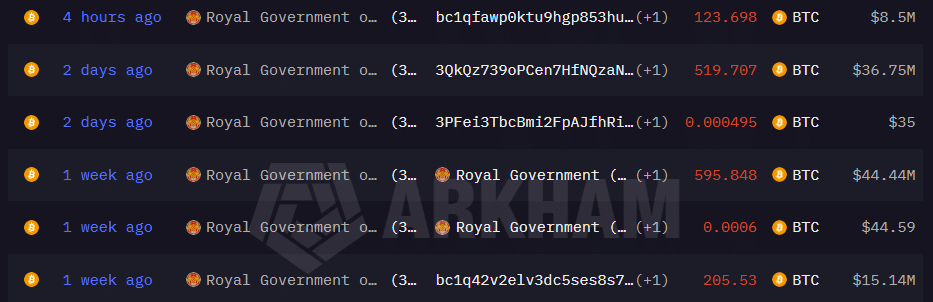
The Royal Government of Bhutan, which became one of the first sovereign Bitcoin miners by using surplus hydroelectric power, has moved 643 BTC worth over $45 million to external wallets over the past two days, according to Arkham Intel data.

Bhutan once held more than 13,000 BTC and now appears to be systematically converting its digital reserves into capital.

Bitcoin traded at $66,500 at press time, down 4% in the last 24 hours, per TradingView.

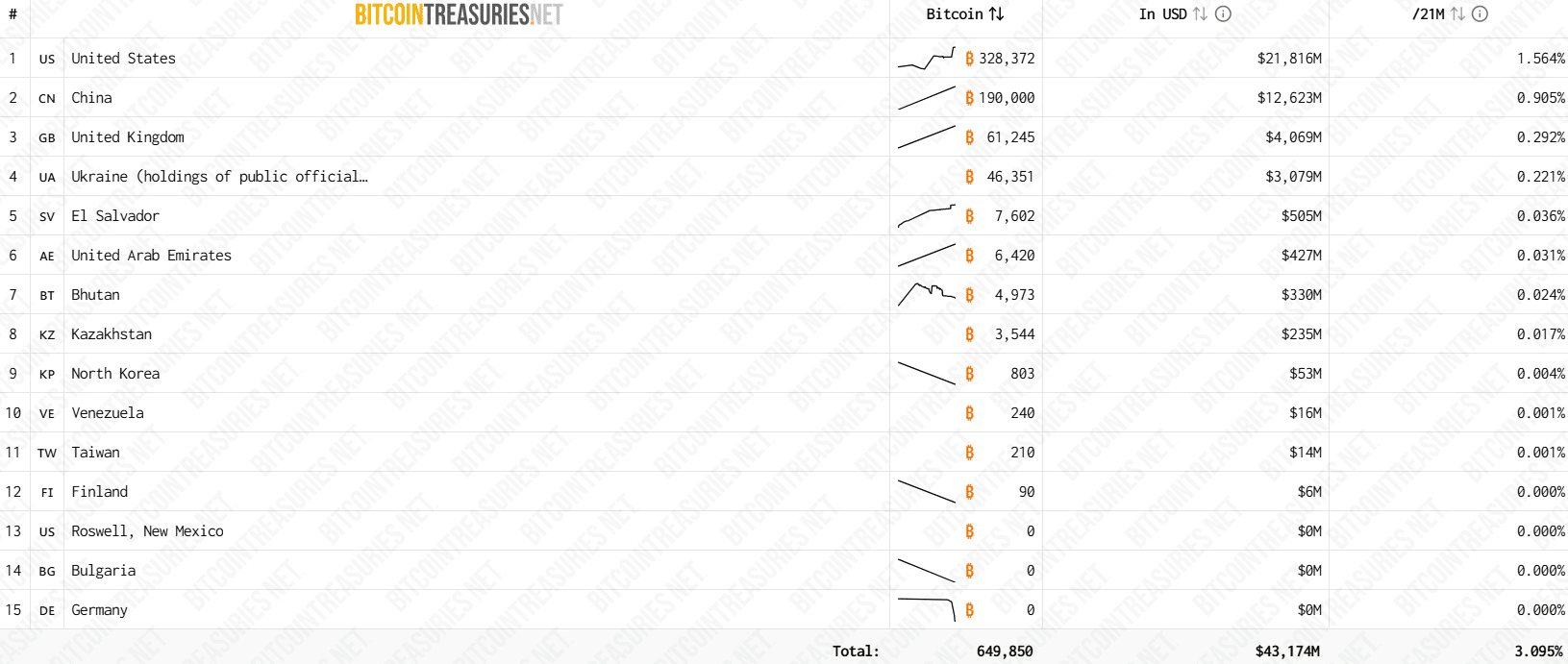
Despite recent Bitcoin sales, Druk Holdings, the investment arm of the Bhutanese government, still holds 4,329 BTC, worth more than $290 million. This keeps Bhutan among the world’s leading governments in terms of digital asset holdings.

Source: BitcoinTreasuries.NET

The US continues to dominate global government Bitcoin holdings, controlling over 328,000 BTC valued at $22 billion, a growth fueled by last October’s landmark seizure of 127,271 BTC.

The case involving the Prince Group, a Cambodian-based transnational criminal organization accused of large-scale investment scams and human trafficking, has sparked international controversy, with China claiming the Bitcoin stash originated from a 2020 theft of mining assets linked to its firms, including LuBian, which has ties to Iran.

Disclosure: This article was edited by Vivian Nguyen. For more information on how we create and review content, see our Editorial Policy.