BlackRock plans to launch a Bitcoin exchange-traded product in Europe following its US Bitcoin ETF success.
The company oversees $4.4 trillion in ETF assets globally and aims to expand its digital asset offerings in Europe.
Share this article
BlackRock is poised to expand its crypto product line with the launch of a Bitcoin ETP in Europe, capitalizing on the runaway success of its US-listed spot Bitcoin ETF, the iShares Bitcoin Trust (IBIT), according to a Wednesday report from Bloomberg, citing sources with knowledge of the matter who requested anonymity due to the confidential nature of the plans.
Projected to be based in Switzerland, the planned fund would be BlackRock’s first crypto ETP in the European market. The world’s leading asset manager, which previously focused on North America, launched the IBIT fund and subsequently introduced its iShares Bitcoin ETF on Cboe Canada. The new ETP may debut as soon as this month, sources said.
BlackRock’s IBIT has become one of the largest Bitcoin ETFs since its launch last January, accumulating approximately $58 billion worth of Bitcoin as of February 4. The fund ranks as the 31st largest ETF globally across all categories, including traditional finance products, according to VettaFi.
IBIT has led the spot Bitcoin ETF market with a five-day winning streak, attracting nearly $934 million in net inflows since January 30. Yesterday’s inflows alone totaled approximately $249 million, driving most of the spot Bitcoin ETF market’s gains, according to data from Farside Investors.
The European crypto ETP market currently features more than 160 products tracking various digital assets, though its size remains smaller than the US market. The expansion comes as Bitcoin has reached new highs this year, amid increased regulatory clarity following the EU’s implementation of new crypto rules.
High stakes, uncertain outcome
Bloomberg ETF analyst James Seyffart initially speculated that BlackRock might consider replicating its Canadian Bitcoin ETF structure in Europe using a “wrapper” approach, where the ETF holds shares of its US-listed IBIT. However, he swiftly confirmed that this strategy is unlikely to be allowed under EU regulations.
Sources told him that EU regulators are poised to reject such a workaround, likely requiring BlackRock to launch a standalone European Bitcoin ETF. This necessitates a different approach and puts the spotlight squarely on fees.
“I have been informed that this is unlikely to be allowed in EU.So will be interesting to see what they charge assuming they launch a standalone product. In the US the total cost is 25 bps. Canada is 32 bps,” he wrote on X. “There’s already products at 25 bps and lower in Europe including Valour who has a zero expense ratio product.”
Beyond regulatory hurdles and pricing pressures, BlackRock faces a more fundamental challenge: market size and investor appetite, Eric Balchunas, Seyffart’s fellow Bloomberg ETF analyst, shared in a comment.
The US spot Bitcoin ETF market, despite being just a year old, has exploded in popularity, capturing a staggering 91% of global market share. Europe, by contrast, lags considerably. While European investors are sophisticated, they have historically shown less enthusiasm for the high-octane investment products that have resonated with US investors.
Ethereum reached a record daily spot trading volume of $38 billion.
Eric Trump publicly expressed optimism about Ethereum’s investment potential.
Share this article
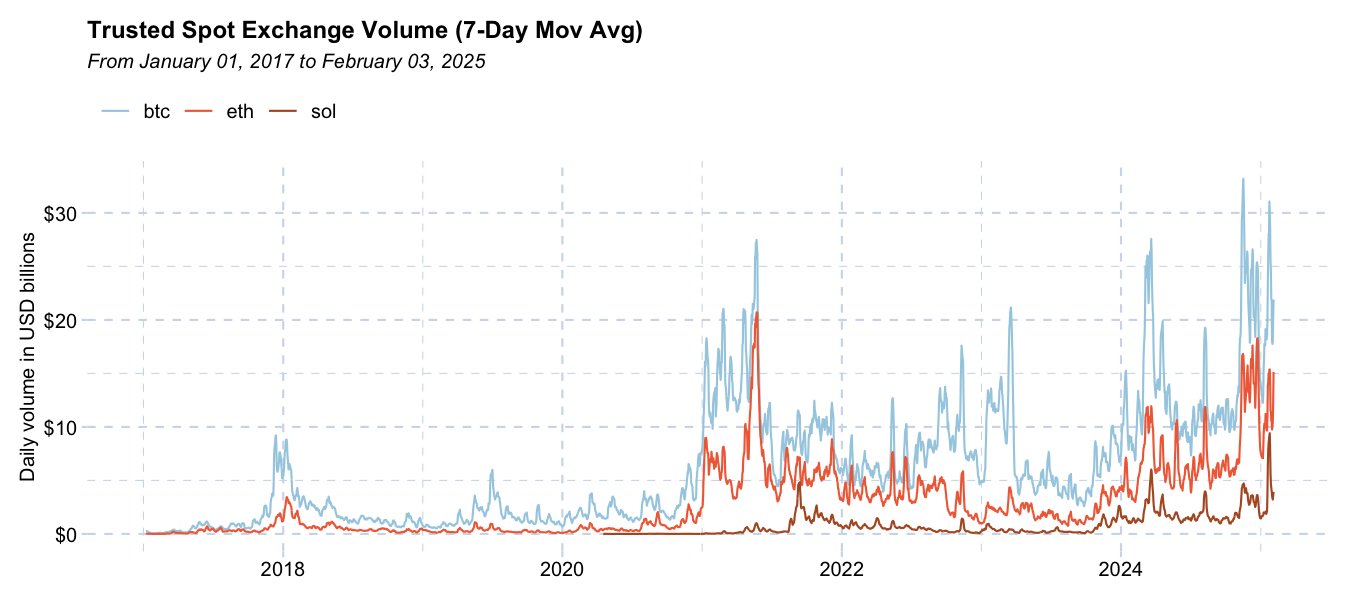
Ethereum reached a record $38 billion in daily spot trading volume, while Bitcoin logged its third-highest volume at $49 billion, according to David Lawant, Head of Research at FalconX.
Unsurprising but for the record:
ETH hits an all-time high spot volume of $38b yesterday, while BTC notches its third-highest at $49b pic.twitter.com/KiL8H9VPE6
The surge in trading activity coincided with a volatile price movement for Ethereum, which dropped to an intraday low of $2,152 before recovering to $2,919.
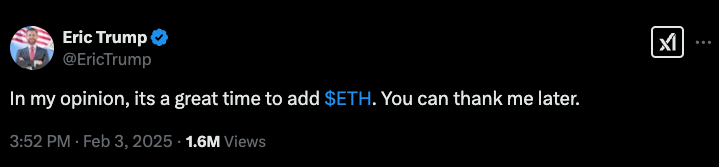
Eric Trump, son of the current US president, expressed optimism about Ethereum on social media, stating, “In my opinion, it’s a great time to add $ETH. You can thank me later.”
In this context, the volume spike for both leading crypto assets aligns with broader market dynamics.
While Ethereum set a new all-time high in spot trading volume, Bitcoin’s activity remained below its historical peak.
The chart, tracking trusted spot exchange volumes from 2017 to February 2025, highlights these movements.
Ethereum’s recent surge stands out as it surpasses its previous records, reflecting heightened interest from investors and traders.
Bitcoin’s volume, although substantial, stayed within familiar ranges, suggesting steady demand rather than a major breakout event.
This divergence emphasizes Ethereum’s growing role in the market as a focus of speculative activity during periods of increased volatility.
In November, Ethereum’s onchain volume soared to $7.1 billion amid a market uptick, the highest in 2024, fueled by significant ETF inflows and a US electoral outcome.
Yesterdays Eric Trump’s positive bull-post on Ethereum coincided with World Liberty Finance transferring significant ETH amounts to Coinbase.
Singularity Finance is reinforcing its position as the go-to blockchain for AI and real-world asset tokenisation through a new partnership with Functionland, a Web3 infrastructure provider operating under the Crestal brand. This collaboration marks the onboarding of Crestal into the SFI ecosystem, in alignment with SFI’s broader vision of integrating advanced AI technology with real-world assets (RWA) and decentralised finance (DeFi).
Integrating Web3 Infrastructure into the SFI Ecosystem
The SFI ecosystem is a collaborative framework designed to support projects building on SFI or offering services that enhance blockchain adoption. Functionland, operating under the Crestal brand, provides a Web3 infrastructure platform that simplifies the process of discovering, designing, and deploying blockchain solutions. As part of the partnership, Crestal will integrate with the SFI ecosystem, allowing developers to leverage its tools to build optimised blockchain architectures from scratch to mainnet deployment.
Strengthening Blockchain Development on SFI
The onboarding of Crestal into the SFI ecosystem aligns with the broader goal of fostering innovation and strategic expansion through direct integration and solution support. The modular “Lego platform” developed by Crestal enables developers to design blockchain applications with increased efficiency and flexibility. By working within the SFI framework, Crestal will contribute to the growth and accessibility of Web3 solutions within the ecosystem.
“Bringing Crestal into the SFI ecosystem is an important step in enhancing the infrastructure available to developers,” said Amaury Dalleur, Head of Incubation at Singularity Finance. “Their expertise in simplifying blockchain deployment aligns with SFI’s mission to provide seamless solutions for decentralised AI and RWA tokenisation. We are excited to collaborate on technology and to see the FULA token launch on the SFI mainnet as part of this partnership.”
Exploring Strategic Growth Opportunities
As an official ecosystem partner, Crestal and SFI will work together to explore mutual opportunities for strategic expansion. This includes potential integrations and collaborative efforts aimed at fostering innovation across Web3 development, AI, and decentralised finance. By leveraging SFI’s compliant RWA tokenisation framework and Crestal’s blockchain infrastructure, the partnership aims to create an environment that supports emerging blockchain applications.
“Singularity Finance provides the ideal ecosystem for Crestal’s blockchain infrastructure to thrive,” said Ehsan Shariati, Founder at Functionland. “We look forward to working together to simplify blockchain development and support the broader adoption of decentralised solutions.”
A Shared Vision for the Future of Web3
The partnership between SFI and Crestal reinforces a shared commitment to driving blockchain adoption through scalable and accessible technology. Both parties will continue exploring ways to support the Web3 community, providing the necessary tools and infrastructure to facilitate long-term growth within the ecosystem.
About Functionland
Functionland, operating under the Crestal brand, is a Web3 infrastructure provider that simplifies blockchain development. It provides a modular platform that enables developers to create, test, and deploy blockchain applications efficiently.
Singularity Finance is the first AI-centric EVM-compatible Layer 2 blockchain bringing the AI economy on-chain. It offers a fully compliant RWA tokenisation framework to tokenise and monetise the AI value chain in its entirety. Stemming from the SingularityNET ecosystem and closely tied to the Artificial Superintelligence Alliance, Singularity Finance is poised to become the financial chain for everything AI.
Bybit CEO estimates crypto liquidations could reach up to $10 billion.
API limitations can cause discrepancies in reported liquidation data.
Share this article
Bybit CEO Ben Zhou estimates total crypto liquidations across exchanges could reach between $8 billion and $10 billion. According to Zhou, his platform alone recorded $2.1 billion in liquidations in the last 24 hours, despite Coinglass data showing only $333 million.
In other words, real crypto liquidations across markets could be considerably higher than publicly reported figures. Bybit CEO explained that API limitations on data feeds were the reason behind the discrepancy between reported and actual liquidation figures.
“We have [API] limitations on how much feeds are pushed out per second. From my observation, other exchanges also practice the same to limit liquidation data,” Zhou said.
In response to these reporting gaps, Zhou added that Bybit would begin publishing comprehensive liquidation data.
“Moving forward, Bybit will start to PUSH all liquidation data. We believe in transparency,” he said.
The crypto market reacted sharply, and brutally following Trump’s tariff announcement on Saturday.
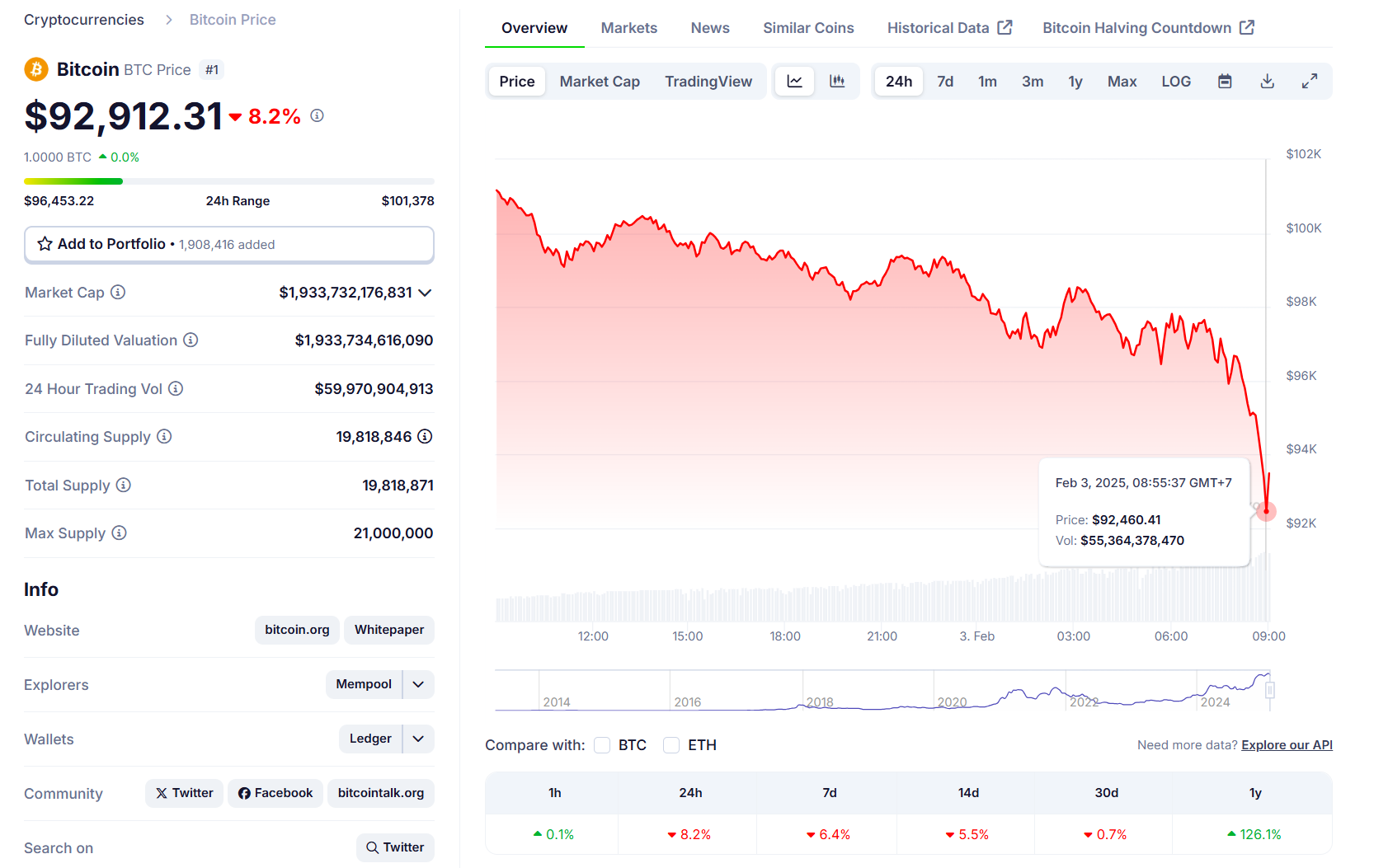
Bitcoin fell below $92,000 for the first time since January, while Ethereum and other altcoins recorded double-digit losses. Coinglass data showed over $2 billion in liquidations across crypto derivatives exchanges during the sell-off.
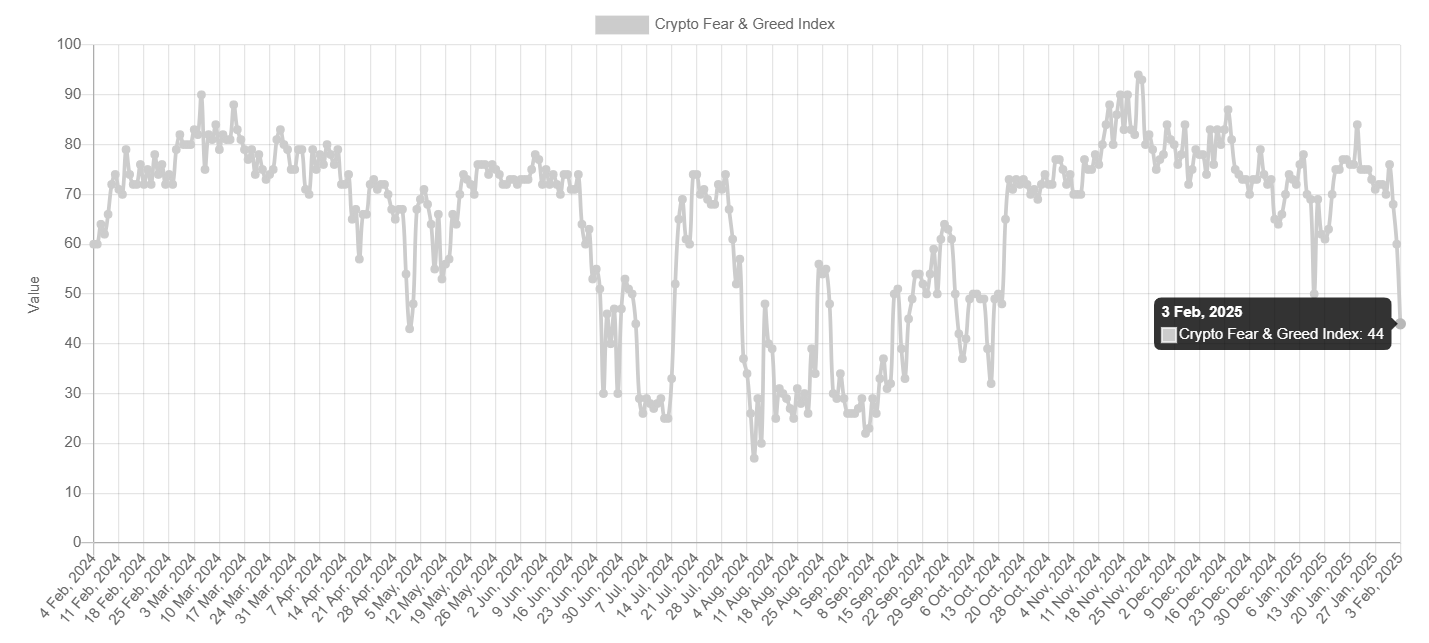
The Crypto Fear and Greed Index dropped from 60 to 44, entering the “fear” zone at its lowest level since October 11.
The President said he would implement a 25% tariff on imports from Canada and Mexico, as well as a 10% tariff on Chinese goods. The measures are scheduled to take effect tomorrow as part of efforts to address border security and combat drug trafficking.
Economists warn that Trump’s new tariffs could worsen inflation, which is still stubbornly below the Fed’s 2% target.
Last week, the central bank decided to leave interest rates unchanged at 4.25% and 4.50%. Fed Chair Jerome Powell indicated that future rate adjustments would be contingent on incoming data, labor market trends, and inflation developments.
Powell had previously indicated that the central bank would assess the impact of Trump’s economic policies to make future rate decisions. Jacob Channel, senior economist at LendingTree, told CBS News that potential changes in economic policies under Trump “might cause a resurgence in inflation or otherwise throw the economy off balance.”
Jeff Park from Bitwise Asset Management, however, suggests Trump’s new tariffs could increase Bitcoin demand as an inflation hedge.
Let’s dive into this to understand everything related to the best cryptocurrency wallets.
What are Crypto Wallets?
Same as our usual wallets that keep our money, IDs, & ATMs – crypto wallets are used to store cryptocurrencies, digital assets, etc. They are virtual wallets that can keep cryptos safe & secure. More advanced than usual wallets, many crypto wallets can also send, receive, and exchange cryptos.
In today’s cryptographic generation, there are so many crypto exchanges, and almost all of them have their own wallets. So, how would you know which one is best?
Let’s find out and know which are the best cryptocurrency wallets around. But before we proceed further, it’s crucial to understand what makes a crypto wallet best.
What Makes a Crypto Wallet Best?
Features: The number one point is its features. Features include what services the wallet offers. They must have the following:
Crypto Trade or Exchange Facility
Dashboard
Transaction History
Security : The Security has to be high.
Multiple Currency Support: The wallet must support multiple cryptocurrencies.
Smooth UI: The wallet must be simple & easy to use for the users.
Speed: The wallet has to be fast & light.
Mobile Apps & Web Version: The wallet must be available on all the platforms.
The wallet must have the above features to stand out. Below are some of the best crypto wallets:
Best Crypto Wallets
Funex Wallet
Funex mobile wallet allows a user to store, send, and receive cryptocurrencies and digital assets with lightning speed.
The Funex wallet app has the below features:
Fast & Secure Transactions at just 2-3 Taps
Easy to Use User Interface & Layout
Super Smooth Experience
High-End Security
Decentralized
Non-Custodial
Multiple Cryptocurrency Support
24*7 Support
Live charts & portfolio
Exodus Wallet
Exodus wallet is second in the list as it has the second-highest number of features and other attributes required to be qualified in this list of the top crypto wallets.
With Exodus wallet, a user can:
Exchange a Large Number of Cryptocurrencies
Hardware Security for Hardware Wallet
24*7 Support
Built-in Exchange
TRON Wallet
TRON has the common features that every other waller has, but it’s here in this list because of its simple UI. With TRON, users can receive, send, store, and exchange cryptocurrencies.
Instant Buy & Sell
Multi-Factor Authentication
Multi-Chain Support
Multisignature Feature
Afterthoughts
Clearly, the Funex wallet seems to be the best crypto wallet with the most advanced features & technological benefits. Funex also deals in its own exchange, coin, and gaming segments. It’s an entire world within just one word.
Crypto crash wiped out $2 billion in leverage liquidations in the last 24 hours.
Despite the recent decline, analysts suggest that a weaker dollar and lower US rates could create favorable conditions for Bitcoin adoption.
Share this article
Bitcoin’s fall to its lowest point since early January caused a massive wave of liquidations across crypto derivatives exchanges, totaling $2 billion. The brutal sell-off followed President Trump’s announcement of new tariffs that sparked inflation concerns, according to Coinglass data.
Trump on Saturday announced plans to impose a 25% tariff on imports from Canada and Mexico, along with a 10% tariff on Chinese goods. The measures, targeting America’s three largest trading partners, will take effect on Tuesday.
The President framed the tariffs as part of a broader strategy to address border security and combat the opioid crisis, particularly fentanyl trafficking.
Economists warn Trump’s new tariffs could increase consumer costs as businesses pass on additional expenses.
While the White House maintains these measures will strengthen American manufacturing, experts caution they could worsen inflation and potentially trigger a trade conflict affecting all nations involved, leading to job losses and supply chain disruptions.
The announcement of these tariffs has triggered volatility in the crypto market as investors reacted to fears of mounting inflationary pressures.
Bitcoin fell below $100,000 on Saturday and continued its decline to $92,000, while Ethereum dropped 24% to $2,300, according to CoinGecko data.
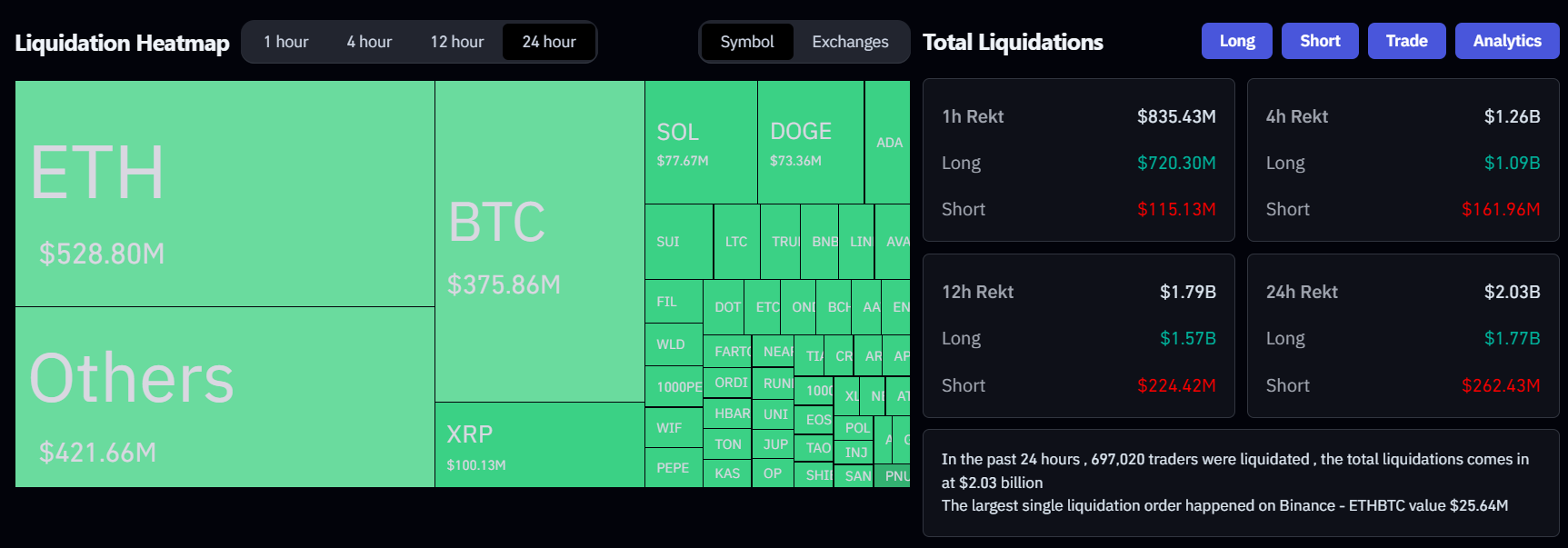
The market turbulence led to $1.7 billion in long position liquidations over 24 hours, with Ethereum traders experiencing $528 million in losses and Bitcoin traders facing $421 million in liquidations, Coinglass data shows.
The overall crypto market capitalization shrank by approximately 8%, with most crypto assets recording double-digit losses within a day. XRP and DOGE fell 30%, ADA declined 35%, while SOL and BNB each dropped 15%.
Trump’s tariffs will send Bitcoin prices higher, faster
Analysts believe that Trump’s new tariffs could lead to increased demand for Bitcoin as a hedge against inflation. Yet, many caution that ongoing market volatility may continue to pressure prices downward in the short term.
According to Jeff Park, head of alpha strategies at Bitwise Asset Management, Trump’s tariff policies could inadvertently set the stage for a Bitcoin boom.
This is the only thing you need to read about tariffs to understand Bitcoin for 2025. This is undoubtedly my highest conviction macro trade for the year: Plaza Accord 2.0 is coming.
Bookmark this and revisit as the financial war unravels sending Bitcoin violently higher. pic.twitter.com/WxMB36Yv8o
The implementation of new tariffs could weaken the dollar and create conditions favorable for Bitcoin’s growth, Park suggests. This comes as the US grapples with the Triffin Dilemma, where its role as the global reserve currency requires maintaining trade deficits to provide worldwide liquidity.
The tariffs are viewed as a strategic move to temporarily weaken the dollar, potentially leading to a multilateral agreement similar to “Plaza Accord 2.0” that could reduce dollar dominance and encourage countries to diversify their reserves beyond US Treasuries.
The analyst indicates that the combination of a weaker dollar and lower US rates could create favorable conditions for Bitcoin adoption. As tariffs push inflation higher, affecting both domestic consumers and international trade partners, foreign nations may face currency debasement, potentially driving their citizens toward Bitcoin as an alternative store of value.
Both sides of the trade imbalance will seek refuge in Bitcoin, driving its price “violently higher,” Park said.
Today, cryptocurrency is one of the most fascinating subjects on the internet. More and more people are getting associated with it one way or the other. Some are trading, some are buying, while some are just curious about it. Moreover, since many other things are associated with crypto – they come with it. People, however, have started understanding cryptocurrency, but the other things are yet to make their way into everyone’s heads.
These things are:
Cryptocurrency Wallets
Custodial & Non-Custodial Wallets
Blockchain Technology
NFTs
Crypto Trading
On that note, today, we will try to cover not all but some of them so that everyone can understand what they are. So, let’s get started.
What are Cryptocurrency Wallets?
Cryptocurrency wallets or crypto wallets are just like the regular wallets you use every day. The only difference is regular wallets are used to store real or fiat currency, while crypto wallets are used to store virtual or digital currency, precisely cryptocurrency. In more exact words, crypto wallets don’t actually store the crypto, but they do store that private key that lets you access the crypto. Now, you must be wondering how it works. So, let’s get this.
How Do Cryptocurrency Wallets Work?
The functions of crypto wallets are not just limited to storing cryptos, but they can also be used to send, receive, & trade cryptocurrencies. There are many types of these wallets depending upon the security and purpose parameters.
Provided by the crypto exchanges, crypto wallets come in many forms like hardware & software wallets. Hardware wallets look like Pendrive. The crypto process works like an account login process to conduct transactions. Like an account has two things – username & password. In the same way, the crypto process too has two things or say keys – a public key and a private key.
The public key is publicly available and visible to others. The private key is private, and it has to be kept a secret. To move your crypto from any wallet, you will need both keys. The function of a wallet is to store these keys safely.
The primary two types of crypto wallets are custodial wallets & non-custodial wallets. Let’s understand them one by one.
Custodial wallets mean a wallet having a custodian. A custodian is someone to takes care of or looks after something. Basically, like a guardian. So, custodial wallets are those wallets that are looked after by a third party and not you. You don’t really have complete ownership. You’re relying on an intermediary to help you make transactions, and they have access to your private key.
How custodial wallets function
Custodial wallets function differently from non-custodial wallets. In custodial wallets, a third-party service provider, such as a cryptocurrency exchange or a wallet platform, takes care of the management, storage, and security of your private keys and funds. Users should carefully assess their priorities, balancing convenience with security considerations, when choosing between custodial and non-custodial wallet options.
Advantages & Disadvantages of Custodial Wallets
Advantages of Custodial Wallets
User-friendly and Convenient: Custodial wallets are often designed to be user-friendly and accessible, particularly for individuals who are new to the world of cryptocurrencies. They typically offer simplified interfaces and easy-to-follow processes for managing and transacting with digital assets. This convenience can be especially appealing to those who may not be familiar with the technical aspects of managing private keys and seed phrases.
Robust Customer Support: Custodial wallet providers usually offer customer support services that users can turn to in case they encounter issues or have questions. This can be reassuring for individuals who are not as confident in troubleshooting technical problems on their own. The availability of customer support can help users resolve issues quickly and efficiently.
Additional Services and Features: Many custodial wallet platforms go beyond just storing and transacting cryptocurrencies. They often provide additional services and features, such as integrated exchange services, the ability to purchase cryptocurrencies using traditional payment methods (like credit cards), portfolio tracking, and more. This can make it convenient for users to manage various aspects of their cryptocurrency activities within a single platform.
Disadvantages of Custodial Wallets
Lack of Control Over Private Keys: One of the primary disadvantages of custodial wallets is that users do not have direct control over their private keys. This means that the wallet provider holds the keys on the user’s behalf, and users rely on the provider’s security measures to protect their assets. This lack of control goes against the fundamental principle of self-custody in the cryptocurrency space.
Centralization and Reliance on Third Parties: Custodial wallets introduce a level of centralization into the ownership and management of cryptocurrencies. Users must trust the custodial service provider to safeguard their funds and ensure reliable access to their wallets. This reliance on a single entity can lead to concerns about censorship, availability, and potential policy changes that might impact the user’s ability to access their assets.
Vulnerability to Hacking and Theft: Centralized custodial platforms can become attractive targets for hackers due to the potentially large sums of cryptocurrencies stored in one place. If the platform’s security measures are compromised, users’ funds could be at risk of theft. Numerous instances of exchange hacks and breaches in the past have resulted in substantial losses for users who stored their funds in custodial wallets.
Non-custodial wallets are just the opposite of custodial. They provide complete ownership, authority, & access to your private key. No one other than you can see your private key. And you are solely responsible for conducting all your transactions.
For a better understanding, let’s see the difference between custodial wallets & non-custodial wallets.
How non-custodial wallets function
When you create a non-custodial wallet, a pair of cryptographic keys is generated: a private key and a public key. With a non-custodial wallet, you have complete control over your private key and funds. It prioritize security by allowing you to manage your private key locally on your device. This reduces the risk of hacking and breaches that can occur on centralized platforms.
Advantages & Disadvantages of Non-Custodial Wallets
Advantages of Non-Custodial Wallets
User Control Over Private Keys: In non-custodial wallets, users have full control over their private keys, which are necessary to access and manage their cryptocurrency funds. This control ensures that users are not dependent on third parties for their funds’ security.
Enhanced Security and Privacy: Non-custodial wallets prioritize security by allowing private keys to be stored locally on the user’s device. This reduces the risk of large-scale hacks and breaches that can occur with centralized platforms. Additionally, user privacy is maintained because the wallet provider doesn’t have access to private key information.
Disadvantages of Non-Custodial Wallets
Higher Responsibility and Risk: While having control over private keys is empowering, it also places a higher level of responsibility on users. Losing access to private keys or mishandling the seed phrase can result in permanent loss of funds. Users must take proactive measures to secure and back up their keys.
Learning Curve for Beginners: Non-custodial wallets can be more technically complex for beginners. Learning about private keys, seed phrases, and the mechanics of blockchain transactions can be overwhelming for those new to cryptocurrencies.
Limited Customer Support: Non-custodial wallet providers might offer limited customer support compared to centralized platforms. Users might have to rely on community forums, online resources, or documentation to troubleshoot issues.
Key Differences Between Non-Custodial and Custodial Wallets
1. Control and Ownership
User Control Over Private Keys (Non-Custodial): In non-custodial wallets, users have complete control over their private keys, which gives them ownership and autonomy over their cryptocurrency funds.
Trust in Third-Party Service Providers (Custodial): Custodial wallets require users to trust the platform provider to manage and secure their private keys and funds. Users relinquish direct control in favor of the convenience provided by the service.
2. Security and Privacy
Decentralization and Trustlessness (Non-Custodial): Non-custodial wallets embody the principle of decentralization and trustlessness, as users control their private keys without relying on a single entity. This enhances security and reduces the risk of single points of failure.
Vulnerability to Hacks and Breaches (Custodial): Custodial wallets are potentially more vulnerable to hacking and breaches, as attackers might target centralized platforms that store large amounts of cryptocurrencies and user data.
3. User Experience and Convenience
Learning Curve and Technical Complexity (Non-Custodial): Non-custodial wallets can have a steeper learning curve due to the need to understand private keys, seed phrases, and blockchain mechanics. This might be challenging for beginners.
Accessibility and Additional Services (Custodial): Custodial wallets are often more user-friendly and accessible, catering to a broader audience. They might offer additional features like integrated exchanges, fiat-crypto conversion, and portfolio tracking.
4. Risk and Responsibility
User Accountability and Recovery Options (Non-Custodial): Non-custodial wallets require users to be accountable for their private keys and seed phrases. Loss of these critical components can lead to irreversible loss of funds. Users have the option to create secure backups to mitigate this risk.
Reliance on Customer Support and Backup Systems (Custodial): Custodial wallets offer recovery options if users lose access to their accounts, but they come with the caveat of relying on the platform’s support and procedures. This introduces a different kind of risk if the platform experiences issues.
Refer to the below table to see the advantages and disadvantages of custodial wallets versus non-custodial wallets.
Attributes
Custodial Wallet
Non-Custodial Wallet
Key Responsibility
Third Party
You
Authority
The Wallet Owner
You
Pricing
High
Cheaper
Security
Low
Higher
Support
Good
Not So-Good
KYC
Yes
Yes
Let’s talk about the benefits and drawbacks of both of these wallets.
The choice between a non-custodial and a custodial wallet depends on your priorities, familiarity with cryptocurrencies, and risk tolerance. Here are some considerations to help you decide:
Which should you choose?
Choose a Non-Custodial Wallet If:
Security and Control: You prioritize security and want full control over your private keys. Non-custodial wallets provide the highest level of control and security, as you’re not relying on a third party to safeguard your funds.
Trustlessness: You value the principle of trustlessness and decentralization that cryptocurrencies are built upon. You want to minimize reliance on intermediaries and prefer to interact directly with the blockchain.
Long-Term Hold: If you’re holding a significant amount of cryptocurrencies for the long term, non-custodial wallets may offer greater peace of mind against potential exchange hacks or platform failures.
Technical Proficiency: You are comfortable with the technical aspects of managing private keys, seed phrases, and conducting transactions on blockchain networks.
Choose a Custodial Wallet If:
User-Friendly Experience: You’re new to cryptocurrencies and prefer a more user-friendly and convenient experience. Custodial wallets often have intuitive interfaces suitable for beginners.
Convenience and Accessibility: You value convenience and ease of use. Custodial wallets often offer integrated exchange services, making it straightforward to buy, sell, and trade cryptocurrencies within the same platform.
Limited Responsibility: You want a wallet solution that requires less technical knowledge and responsibility for securing private keys. Custodial wallets handle security on your behalf.
Trading and Active Use: If you’re an active trader or frequently engage in transactions, custodial wallets might provide smoother and faster transaction experiences.
Conclusion
Crypto is a vast world and we are living in the crypto era. The peak is yet to come and so we should be ready for it. Even if you have nothing to do with crypto – we recommend you to have a bit if not all knowledge about it because you never know when you get to deal with it. Custodial & non-custodial wallets are just one kind – there are many other kinds of crypto wallets as well – about them, you can read here. Many exchanges and individual crypto ecosystems are offering their customised wallets with more advanced and user-beneficial features like the Funex wallet.
Your choice should align with your comfort level and goals. Many individuals use a combination of both types of wallets to take advantage of the strengths each offers. For larger amounts of cryptocurrencies, it’s generally recommended to use non-custodial wallets for long-term storage, while keeping smaller amounts on custodial wallets for day-to-day transactions. Always prioritize security by using reputable wallets and following best practices for backup and protection, regardless of the type you choose.
FAQs
Q1. Can I switch from a custodial to a non-custodial wallet or vice versa?
Yes, you can switch between custodial and non-custodial wallets. However, the process might involve transferring your funds from one wallet to another, and you need to be cautious about potential fees and the security of your funds during the transfer. If you’re switching from a custodial to a non-custodial wallet, you’ll need to generate a new non-custodial wallet and transfer your assets there. If you’re switching from a non-custodial to a custodial wallet, you’ll need to create an account with the custodial platform and deposit your funds.
Q2. Which type of wallet is recommended for beginners?
For beginners, custodial wallets often offer a more user-friendly experience due to their simplified interfaces and integrated services. They can help you get started with cryptocurrency transactions without the need to manage private keys and seed phrases. However, as you become more comfortable with cryptocurrencies and learn about security practices, you might consider transitioning to a non-custodial wallet for greater control and security.
Q3. Can I use both types of wallets simultaneously?
Yes, you can use both types of wallets simultaneously. Many people use a combination of custodial and non-custodial wallets to cater to different needs. For example, you might use a custodial wallet for frequent transactions and a non-custodial wallet for long-term storage of larger amounts.
Q4. How do I choose the right wallet for my specific needs?
Choosing the right wallet depends on your priorities and use cases. If you’re looking for short-term trading, long-term holding, or a mix of both. If security is a top concern and you’re willing to take on the responsibility of managing private keys, a non-custodial wallet might be suitable. Look for reputable wallet options in each category. Read reviews, check their security features, and verify their track record. Consider using a combination of both wallet types. Keep smaller amounts in a custodial wallet for convenience and active use, and larger amounts in a non-custodial wallet for enhanced security.