
Saturday, March 21, 2026
Home Blog Page 98

BlackRock moves $441 million in Bitcoin to Coinbase in the past hour

0


Key Takeaways

  • BlackRock moved 5,100 Bitcoin and 30,000 Ether to Coinbase Prime on Thursday.
  • IBIT has seen $741 million in outflows this week amid Bitcoin price volatility and strategic hedge fund actions.

Share this article

BlackRock moved 5,100 Bitcoin worth approximately $441 million and 30,000 Ether valued at about $71 million to Coinbase Prime within the last hour, as tracked by Arkham Intelligence.

The transfer follows BlackRock’s Tuesday movement of $160 million in Bitcoin and $44 million in Ethereum to Coinbase Prime, amid mounting pressure on BlackRock’s flagship Bitcoin ETF, the iShares Bitcoin Trust (IBIT).

IBIT has experienced negative performance for three consecutive days, with approximately $741 million in net outflows so far this week, based on Farside Investors data. US-listed spot Bitcoin ETFs recorded their largest single-day outflows of over $1 billion on Tuesday, with IBIT accounting for $164 million of the withdrawals.

Given the recent Bitcoin ETF sell-off, with IBIT posting negative performance for three consecutive days, the deposit raises concerns about further liquidations.

The latest transfers come as Bitcoin recovered slightly above $86,000 after dropping to $83,000 on Tuesday, its lowest level since November 2024.

BitMEX co-founder Arthur Hayes previously warned that hedge funds employing an arbitrage strategy—long IBIT and short CME futures for enhanced yield—pose a potential risk to Bitcoin’s price.

He cautioned that if the basis spread narrows during a Bitcoin decline, these funds might sell IBIT and buy back futures, potentially driving the price towards $70,000.

Share this article


Bitcoin ETFs suffer record $935 million net outflows as investors turn risk-averse

0


Key Takeaways

  • Bitcoin ETFs recorded a record $935 million net outflows amid a sell-off driven by macroeconomic concerns.
  • The crypto market’s downturn is fueled by investors’ risk aversion due to tariff threats and inflation concerns.

Share this article

US spot Bitcoin ETFs posted around $935 million in net outflows on Tuesday, extending their losses so far this week to approximately $1.5 billion.

The massive withdrawal continued during a sharp crypto market sell-off, with investors retreating from risk assets in dealing with growing macroeconomic concerns after President Trump’s tariff threats.

According to data combined from Farside Investors and Trader T, Fidelity’s FBTC led the exodus with around $344 million in outflows, followed by BlackRock’s IBIT with almost $162 million in redemptions.

Meanwhile, Bitwise’s BITB and Grayscale’s BTC each recorded over $85 million in net outflows.

Franklin Templeton’s EZBC lost $74 million, with Grayscale’s GBTC and Invesco’s BTCO declining by $66 million and $62 million respectively.

Competing funds managed by Valkyrie, WisdomTree, and VanEck also reported net outflows.

Intense outflows eclipsed the previous record set on Dec. 19, when the group of spot Bitcoin ETFs saw nearly $672 million in withdrawals after Bitcoin sank below $97,000.

The withdrawals surpassed the previous record of $672 million set on December 19, marking the sixth consecutive day of outflows for the ETF group, which saw $539 million withdrawn on Monday.

Bitcoin touched $86,000 today, its lowest level since November, and currently trades at $88,000, down 7% over the past week, per TradingView. The total crypto market cap has declined 3.5% over the past 24 hours.

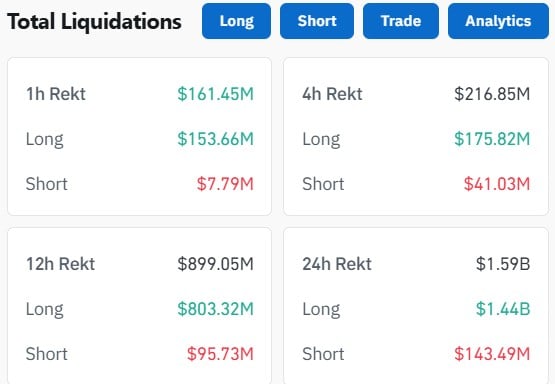
The steep decline across all assets triggered $1.6 billion in leveraged liquidations on Monday, Crypto Briefing reported.

Former BitMEX CEO Arthur Hayes warned of a potential market downturn as hedge funds unwind their basis trades involving Bitcoin ETFs.

“Lots of $IBIT holders are hedge funds that went long ETF short CME futures to earn a yield greater than where they fund, short term US treasuries,” Hayes said. He cautioned that if Bitcoin’s price falls, “these funds will sell $IBIT and buy back CME futures.”

The market turmoil follows President Trump’s reactivation of tariffs on goods from Mexico and Canada, which reignites inflation fears, pushing investors away from risk assets.

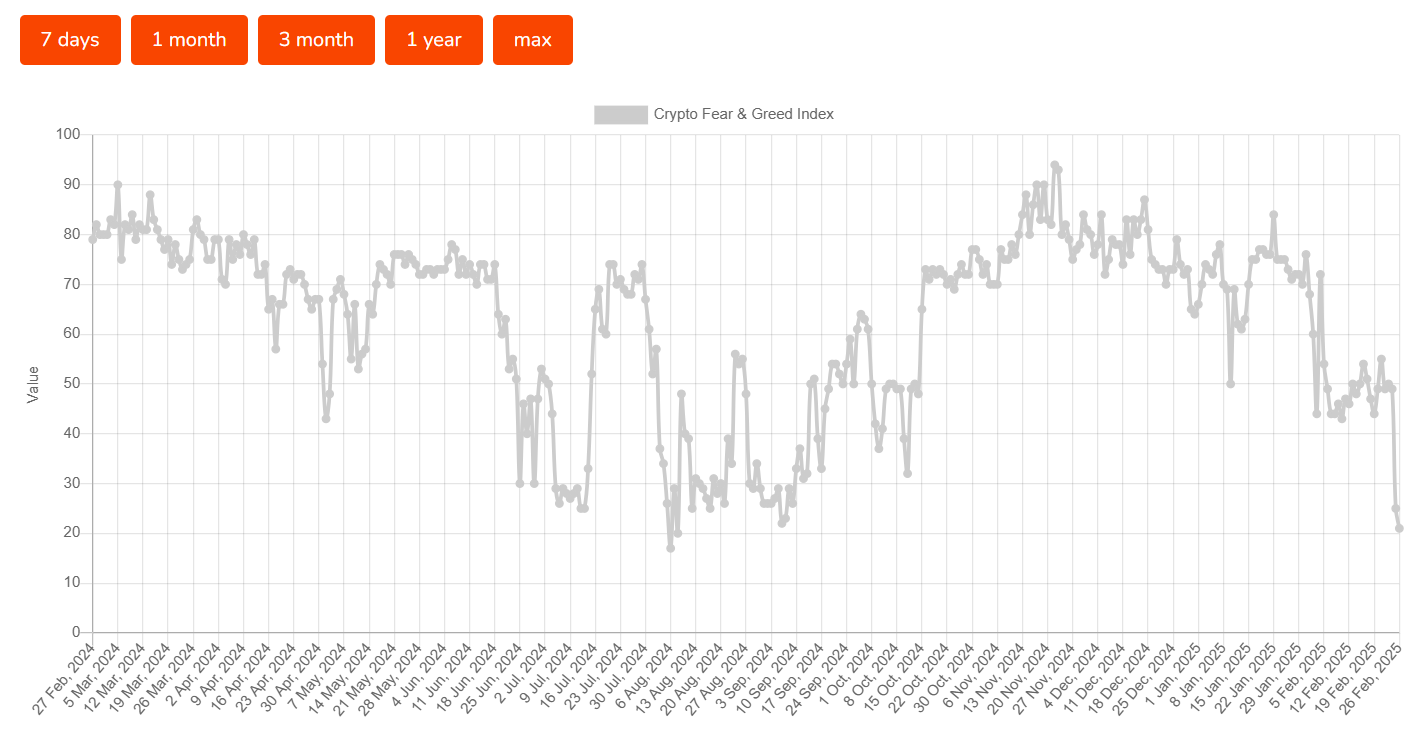
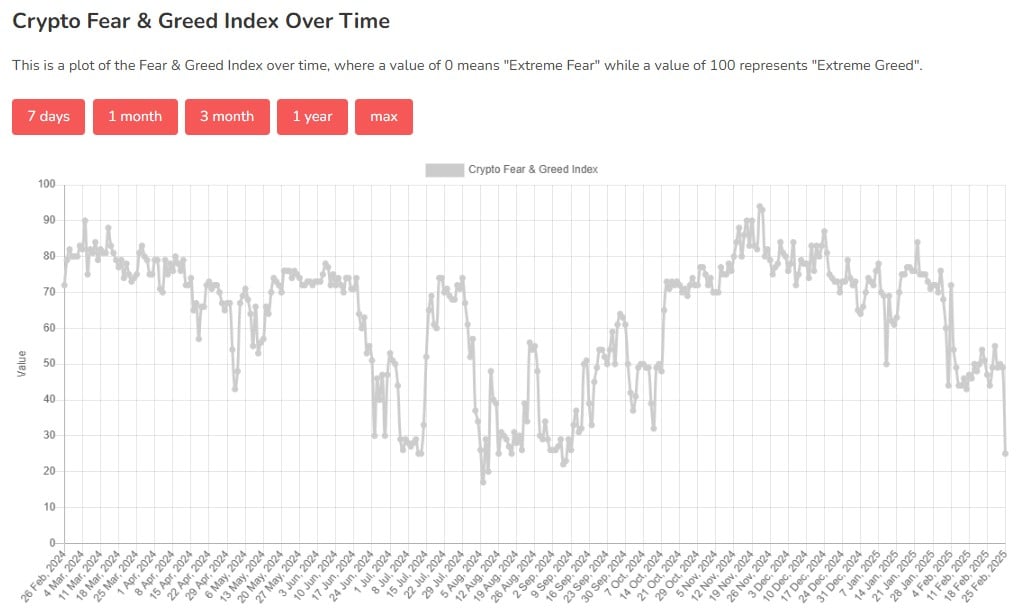
The Crypto Fear and Greed Index, a measure of crypto markets’ sentiment, has dropped from 25 to 21, remaining in the “extreme fear zone.”

Crypto Fear and Greed Index Drops to 21

Share this article


Bitcoin crashes to $86,000, triggers $1.6 billion liquidation in 24 hours

0


Key Takeaways

  • Over $1.6 billion in crypto was liquidated as Bitcoin fell below $86,000.
  • The Bitcoin ETF selloff of $500 million fueled widespread market liquidations.

Share this article

Bitcoin’s drop to $86,000 led to the liquidation of $1.6 billion in trading positions over the past 24 hours, according to Coinglass data.

The drop is attributed to President Donald Trump’s renewed tariff threats against Mexico and Canada and a significant selloff of Bitcoin ETFs.

A $500 million Bitcoin ETF selloff intensified the market downturn, leading to widespread liquidations across major digital assets. The price decline marks Bitcoin’s first drop below $86,000 since November.

The liquidation event affected between 286,534 and 367,789 traders, with long positions bearing the majority of losses ranging from $144 million to $1.4 billion.

Bitcoin, Ethereum, and XRP were among the most impacted digital assets.

This event follows a larger liquidation on February 3, 2025, when over $2.2 billion in leveraged positions were wiped out, affecting approximately 729,073 traders.

During that event, Ethereum traders experienced over $600 million in losses, while Bitcoin traders faced $409 million in liquidations.

Trump’s latest statements on trade policy, which revived discussions from his February 3 announcement, have heightened concerns about economic disruptions.

The combination of trade policy uncertainty and institutional investor outflows has contributed to increased volatility across crypto markets.

Share this article


BlackRock’s $200M Coinbase deposit raises concerns over further liquidations

0


Key Takeaways

  • BlackRock transferred 18,168 ETH and 1,800 Bitcoin to Coinbase amid market uncertainty.
  • Crypto markets faced $1.6 billion in liquidations, influenced by geopolitical tensions and institutional selling.

Share this article

Today, BlackRock transferred 18,168 Ethereum ($44 million) and 1,800 Bitcoin ($160 million) to Coinbase amid growing market uncertainty and widespread liquidations in crypto markets.

The deposit comes as Bitcoin fell below $86,000 for the first time since November, while crypto markets experienced $1.6 billion in liquidations over the past 24 hours.

Large entities moving significant amounts of crypto to exchanges are often seen as a signal that they may be preparing to sell.

This trend can lead to further price drops, as other investors may interpret such moves as a sign of weakening confidence or an impending decline.

Market pressure intensified following a $500 million Bitcoin ETF sell-off, coupled with renewed tariff threats from President Donald Trump.

The Crypto Fear and Greed Index dropped to 25, indicating extreme fear and marking its lowest level since September 2024.

Share this article


Crypto market faces $950 million in leveraged liquidations as Trump’s tariff threats reintroduce inflation concerns

0


Key Takeaways

  • The announcement of new tariffs by Trump caused nearly $900 million in leveraged liquidations in the crypto market.
  • Bitcoin and Ethereum prices dropped significantly, triggering major losses among traders.

Share this article

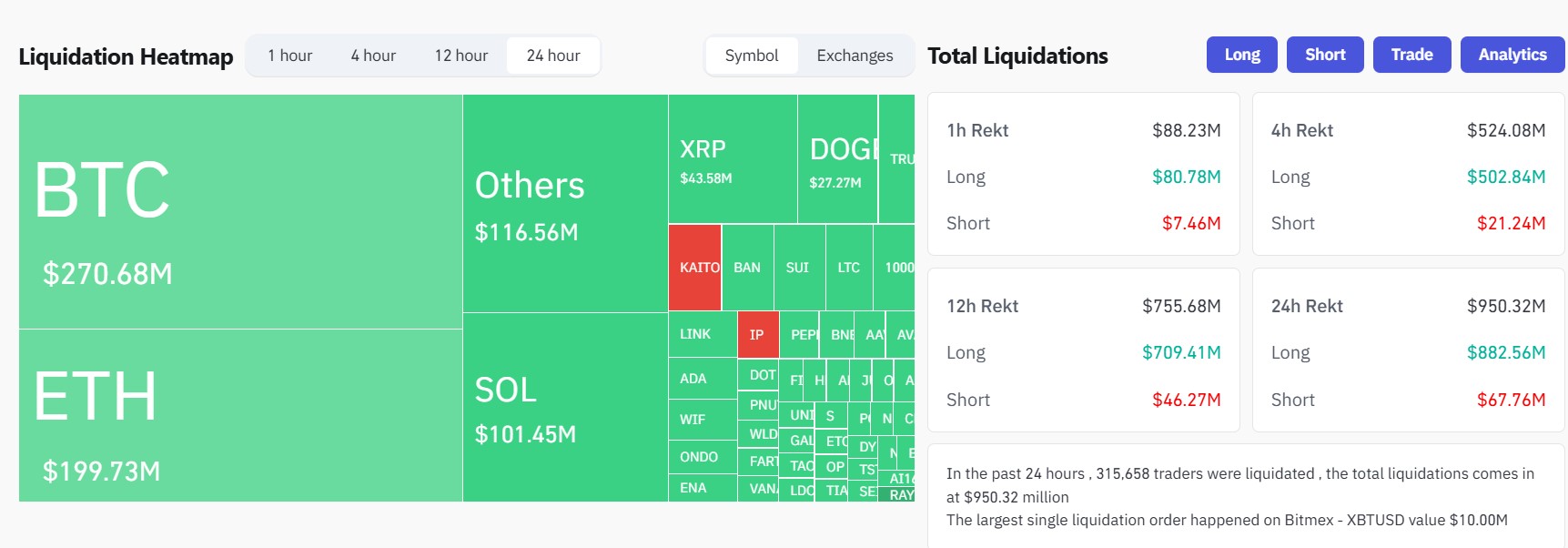
Bitcoin’s slide to a multi-week low sparked a $950 million liquidation wave on crypto exchanges. The sell-off followed President Trump’s statement indicating reactivated Canada and Mexico tariffs, ending a month-long pause and, again, raising inflation concerns.

Trump said Monday that tariffs on imports from Canada and Mexico will be implemented next month, ending a monthlong suspension of planned import taxes.

The 25% tariff on Canadian and Mexican goods will begin in early March 2025, affecting over $900 billion worth of US imports including automobiles, auto parts, and agricultural products.

“We’re on time with the tariffs, and it seems like that’s moving along very rapidly,” Trump said at a White House news conference with French President Emmanuel Macron. “The tariffs are going forward on time, on schedule.”

Trump has maintained that other countries impose unfair import taxes that harm domestic manufacturing and jobs. While he claims the tariffs would generate revenue to reduce the federal budget deficit and create new jobs, his threats have raised concerns among businesses and consumers about a potential economic slowdown and accelerating inflation.

The tariff announcement immediately triggered crypto market volatility.

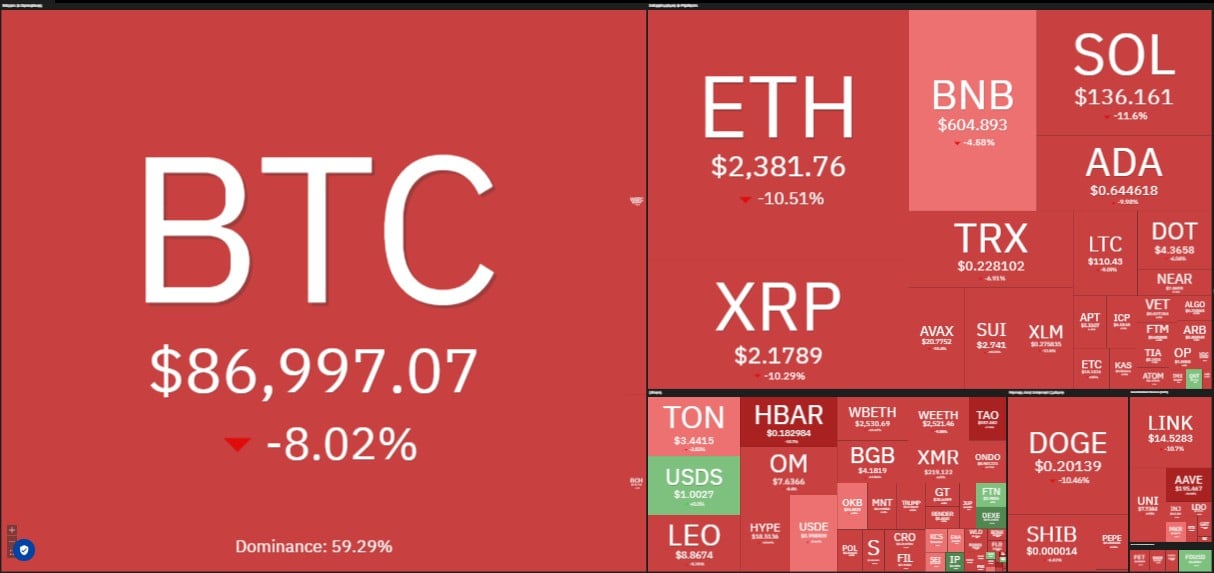
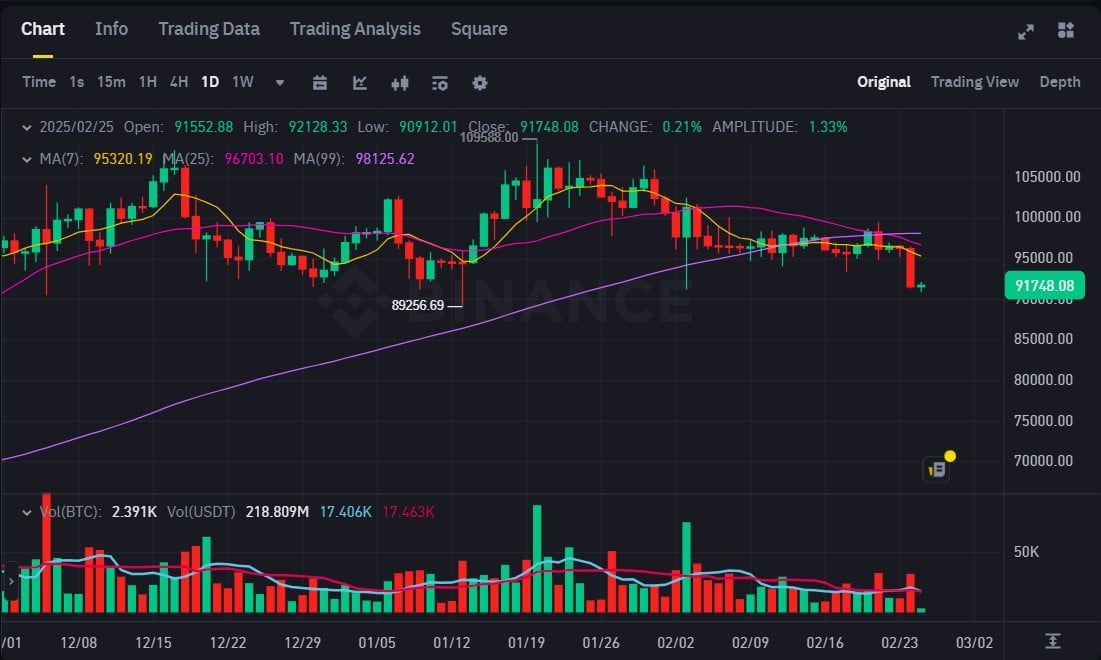
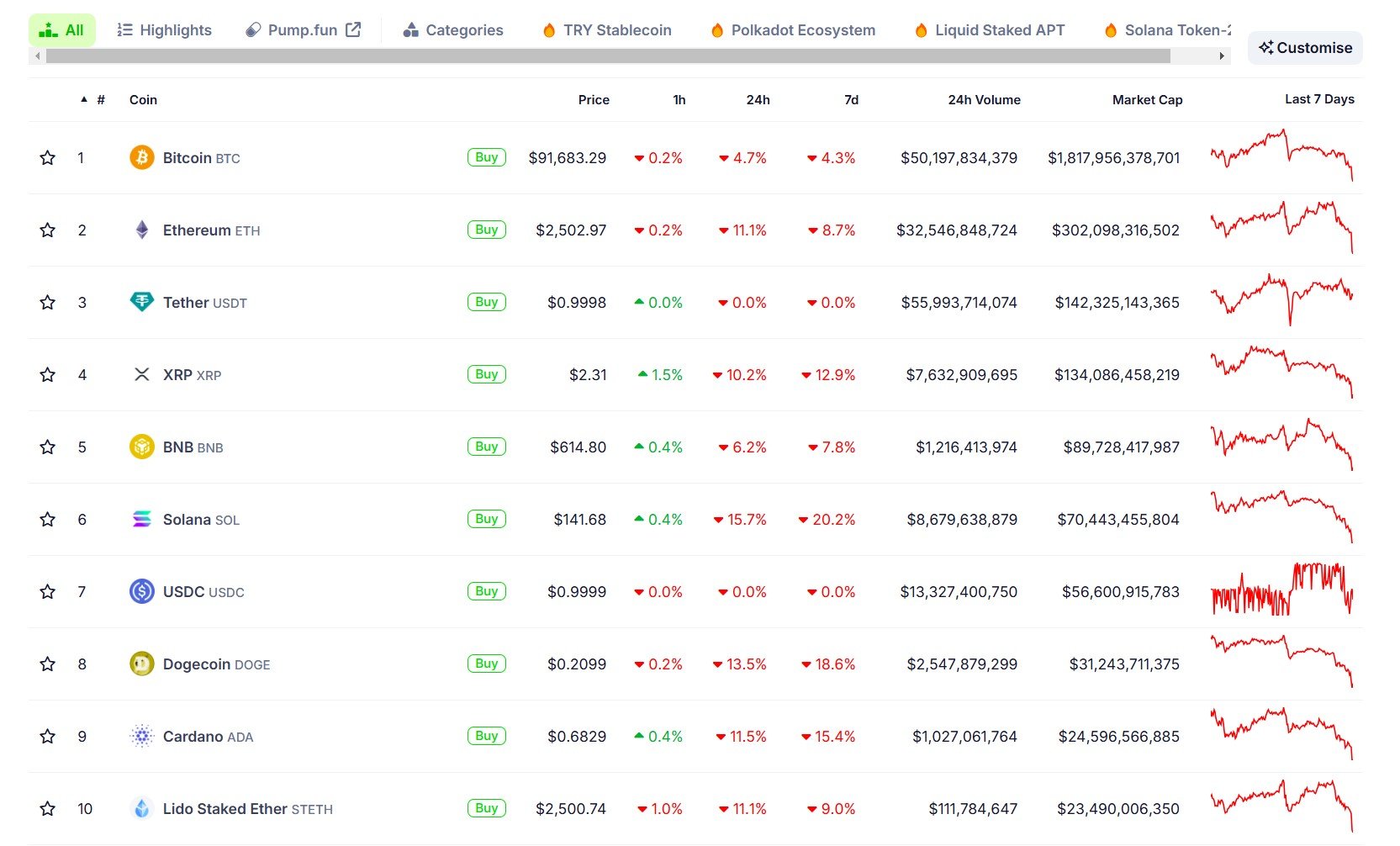
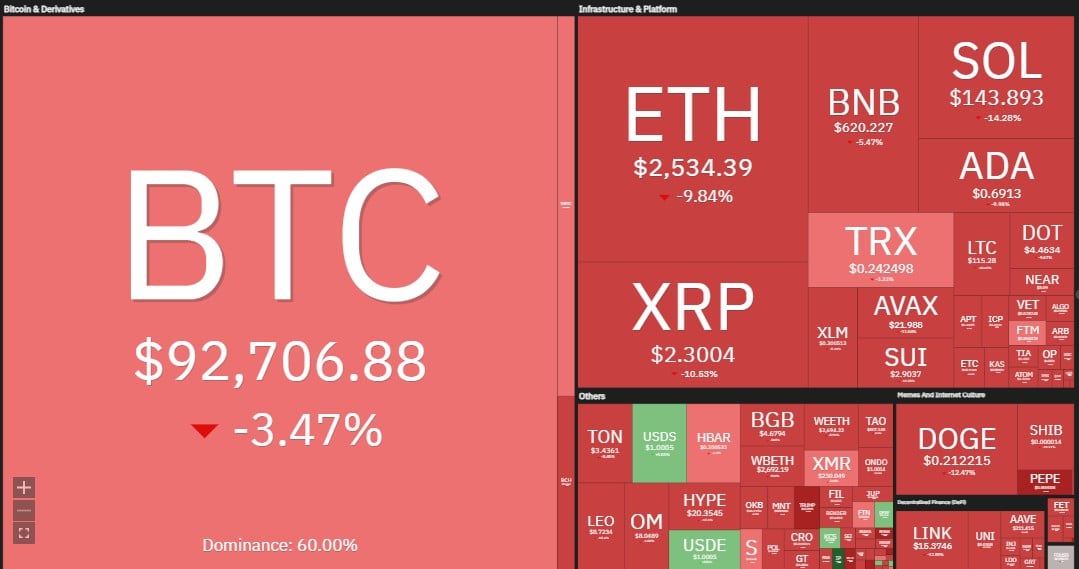
The price of Bitcoin fell below $95,000 and continued sliding to around $91,000, while Ethereum dropped 11% to $2,500, according to CoinGecko data.

The broader crypto market saw widespread losses, with the total market capitalization declining by approximately 8%.

The market turmoil resulted in $880 million in long position liquidations over 24 hours. Ethereum traders suffered $255 million in losses, while Bitcoin traders experienced $185 million in liquidations, according to Coinglass data.

Most altcoins posted double-digit losses. XRP fell 10%, while SOL dropped almost 16%. DOGE declined 13%, and ADA fell 11%. BNB decreased by around 6% in the last 24 hours.

Bitcoin reserve bills fail in multiple US states

Elsewhere, the push for states to hold Bitcoin as part of their reserves has hit a wall. Bitcoin reserve bills have been defeated in Montana, North Dakota, Wyoming, and South Dakota.

Montana’s House Bill 429, which sought to allocate up to $50 million to Bitcoin, precious metals, and stablecoins, was defeated in a decisive 41-59 vote.

North Dakota’s HB 1184, designed specifically for a Bitcoin reserve, met a similar fate, falling short with a 57-32 rejection.

Wyoming lawmakers also rejected HB 0201, which would have empowered the state treasurer to invest public funds in Bitcoin, by a 7-2 margin.

In South Dakota, HB 1202, proposing a 10% Bitcoin allocation, was effectively stalled when legislators employed a procedural maneuver to delay the vote beyond the session’s deadline.

Share this article


Sam Bankman-Fried returns to Twitter after two-year silence, giving HR and corporate management advice

0


Key Takeaways

  • Bankman-Fried’s unexpected return to X, after a two-year hiatus, focused on layoffs and corporate challenges.
  • He emphasized that terminations are often not the employee’s fault but sometimes necessary for business needs.

Share this article

Sam Bankman-Fried, the disgraced former CEO of FTX, has ended his two-year silence on X with a series of posts discussing employee terminations and corporate management challenges. The tweets, which came out on Monday evening, have sparked widespread discussion and speculation among members of the crypto community.

Bankman-Fried opened his thread with a reference to his current situation, writing “I have a lot of sympathy for gov’t employees: I, too, have not checked my email for the past few (hundred) days,” adding that “being unemployed is a lot less relaxing than it looks.”

Bankman-Fried went on to argue that often, the root cause of layoffs is a mismatch between the employee’s skills and the company’s needs. The former CEO of FTX detailed several potential scenarios, including a lack of managerial support, incompatible work styles, and misaligned project interests.

” More often, the problem is that the company just doesn’t have the right job for them,” Bankman-Fried stated.

“Maybe we just didn’t really have anyone free to manage them right then. Maybe they worked best remotely, but our company communicated in-person,” he wrote.

He also pointed to departmental issues and the problem of over-hiring, citing examples of competitors who hired excessively and then struggled to manage their workforce.

“This happens, now and then. We saw it at competitors that hired 30,000 too many employees and then had no idea what to do with them—so entire teams just sat around doing nothing all day,” he stated, without naming specific companies. “And we saw it internally, when a manager would get busy or distracted, and half of a department would lose its bearing at the same time.”

“It isn’t the employee’s fault, when that happens. It isn’t their fault if their employer doesn’t really know what to do with them, or doesn’t really have anyone to effectively manage them. It isn’t their fault if internal politics lead their department to lose its way,” he added.

“But there’s no point in keeping them around, doing nothing,” Bankman-Fried concluded.

Bankman-Fried’s sudden reappearance on X has raised questions about how he is managing his account at the Brooklyn Metropolitan Detention Center, where he is serving a 25-year sentence for orchestrating a major crypto scam.

Bankman-Fried recently expressed hope for a presidential pardon in his first interview from jail. He also criticized the Biden administration and portrayed his conviction as part of a “prosecutorial overreach” during Biden’s presidency. Bankman-Fried’s parents are reportedly exploring ways to secure a pardon for their son, including talking to lawyers and individuals with connections to Trump.

Share this article


Bitcoin drops to three-week low as Trump reignites tariffs on Canada and Mexico

0


Key Takeaways

  • Bitcoin price is down 3.9% due to new tariffs from President Trump.
  • The crypto market experienced a $110 billion loss today.

Share this article

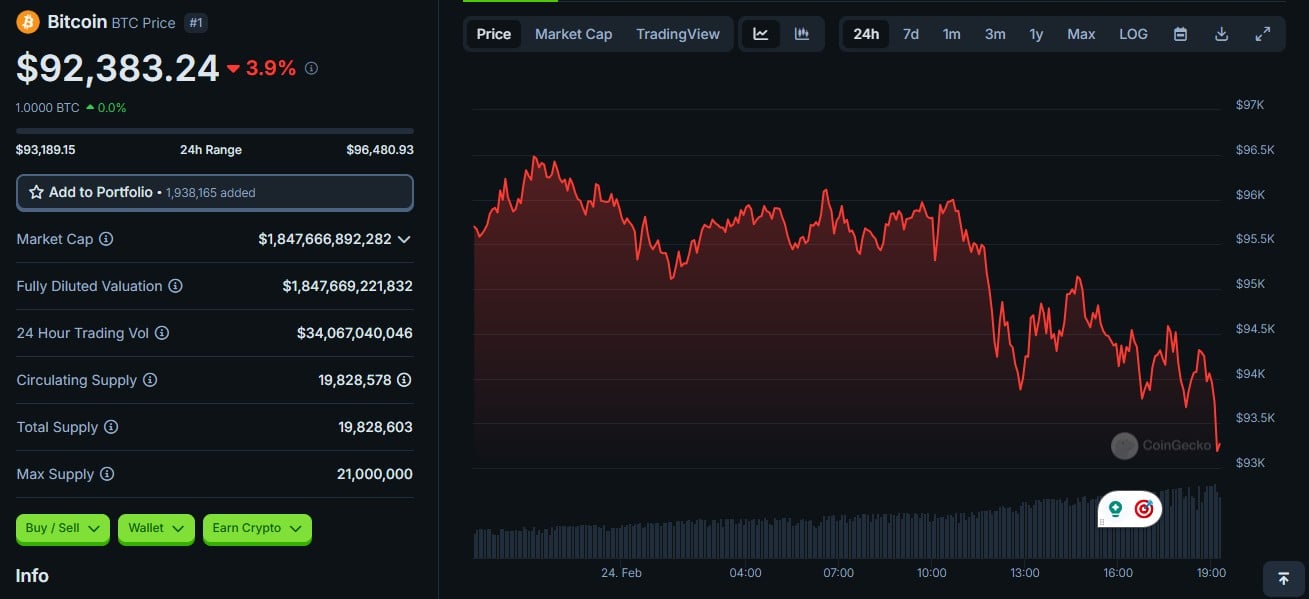
Bitcoin fell 3.9% today to a three-week low after President Trump announced new tariffs on imports from Canada and Mexico, deepening a broader crypto market selloff that erased more than $110 billion in value.

The largest digital asset traded around $92,400, its lowest level since February 2, with the decline accelerating after Trump confirmed tariffs on Mexican and Canadian imports “are going forward.”

Trump signed executive orders on February 1 imposing a 25% tariff on all products imported from Canada and Mexico, with a lower 10% rate on Canadian energy resources.

The administration cited a “national emergency” related to illegal immigration and drug trafficking, including fentanyl, as justification for the measures. The tariffs are scheduled to start to apply on March 4, 2025.

The market-wide downturn affected major crypto assets, with Solana dropping 14%, XRP falling around 10%, and Ethereum declining nearly 10%. BNB saw a more ‘modest’ decrease of 5.5%.

The $110 billion in market-wide liquidations represents one of the largest dollar-volume declines in crypto market history.

Share this article