Sunday, March 22, 2026
Home Blog Page 96

Coinbase files to launch Cardano, Natural Gas futures contracts

0


Key Takeaways

  • Coinbase is introducing futures contracts for Cardano and Natural Gas, pending CFTC approval.
  • Cardano futures allow traders exposure to price movements without holding the asset.

Share this article

Coinbase is seeking regulatory approval to launch Cardano (ADA) and Natural Gas (NGS) futures contracts—a move that would expand its offerings in the energy and crypto derivatives markets.

Coinbase Derivatives, Coinbase’s futures exchange, said Friday it had submitted documentation to the CFTC to self-certify futures for ADA and NGS.

Self-certification with the CFTC allows Coinbase to assert regulatory compliance with futures contracts, expediting their launch unless the CFTC raises objections. If approved, these new futures contracts are expected to go live on March 31.

The move follows Coinbase’s recent introduction of Solana (SOL) and Hedera (HBAR) futures contracts, and is part of the firm’s ongoing strategy to provide traders access to both crypto and traditional futures trading on a single regulated platform.

Cardano is one of the most prominent blockchain platforms, known for its focus on scalability, sustainability, and security. With a dedicated ecosystem and increasing adoption of DeFi, NFTs, and enterprise blockchain solutions, Cardano is a natural addition to Coinbase’s futures lineup.

The ADA futures would allow traders to gain exposure to Cardano’s price movements without holding the underlying asset, enabling advanced risk management and leveraged trading strategies.

Following Coinbase’s announcement, ADA surged around 2% to $0.75, per CoinGecko.

The Natural Gas futures offering would position Coinbase to compete with traditional futures exchanges in the energy sector, where the commodity plays a crucial role in global markets and economic stability.

The SEC has been cautious about approving crypto ETFs, but the launch of futures contracts may help alleviate some concerns by providing a regulated framework for price discovery and risk management. This could make the SEC more inclined to approve ETFs, especially if futures trading demonstrates market stability.

Grayscale Investments is the only manager that has filed for a spot Cardano ETF. This filing was submitted through NYSE Arca, which proposed to list and trade shares of the Grayscale Cardano Trust on the exchange.

On Tuesday, the SEC postponed its decision regarding the proposed Grayscale’s spot ADA ETF and also extended the review period for other crypto ETFs.

Share this article


Rising stablecoin supply signals crypto’s bull run isn’t over yet

0


Key Takeaways

  • Historical patterns show crypto cycle peak is not yet here.
  • Stablecoins increasingly serve as a bridge between fiat currencies and crypto markets, comprising the majority of crypto trading pairs.

Share this article

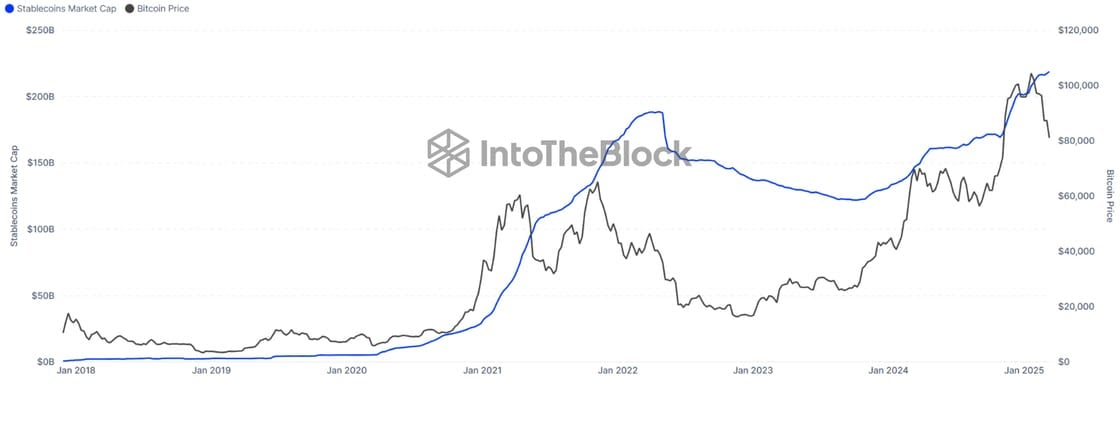
The total supply of stablecoin has reached $219 billion and continues to climb, suggesting the crypto bull run is still far from over, IntoTheBlock said in a Friday statement.

Stablecoin growth indicates the crypto bull cycle is still in mid-run

According to the crypto analytics firm, historical data shows stablecoin supply typically peaks during market cycle highs, with the previous peak of $187 billion recorded in April 2022 just before the market started declining.

Since stablecoin supply is now higher than ever and increasing, this suggests the market has not yet peaked and is still in a growth phase.

After a drop below $77,000 earlier this week, Bitcoin climbed above $85,000 on Friday morning, TradingView data shows. At press time, Bitcoin was trading at around $84,700, up 4.5% in the last 24 hours.

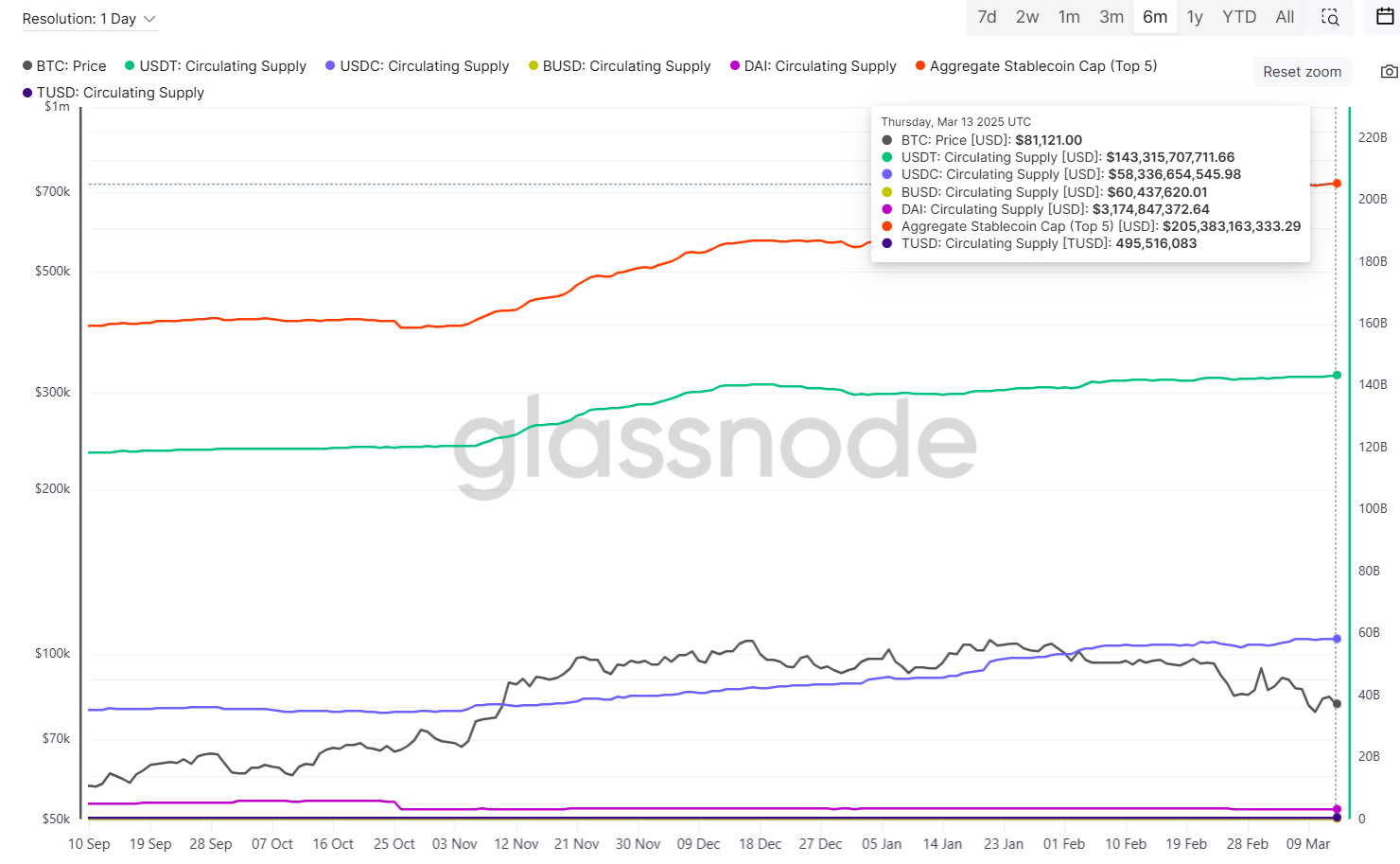
The recent resurgence of Bitcoin coincides with a rise in the market capitalization of major stablecoins, including USDT, USDC, BUSD, and DAI. Their combined market cap increased from around $204 billion to over $205 billion between March 10 and 14, according to Glassnode data.

Stablecoins serve as a bridge between fiat currencies and crypto markets, comprising the majority of crypto trading pairs and market liquidity. The rising market cap indicates higher stablecoin adoption and their growing role as a preferred medium for crypto transactions.

The increase in supply likely reflects a market-wide movement of assets into stablecoins in preparation for trading, suggesting anticipated market activity in the coming weeks.

The aggregate market cap of five leading stablecoins has increased over 28% since November 5, 2024, US Election Day.

Share this article


White House reveals David Sacks sold $200M in Bitcoin, Ether, and other crypto holdings before new role

0


Key Takeaways

  • David Sacks sold over $200 million in digital assets including Bitcoin and Ethereum before his White House role.
  • Sacks maintains limited exposure to the crypto industry through Craft Ventures’ venture capital funds.

Share this article

The White House disclosed that David Sacks, Trump’s AI and crypto czar, and his venture firm Craft Ventures divested over $200 million in crypto assets and related holdings before taking on his new role. At least 85% was personally attributed to Sacks.

The revelation came in a memorandum dated March 5, granting Sacks a limited ethics waiver to participate in digital asset policy matters.

“Altogether, you and Craft Ventures have divested over $200 million of positions related to the digital asset industry, of which at least $85 million is directly attributable to you,” the memo states.

Sacks indeed disclosed this information when joining The All-In Podcast last week. The White House crypto tsar faced numerous allegations that he exploited his position for personal gain in crypto.

“We cleared that before day one, paid taxes on it, and basically said there wouldn’t be a conflict,” he said, dismissing allegations of using his government position to benefit personally from crypto market movements.

The divestments, completed before the start of the President’s second term on January 20, 2025, included liquid crypto assets such as Bitcoin, Ethereum, and Solana, as well as positions in the Bitwise 10 Crypto Index Fund. Sacks also sold his directly held stock in public companies Coinbase and Robinhood, along with shares in private digital asset companies.

Sacks liquidated his limited partner interests in crypto-focused investment funds, including Multicoin Capital and Blockchain Capital. His firm, Craft Ventures, also sold its stakes in Multicoin Capital and Bitwise Asset Management.

The tech investor still maintains some exposure to the digital asset industry through venture capital funds managed by Craft Ventures, where he serves as both a general and limited partner. These remaining holdings include stakes in BitGo and Lightning Labs representing less than 2.5% and 1.2% of his total investment assets, respectively.

As a special government employee, Sacks was not eligible for tax relief typically available through certificates of divestiture. He also began selling interests in approximately 90 venture capital funds, including Sequoia, which may hold minor digital asset positions.

The White House granted Sacks a limited ethics waiver to participate in digital asset policy matters, despite his retaining minor holdings in private crypto companies through Craft Ventures.

Sacks has agreed not to acquire new digital asset holdings during his tenure, which is limited to 130 days or fewer annually as a special government employee.

Share this article


Bitcoin soars above $84,000 as US inflation cools in February

0


Key Takeaways

  • US inflation in February showed a decrease, with annual CPI dropping to 2.8% from the previous 3%.
  • Economists warn that Trump’s tariffs could reverse the cooling inflation trend and lead to further price hikes.

Share this article

Consumer prices rose 0.2% in February from January, according to fresh CPI data released Wednesday, bringing annual inflation to 2.8%—a decline from 3% in the previous month. Bitcoin spiked above $84,000 in response to the lower-than-expected data.

Core CPI, which excludes volatile food and energy prices, increased 0.2% month-over-month, with the annual rate settling at 3.1%, below January’s 3.3%.

However, economists warn that President Trump’s tariff policies could keep prices elevated in the months ahead.

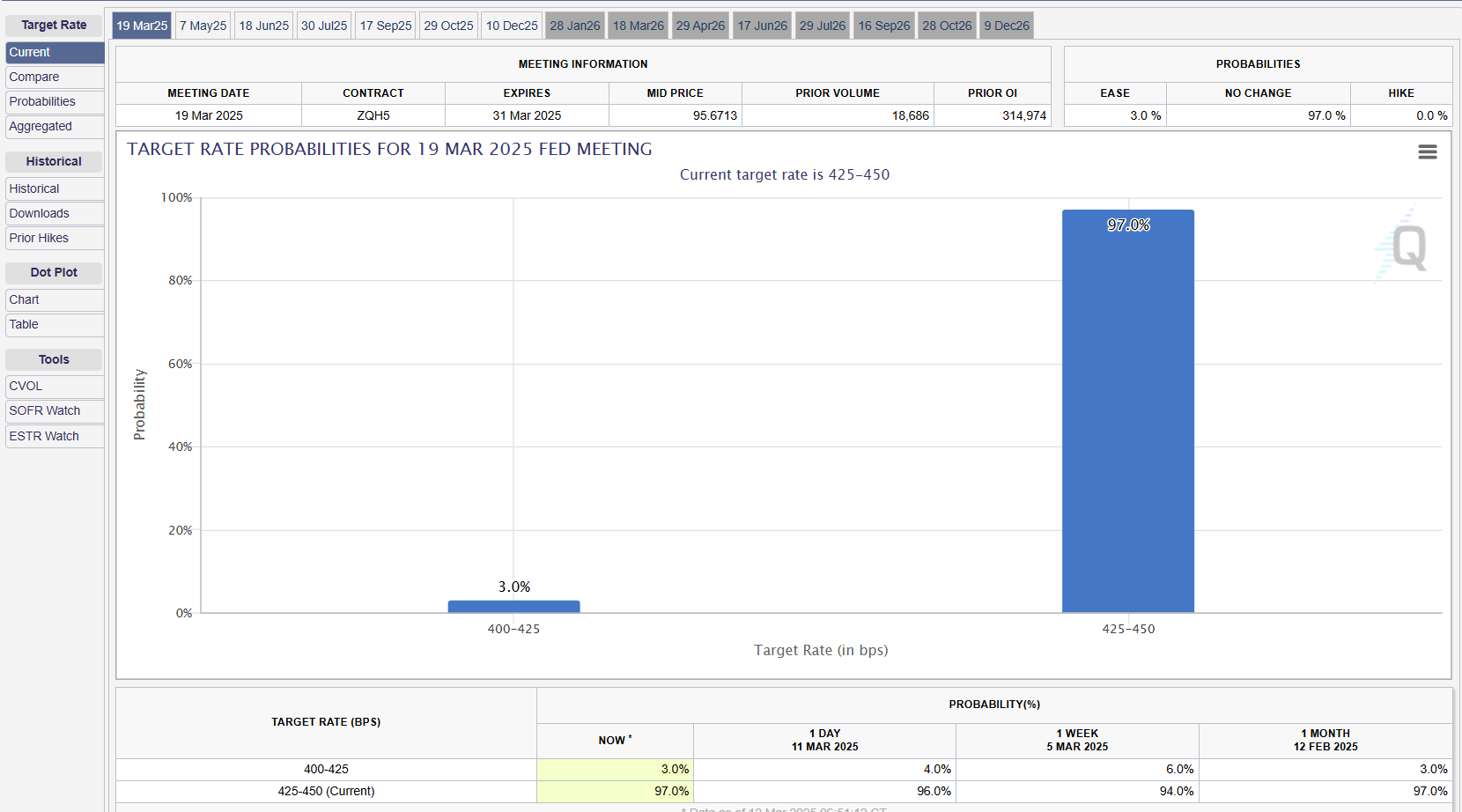
The inflation report comes as markets widely expect the Fed to hold rates steady in the near term. As of the latest data from CME Group’s FedWatch tool, traders were pricing in a low probability of a rate cut at the central bank’s meeting next week.

Fed Chair Jerome Powell warned last Friday that Trump’s enacted and proposed tariffs could lead to a series of price increases, potentially causing consumers to anticipate higher inflation.

The inflation rate appears to have stalled after previous declines, remaining stubbornly above the Fed’s target. While long-term inflation expectations have stayed relatively stable, short-term expectations have increased, partly due to tariff concerns, according to Powell.

The Fed, which had been implementing rate cuts, has paused its monetary policy adjustments, keeping the federal funds rate steady at 4.25%-4.5%.

Unless inflation clearly aligns with the Fed’s target, the Fed will maintain a tight monetary policy. This could keep Bitcoin prices volatile as investors weigh the potential for future rate cuts against ongoing economic uncertainty.

Bitcoin’s observed resilience to short-term macroeconomic shifts indicates that its price may not be heavily influenced solely by inflation data. Yet, general economic conditions and investor sentiment can still impact its value.

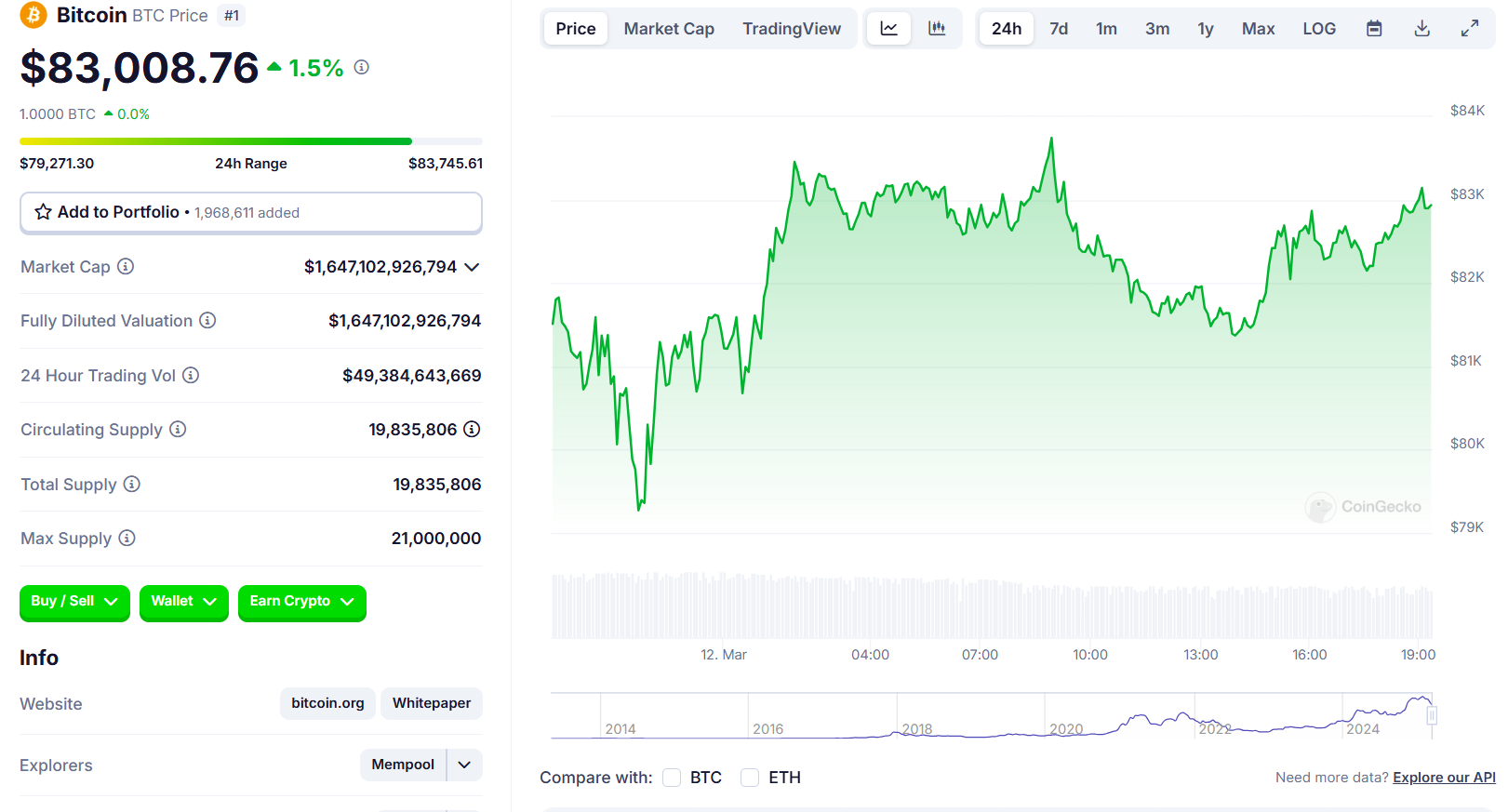
Bitcoin traded above $83,000 ahead of the inflation data release, recovering from a recent dip below $80,000. The crypto asset has gained 1.5% in the last 24 hours, per CoinGecko data.

Share this article


Bitcoin’s price drop sparks speculation over DOJ’s possible sell-off

0


Key Takeaways

  • Speculation suggests the US DOJ may be liquidating seized Bitcoin, impacting its price.
  • Clarity on Bitcoin’s price movement linked to DOJ actions is expected within 30 days.

Share this article

David Bailey, a well-known Bitcoin advocate and CEO of BTC Inc, speculated that Bitcoin’s recent price decline might be connected to the US Department of Justice’s (DOJ) selling activities.

“If the DOJ has been liquidating America’s bitcoin with haste (in defiance of the President) ever since getting court approval to do so 3 months ago… then Bitcoin’s price action makes perfect sense,” Bailey, who recently attended the White House Crypto Summit alongside other industry leaders, wrote on X.

In a follow-up statement, Bailey indicated that clarity on the situation should come within “30 days.”

His comment came after President Trump issued an executive order to establish a strategic Bitcoin reserve using seized coins.

Under Trump’s new order, the Secretaries of Treasury and Commerce will be responsible for building budget-neutral strategies for further BTC acquisitions, provided that these strategies impose no incremental costs on American taxpayers.

The exact amount of Bitcoin, as well as other altcoins seized by the US authorities, remains unknown. According to data tracked by Arkham Intelligence, a US government-labeled wallet currently holds 198,109 BTC worth nearly $16 billion.

In an interview with Bloomberg TV last Friday, White House AI and crypto czar David Sacks said that the government would conduct a full audit of its crypto holdings following the establishment of the Strategic Bitcoin Reserve.

The audit is part of Trump’s executive order, which aims to ensure that all digital assets, including Bitcoin, are properly accounted for and safeguarded. According to Sacks, the DOJ may possess up to 200,000 BTC, but an official audit is necessary for verification.

Last December, the DOJ was authorized to sell approximately 69,370 Bitcoin seized from the Silk Road darknet marketplace. A January report from GIP Digital Watch, however, suggested that the US government has not yet taken steps to sell their Bitcoin holdings.

Analysts see Bitcoin testing lower support before potential recovery

It’s still unclear if the DOJ has offloaded part of the government’s Bitcoin holdings. What is clear, however, is the waning enthusiasm for the US Strategic Bitcoin Reserve narrative, as no new purchases are anticipated in the near future.

Moreover, concerns over a potential recession have deepened after Trump left open the possibility of an economic downturn in a recent Fox News interview, adding more downward pressure on risk assets.

Bitcoin hit a low of $79,300 on Monday morning as bearish sentiment continued to dominate the global financial markets, according to CoinGecko data.

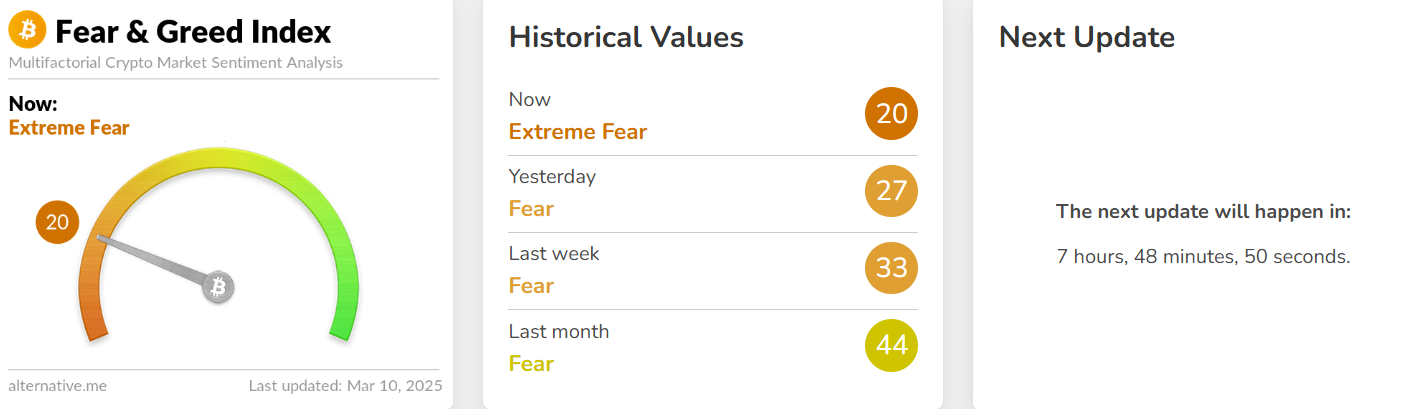
The total crypto market cap plunged around 5% to $2.7 trillion in the last 24 hours, while the Crypto Fear and Greed Index tumbled seven points, firmly landing in the “extreme fear” zone.

Ryan Lee, chief analyst at Bitget Research, expects Bitcoin to test support levels between $70,000 and $75,000 this week, with resistance around $85,000-$87,000.

“A failure to maintain the $77,000 level could lead BTC to test the lower range of $70,000–$72,000. However, if the market sees a recovery, a potential bounce from $75,000 could push the price back into the $80,000–$85,000 range,” Lee said in a Monday note.

“The most likely scenario for this week suggests a mid-week test of $72,000–$75,000, with Bitcoin stabilizing near $83,000 by March 18-19, depending on broader market sentiment, external factors like regulatory news and the upcoming FOMC meeting,” he stated.

Share this article


Strategy to offer $21B in preferred stock to expand Bitcoin holdings

0


Key Takeaways

  • Strategy plans to offer up to $21 billion in preferred stock to expand its Bitcoin holdings.
  • The company uses various financing methods, such as debt offerings and equity issuances, to fund Bitcoin acquisitions.

Share this article

Strategy plans to sell up to $21 billion in 8.00% Series A Perpetual Strike Preferred Stock through an at-market offering, according to a Monday filing with the SEC. The company intends to use the net proceeds from this offering for general corporate purposes, including Bitcoin acquisitions and working capital.

As detailed in the filing, the Nasdaq-listed company entered into a Sales Agreement with multiple financial institutions, including TD Securities, Barclays Capital, and Cantor Fitzgerald, to manage the stock sale. The preferred shares will trade on the Nasdaq Global Select Market under the ticker “STRK.”

The offering will be conducted over time through 12 financial institutions acting as sales agents, who will receive up to 2% of gross proceeds.

The preferred stock carries an 8.00% annual dividend based on a $100 per share liquidation preference, paid quarterly on March 31, June 30, September 30, and December 31. Shareholders can convert their preferred shares into Class A common stock at a rate of $0.1000 Class A shares per preferred share, with an initial conversion price of $1,000 per Class A share.

The offering marks another move by Strategy to increase its Bitcoin Treasury position. The company has previously used debt offerings and equity issuances to fund Bitcoin acquisitions under the leadership of Executive Chairman Michael Saylor, who has championed Bitcoin as a Treasury reserve asset.

Earlier this year, Strategy announced a plan to raise $2 billion through stock offerings to fund more Bitcoin purchases as part of their “21/21 Plan.”

The 21/21 plan is the company’s strategic initiative to raise a total of $42 billion over three years, including $21 billion in equity and $21 billion in fixed-income instruments. The goal is to use the raised capital to acquire more Bitcoin, further solidifying its position as the world’s largest Bitcoin Treasury Company.

As of early 2025, Strategy had already raised $15 billion through equity and $3 billion via convertible debt. The company is shifting its focus toward fixed-income issuances this year.

Strategy currently holds 499,096 BTC, valued at $41.5 billion at current market prices.

Share this article


Bitcoin sinks, XRP, ADA, DOGE dip as Trump stirs recession fears amid rising trade conflict

0


Key Takeaways

  • Bitcoin and altcoins plunge amid growing economic uncertainty.
  • Market reactions remain tepid as the Strategic Bitcoin Reserve will not involve new government purchases for now.

Share this article

Fears of a looming recession, coupled with escalating trade tensions between the US and Canada, triggered Bitcoin price drops and altcoin sell-offs on Sunday night.

Speaking on Fox News’ Sunday Morning Futures, Trump avoided directly addressing recession possibilities in 2025, saying he hated predicting “things like that.” He emphasized his economic policies aim to bring wealth back to America, though the transition may take time.

Trump’s tariffs on imports from countries like Canada, Mexico, and China have been a source of market volatility. Despite this, the US President defended his approach as necessary for achieving his economic goals.

Also on March 9, Mark Carney, a former governor of the Bank of Canada, won the Liberal Party leadership election, replacing Justin Trudeau as Canada’s prime minister.

The new prime minister-elect went off on Trump in his first speech, stating that Trump won’t succeed in his trade war with Canada.

“America is not Canada. And Canada never, ever, will be part of America in any way, shape or form,” Carney said. Trump has repeatedly referred to Trudeau as the “Governor” of Canada, suggesting that Canada would be better off as the 51st U.S. state.

“My government will keep our tariffs on until the Americans show us respect,” he said. Canada has imposed 25% tariffs on US consumer goods in retaliation to Trump’s tariffs.

Bitcoin fell below $81,000 following Carney’s victory, according to CoinGecko data. At press time, BTC recovered slightly above $82,000, down 4% in the last 24 hours.

Market turmoil deepened as Bitcoin declined. Ether and XRP each shed more than 6%, while Dogecoin dropped over 10%.

Other top coins like BNB, Solana, Cardano, and TRON also saw significant losses, while lower-cap tokens such as Injective, Maker, and Render experienced double-digit drops.

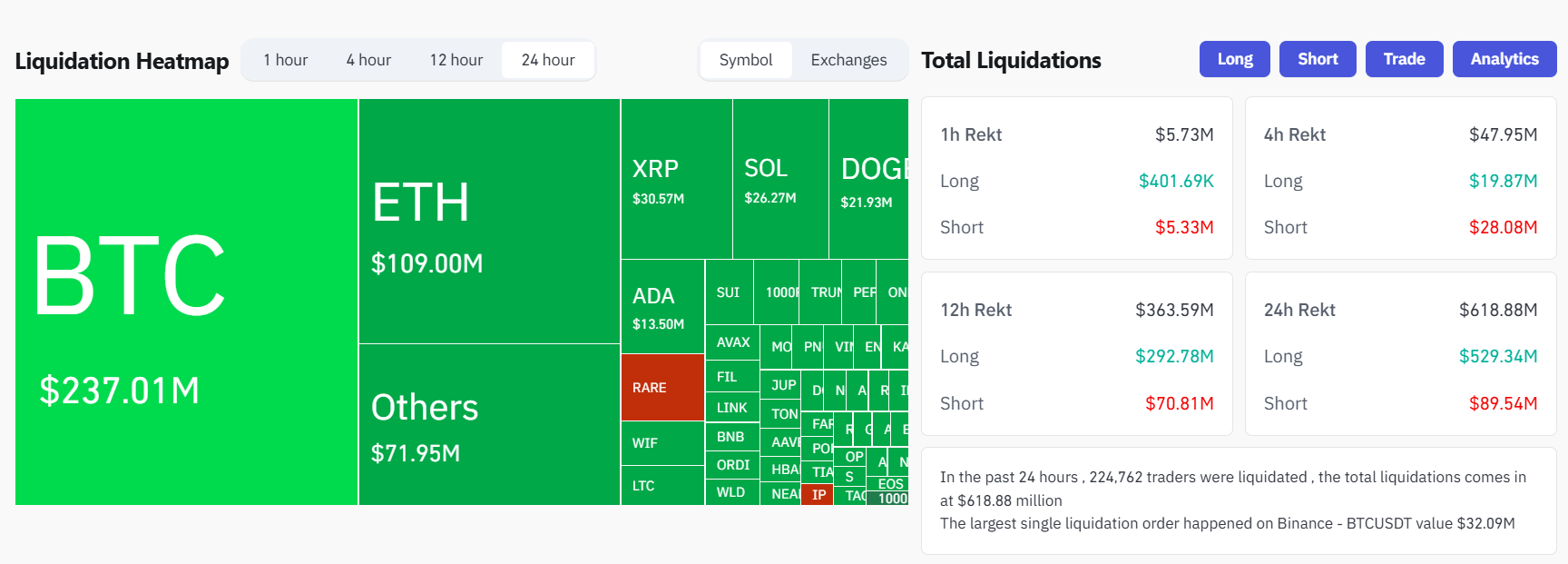
The total crypto market capitalization decreased 6% to $2.8 trillion within a day. Leveraged liquidations reached $600 million, with approximately $530 million in long positions eliminated, according to Coinglass data.

The Atlanta Federal Reserve’s GDPNow model has revised its forecast for the first quarter of 2025, predicting a GDP contraction of 2.4%. This downward revision reflects weaker-than-expected consumer spending and a widening trade deficit, raising concerns about a potential recession.

Market reaction to Trump’s Bitcoin reserve: A mixed bag

The market turbulence continued after Trump’s Thursday executive order establishing a Strategic Bitcoin Reserve, which initially sparked selling pressure due to limited details about funding beyond existing US-held Bitcoin.

US Treasury Secretary Scott Bessent said Friday that discussions are underway about additional BTC acquisitions, but the first step is to halt the sale of seized Bitcoin.

He also noted that while the current focus is on Bitcoin, the broader strategy is to establish a comprehensive crypto reserve.

While some analysts view the reserve’s creation as formal recognition of Bitcoin’s role as a strategic asset, positioning it alongside traditional reserves like gold, this recognition has not translated into immediate market confidence.

Crypto community members also had mixed reactions to the White House Crypto Summit held after the executive order.

Speaking at the event, Chainlink co-founder Sergey Nazarov expressed optimism that US officials are now actively engaging with the blockchain and crypto industry, which he believes could help the country stay at the forefront of financial innovation.

“Me and other people in the room do believe that the crypto, blockchain, Web3 infrastructure is the next iteration of the financial system,” Nazarov said. “And I think that the US should have its leadership position continue in that new financial system.”

Multicoin Capital managing partner Kyle Samani also viewed the event positively, labeling it a “historic moment” for crypto.

In contrast, Coin Bureau CEO Nic Puckrin and Bitcoin maximalist Justin Bechler expressed disappointment, questioning the summit’s impact and criticizing its approach.

Share this article