Over $1.6 billion in crypto was liquidated as Bitcoin fell below $86,000.
The Bitcoin ETF selloff of $500 million fueled widespread market liquidations.
Share this article
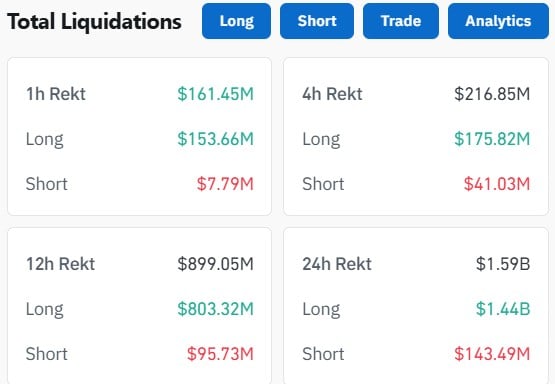
Bitcoin’s drop to $86,000 led to the liquidation of $1.6 billion in trading positions over the past 24 hours, according to Coinglass data.
The drop is attributed to President Donald Trump’s renewed tariff threats against Mexico and Canada and a significant selloff of Bitcoin ETFs.
A $500 million Bitcoin ETF selloff intensified the market downturn, leading to widespread liquidations across major digital assets. The price decline marks Bitcoin’s first drop below $86,000 since November.
Feb 25 Update:
10 #Bitcoin ETFs NetFlow: -5,474 $BTC(-$485.98M)🔴#Fidelity outflows 2,620 $BTC($232.58M) and currently holds 204,180 $BTC($18.13B).
The liquidation event affected between 286,534 and 367,789 traders, with long positions bearing the majority of losses ranging from $144 million to $1.4 billion.
Bitcoin, Ethereum, and XRP were among the most impacted digital assets.
This event follows a larger liquidation on February 3, 2025, when over $2.2 billion in leveraged positions were wiped out, affecting approximately 729,073 traders.
During that event, Ethereum traders experienced over $600 million in losses, while Bitcoin traders faced $409 million in liquidations.
Trump’s latest statements on trade policy, which revived discussions from his February 3 announcement, have heightened concerns about economic disruptions.
The combination of trade policy uncertainty and institutional investor outflows has contributed to increased volatility across crypto markets.
BlackRock transferred 18,168 ETH and 1,800 Bitcoin to Coinbase amid market uncertainty.
Crypto markets faced $1.6 billion in liquidations, influenced by geopolitical tensions and institutional selling.
Share this article
Today, BlackRock transferred 18,168 Ethereum ($44 million) and 1,800 Bitcoin ($160 million) to Coinbase amid growing market uncertainty and widespread liquidations in crypto markets.
The deposit comes as Bitcoin fell below $86,000 for the first time since November, while crypto markets experienced $1.6 billion in liquidations over the past 24 hours.
Large entities moving significant amounts of crypto to exchanges are often seen as a signal that they may be preparing to sell.
This trend can lead to further price drops, as other investors may interpret such moves as a sign of weakening confidence or an impending decline.
Market pressure intensified following a $500 million Bitcoin ETF sell-off, coupled with renewed tariff threats from President Donald Trump.
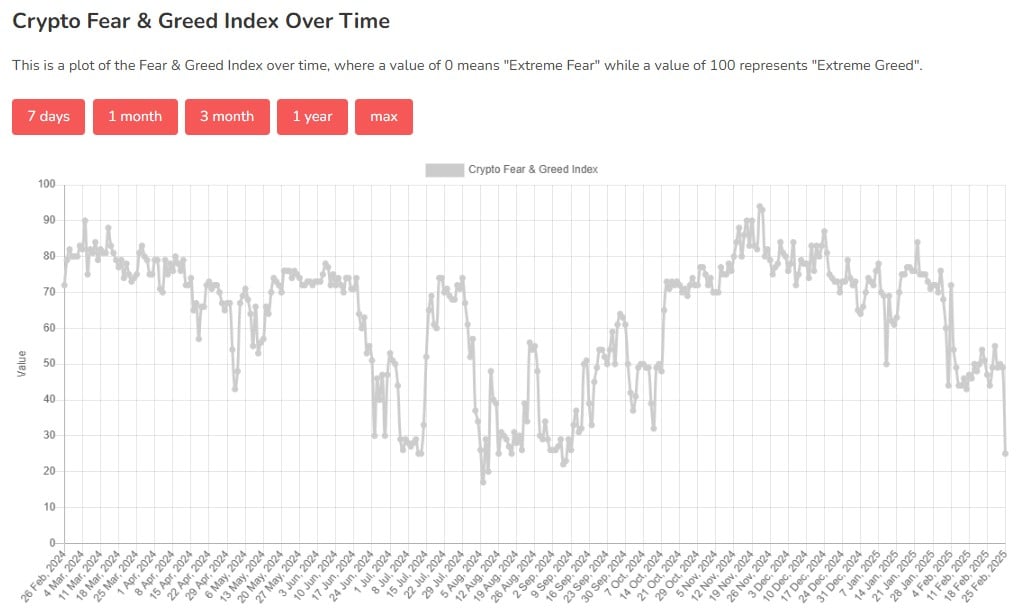
The Crypto Fear and Greed Index dropped to 25, indicating extreme fear and marking its lowest level since September 2024.
The announcement of new tariffs by Trump caused nearly $900 million in leveraged liquidations in the crypto market.
Bitcoin and Ethereum prices dropped significantly, triggering major losses among traders.
Share this article
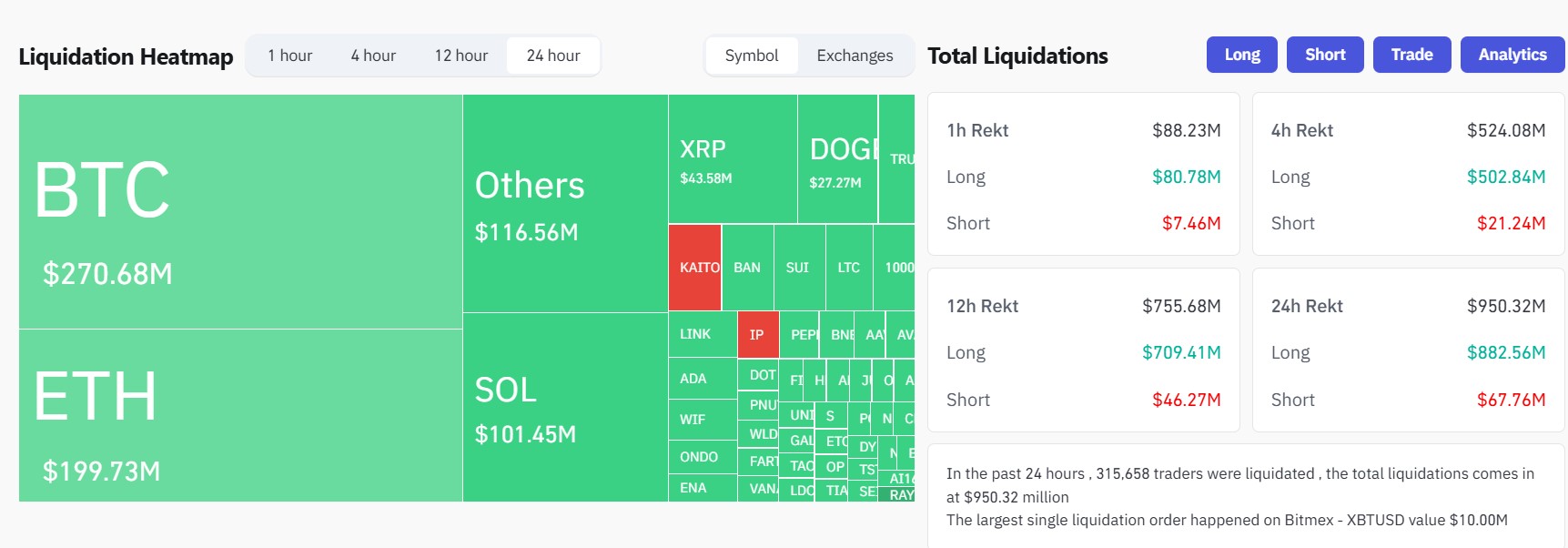
Bitcoin’s slide to a multi-week low sparked a $950 million liquidation wave on crypto exchanges. The sell-off followed President Trump’s statement indicating reactivated Canada and Mexico tariffs, ending a month-long pause and, again, raising inflation concerns.
Trump said Monday that tariffs on imports from Canada and Mexico will be implemented next month, ending a monthlong suspension of planned import taxes.
The 25% tariff on Canadian and Mexican goods will begin in early March 2025, affecting over $900 billion worth of US imports including automobiles, auto parts, and agricultural products.
“We’re on time with the tariffs, and it seems like that’s moving along very rapidly,” Trump said at a White House news conference with French President Emmanuel Macron. “The tariffs are going forward on time, on schedule.”
Trump has maintained that other countries impose unfair import taxes that harm domestic manufacturing and jobs. While he claims the tariffs would generate revenue to reduce the federal budget deficit and create new jobs, his threats have raised concerns among businesses and consumers about a potential economic slowdown and accelerating inflation.
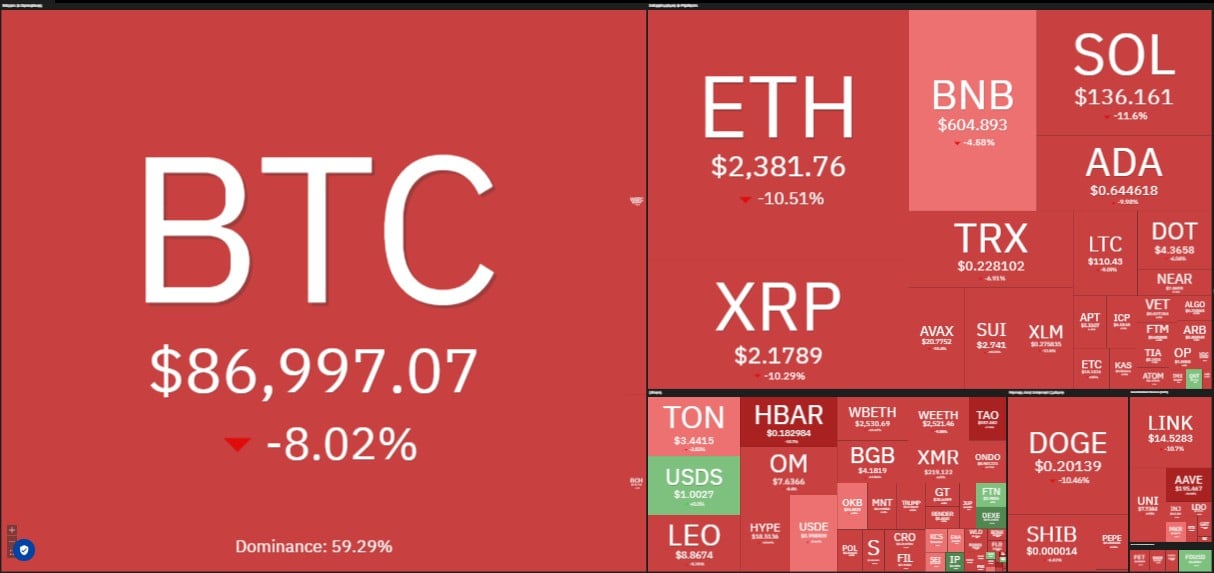
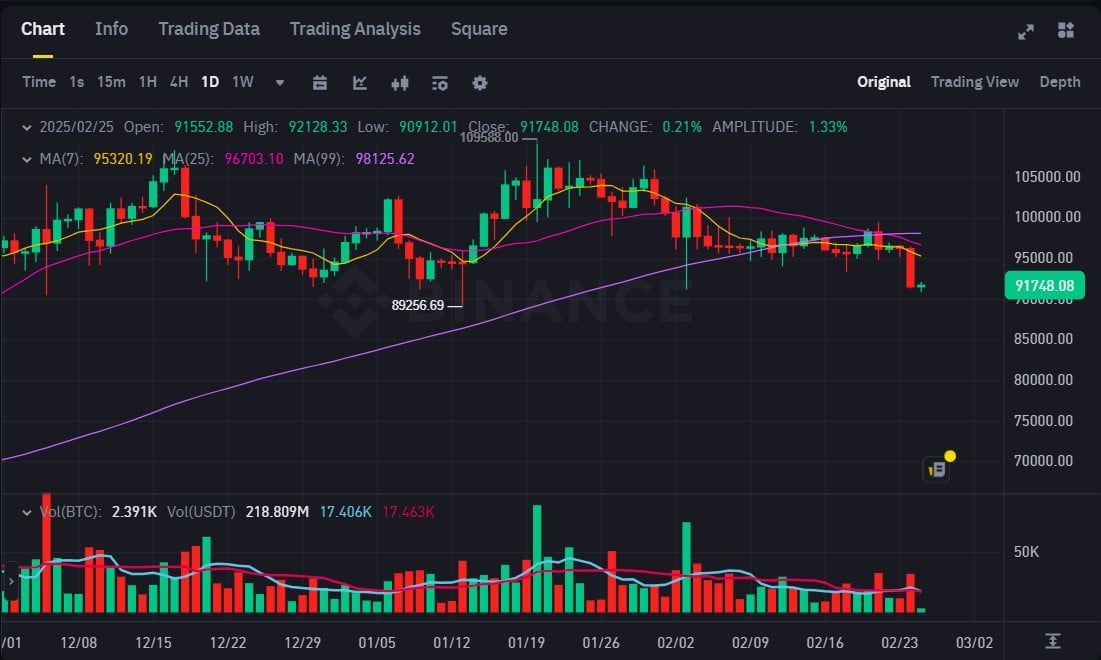
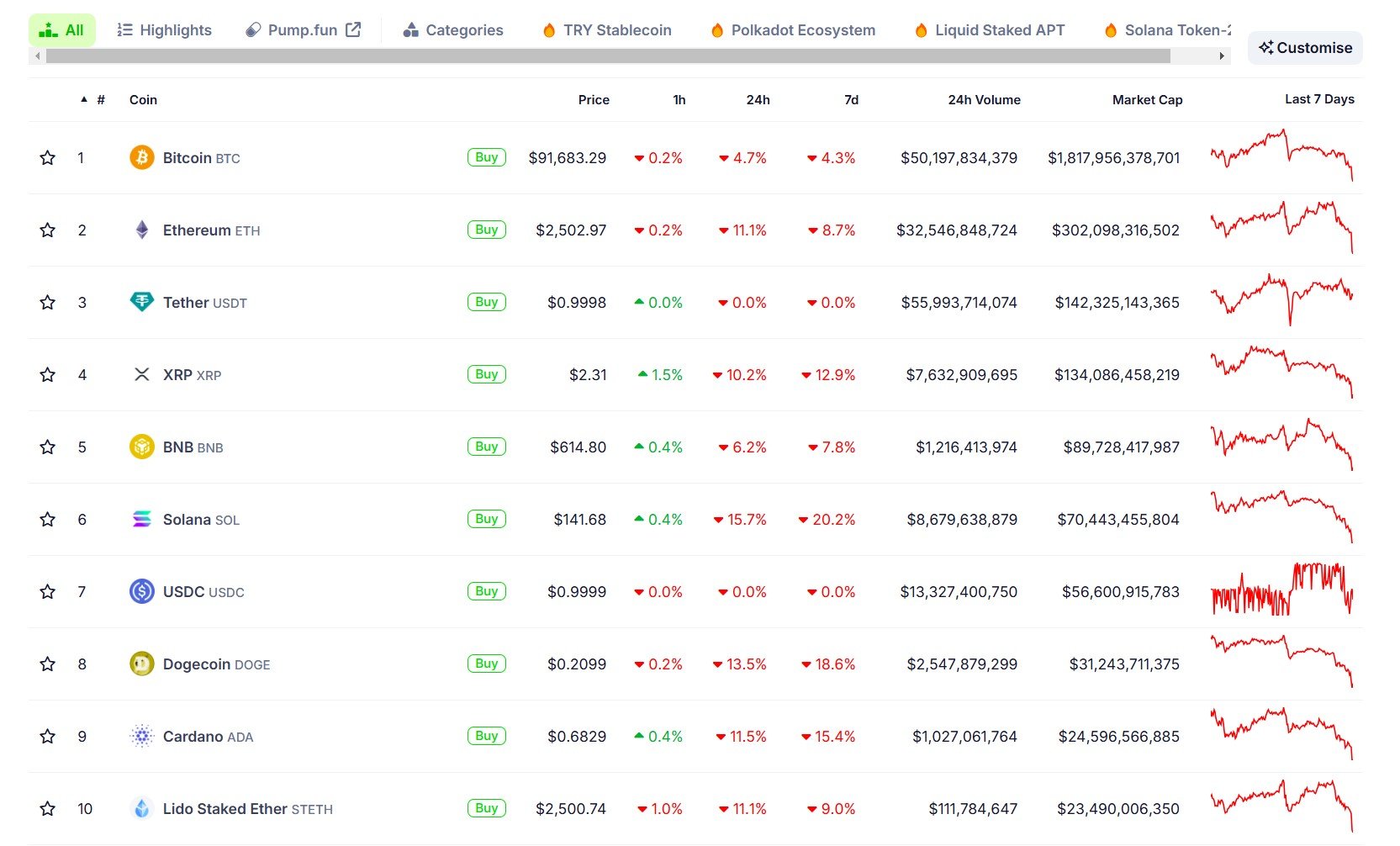
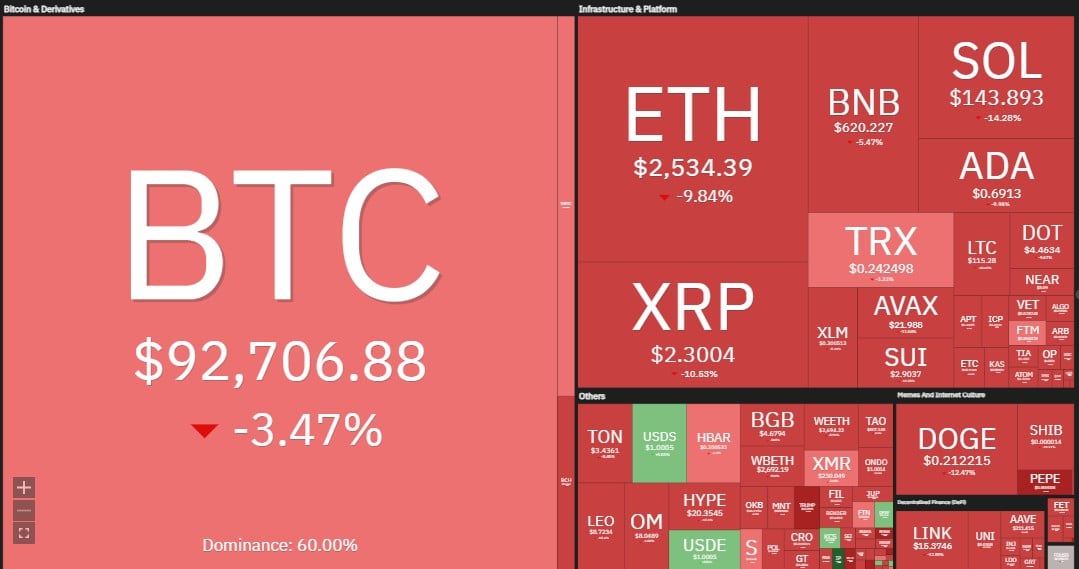
The price of Bitcoin fell below $95,000 and continued sliding to around $91,000, while Ethereum dropped 11% to $2,500, according to CoinGecko data.
The broader crypto market saw widespread losses, with the total market capitalization declining by approximately 8%.
The market turmoil resulted in $880 million in long position liquidations over 24 hours. Ethereum traders suffered $255 million in losses, while Bitcoin traders experienced $185 million in liquidations, according to Coinglass data.
Most altcoins posted double-digit losses. XRP fell 10%, while SOL dropped almost 16%. DOGE declined 13%, and ADA fell 11%. BNB decreased by around 6% in the last 24 hours.
Bitcoin reserve bills fail in multiple US states
Elsewhere, the push for states to hold Bitcoin as part of their reserves has hit a wall. Bitcoin reserve bills have been defeated in Montana, North Dakota, Wyoming, and South Dakota.
Montana’s House Bill 429, which sought to allocate up to $50 million to Bitcoin, precious metals, and stablecoins, was defeated in a decisive 41-59 vote.
North Dakota’s HB 1184, designed specifically for a Bitcoin reserve, met a similar fate, falling short with a 57-32 rejection.
Wyoming lawmakers also rejected HB 0201, which would have empowered the state treasurer to invest public funds in Bitcoin, by a 7-2 margin.
In South Dakota, HB 1202, proposing a 10% Bitcoin allocation, was effectively stalled when legislators employed a procedural maneuver to delay the vote beyond the session’s deadline.
Bankman-Fried’s unexpected return to X, after a two-year hiatus, focused on layoffs and corporate challenges.
He emphasized that terminations are often not the employee’s fault but sometimes necessary for business needs.
Share this article
Sam Bankman-Fried, the disgraced former CEO of FTX, has ended his two-year silence on X with a series of posts discussing employee terminations and corporate management challenges. The tweets, which came out on Monday evening, have sparked widespread discussion and speculation among members of the crypto community.
Bankman-Fried opened his thread with a reference to his current situation, writing “I have a lot of sympathy for gov’t employees: I, too, have not checked my email for the past few (hundred) days,” adding that “being unemployed is a lot less relaxing than it looks.”
1) I have a lot of sympathy for gov’t employees: I, too, have not checked my email for the past few (hundred) days
And I can confirm that being unemployed is a lot less relaxing than it looks
Bankman-Fried went on to argue that often, the root cause of layoffs is a mismatch between the employee’s skills and the company’s needs. The former CEO of FTX detailed several potential scenarios, including a lack of managerial support, incompatible work styles, and misaligned project interests.
” More often, the problem is that the company just doesn’t have the right job for them,” Bankman-Fried stated.
“Maybe we just didn’t really have anyone free to manage them right then. Maybe they worked best remotely, but our company communicated in-person,” he wrote.
He also pointed to departmental issues and the problem of over-hiring, citing examples of competitors who hired excessively and then struggled to manage their workforce.
“This happens, now and then. We saw it at competitors that hired 30,000 too many employees and then had no idea what to do with them—so entire teams just sat around doing nothing all day,” he stated, without naming specific companies. “And we saw it internally, when a manager would get busy or distracted, and half of a department would lose its bearing at the same time.”
“It isn’t the employee’s fault, when that happens. It isn’t their fault if their employer doesn’t really know what to do with them, or doesn’t really have anyone to effectively manage them. It isn’t their fault if internal politics lead their department to lose its way,” he added.
“But there’s no point in keeping them around, doing nothing,” Bankman-Fried concluded.
Bankman-Fried’s sudden reappearance on X has raised questions about how he is managing his account at the Brooklyn Metropolitan Detention Center, where he is serving a 25-year sentence for orchestrating a major crypto scam.
Bankman-Fried recently expressed hope for a presidential pardon in his first interview from jail. He also criticized the Biden administration and portrayed his conviction as part of a “prosecutorial overreach” during Biden’s presidency. Bankman-Fried’s parents are reportedly exploring ways to secure a pardon for their son, including talking to lawyers and individuals with connections to Trump.
Bitcoin price is down 3.9% due to new tariffs from President Trump.
The crypto market experienced a $110 billion loss today.
Share this article
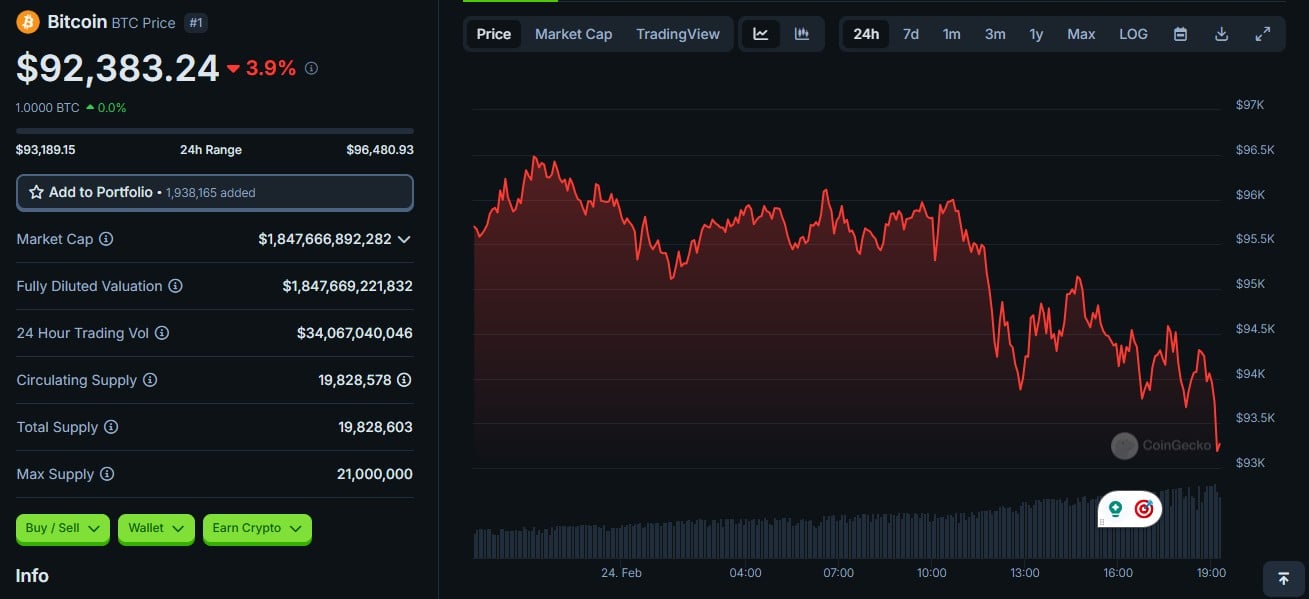
Bitcoin fell 3.9% today to a three-week low after President Trump announced new tariffs on imports from Canada and Mexico, deepening a broader crypto market selloff that erased more than $110 billion in value.
The largest digital asset traded around $92,400, its lowest level since February 2, with the decline accelerating after Trump confirmed tariffs on Mexican and Canadian imports “are going forward.”
BREAKING: President Trump just announced that the 25% tariff on Canada and Mexico will officially start on March 4, 2025
“The tariffs are going forward on time, on schedule. This is an abuse that took place for many, many years. And I’m not even blaming the other countries that… pic.twitter.com/MEYa07vvyx
Trump signed executive orders on February 1 imposing a 25% tariff on all products imported from Canada and Mexico, with a lower 10% rate on Canadian energy resources.
The administration cited a “national emergency” related to illegal immigration and drug trafficking, including fentanyl, as justification for the measures. The tariffs are scheduled to start to apply on March 4, 2025.
The market-wide downturn affected major crypto assets, with Solana dropping 14%, XRP falling around 10%, and Ethereum declining nearly 10%. BNB saw a more ‘modest’ decrease of 5.5%.
The $110 billion in market-wide liquidations represents one of the largest dollar-volume declines in crypto market history.
London, united kingdom, December 6th, 2024, Chainwire
Pepeto: Low Price and Big Announcements Ahead
Pepeto has captured the crypto community’s attention with its compelling story and utility. Currently priced at just $0.000000096, Pepeto offers an affordable entry point, with five days left in its current presale stage. Pepeto has also teased major upcoming announcements, further fueling speculation and interest. Its combination of narrative-driven appeal, advanced utilities like a cross-chain bridge and zero-fee exchange, and a rapidly growing community can make it a noticeable opportunity in the memecoin space.
Pepeto: Community and Adoption for the Memecoin Era
Pepeto has made a wave of excitement across the crypto space, driven by its captivating story tied to the six documents—P, E, P, E, T, and O—that define its vision. This narrative has rallied a vibrant and growing community, as evident across its active social media platforms. Pepeto’s adoption utility stands out, positioning it as a possible exchange for the next generation of frog-themed and memecoin projects. By offering a seamless platform for trading, bridging, and listing, Pepeto aims to empower the wave of innovative frog-inspired tokens.
Pepe Unchained: Scaling Memecoins with Layer 2 and Upcoming Listings
Pepe Unchained brings a focus on Layer 2 technology, offering enhanced scalability and efficiency for blockchain transactions. This technical foundation positions the project to support higher transaction volumes and smoother operations, especially during peak market activity. With its presale now completed, Pepe Unchained is building momentum as it prepares for its official listing in less than four days. This milestone marks an important step in delivering value to both its community and the broader memecoin ecosystem.
Two Major Announcements Pending
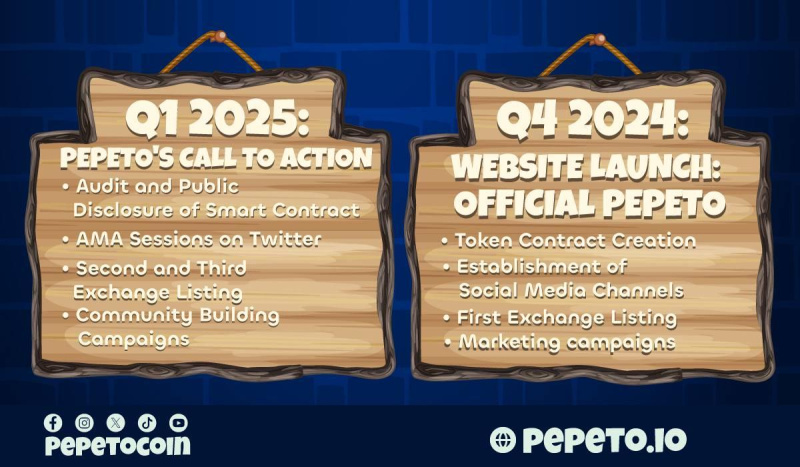
Pepeto has hinted at two significant announcements on the horizon. These announcements are hinted to include a potential exchange listing and the beta version launch of PepetoSwap, the project’s core utility.
By adhering to its roadmap, Pepeto works to continue to build trust and excitement within its growing community. The upgraded platform will soon serve as the foundation for the bridge and exchange functionalities, offering a vital resource for the next generation of blockchain projects.
Pepeto’s presale is rapidly approaching the $2 million mark. This achievement can highlight the community’s confidence in Pepeto’s vision and utility, which includes its advanced bridge, zero-fee exchange, and staking rewards. With its low presale price and an ecosystem designed to support the next generation of memecoins, Pepeto aims to become a standout project in the lead-up to the 2025.
Pepeto: Building Momentum for the Future of Memecoins
Pepeto’s steady progress reflects its commitment to delivering value and innovation to its community. From unveiling the anticipated PepetoSwap to upgrading its official website, every step underscores the team’s focus on creating meaningful utilities. With the beta launch of its bridge and exchange on the horizon and major announcements fueling excitement, Pepeto is positioning itself as a key player in the crypto space, paving the way for widespread adoption and collaborative growth in the memecoin ecosystem.
About Pepeto
Pepeto is a memecoin project designed to integrate cross-chain utility with community-driven development. Offering zero-fee trading, blockchain bridge functionality, and a staking rewards program, Pepeto seeks to combine accessibility with practical features. The project emphasizes interoperability and long-term value, fostering a dedicated user base through its ecosystem innovations and community-focused approach.
Disclaimer:
The official website for Pepeto is https://pepeto.io/. Be cautious of fraudulent websites.
To learn more about Pepeto’s progress and upcoming features, users can visit the official website and Pepeto official socials – https://pepeto.io/
Singapore, Singapore, December 13th, 2024, Chainwire
Cross-chain web3 collective network Astar has unveiled Astar Surge, its Pre-Deposit Campaign designed to accelerate integration with Soneium. Launching on December 18, the initiative offers ASTR holders an opportunity to earn rewards while contributing to the growth of Astar’s expanding web3 ecosystem.
As part of Astar Surge, ASTR holders can deposit their tokens into dedicated contracts on Astar’s Layer 1 network. In doing so, participants will accumulate points for each participating Soneium dApp. These points can later be redeemed for project tokens during their respective Token Generation Events (TGEs), adding a tangible incentive for early adopters.
“Astar Surge represents a significant milestone in our mission to connect people to web3 and bring this technology to billions. By empowering our community with early access to groundbreaking Soneium dApps, we’re not only accelerating ecosystem growth but also ensuring a seamless transition to Soneium’s infrastructure. This collaboration underscores our commitment to driving global adoption of the Astar Network and its representative token, ASTR, creating lasting value for all current and future holders.”
Key Soneium projects including Yay!, Sake Finance, Untitled Bank, SoneX, and Kyo Finance are collaborating with Astar to deploy pre-deposit contracts, each benefiting from increased Total Value Locked (TVL) and heightened visibility ahead of the Soneium mainnet launch. The Pre-Deposit Campaign will ensure that liquidity is readily available for migration to Soneium’s infrastructure, laying the groundwork for a robust ecosystem from day one.
Security is a cornerstone of the Pre-Deposit Campaign, with contracts developed by Sake Finance and audited by leading blockchain security firm PeckShield. Utilizing ERC-6551 token bound accounts, the system ensures users retain ownership of their tokens while facilitating a seamless transition to Soneium’s mainnet. Upon depositing ASTR or ASTR LST, a token-bound smart contract account is created, locking the assets until the mainnet launch. The NFT tied to the account remains under the user’s control, guaranteeing ownership throughout the process.
After the Soneium mainnet launch, users can unlock their assets by signing a transaction to update the bridge contract utilizing interoperability protocols such as LayerZero and Chainlink CCIP. This allows seamless bridging of assets to Soneium and deposits into designated protocol contracts, guided by customized logic, for a secure and efficient transition.
Ecosystem projects will benefit from increased visibility and liquidity, with pre-deposit contracts designed to create a robust foundation for the upcoming Soneium mainnet. Regular community updates, including project highlights and interactive AMA sessions, will keep participants informed and engaged throughout the campaign.
The Pre-Deposit Campaign follows Astar’s decision to expand to Soneium’s Superchain ecosystem and become a chain-agnostic web3 service provider. Making the ASTR token available on Soneium’s Ethereum L2 will be one of the first steps in realizing this goal, paving the way for a successful Soneium mainnet launch.
About the participating projects
Sake Finance: Sake is all about making decentralized finance easier, offering smooth asset swaps and exciting yield farming opportunities for Astar users.
Yay!: Yay! brings a fun, social twist to web3, combining community-driven features with decentralized finance on Soneium.
Untitled Bank: Untitled Bank is creating a more inclusive financial space on Soneium, offering services like lending, borrowing, and staking to everyone in the ecosystem including ASTR holders.
SoneX: SoneX is making it easy to swap tokens with speed and security, all while boosting liquidity and scalability within Soneium’s growing ecosystem.
Kyo Finance: Kyo Finance helps users maximize their capital with advanced DeFi tools, including leveraged yield farming and staking available for the ASTR token.
About Astar Network
Astar Network connects you to web3 as the premier gateway for projects spanning enterprises, entertainment, and gaming in Japan and beyond, driving global adoption and bringing web3 to billions. Powered by Polkadot, Astar utilizes a multi-layered tech stack to offer customizable blockchain solutions that support both EVM and WASM. With this robust framework, Astar accelerates the expansion of web3 technology worldwide. Recently, Astar announced the transition of Astar zkEVM to Soneium, an Ethereum Layer 2 solution developed by Sony Block Solutions Labs. This shift is set to extend web3 experiences to a wider audience, seamlessly bridging the gap between web3 and web2 users.