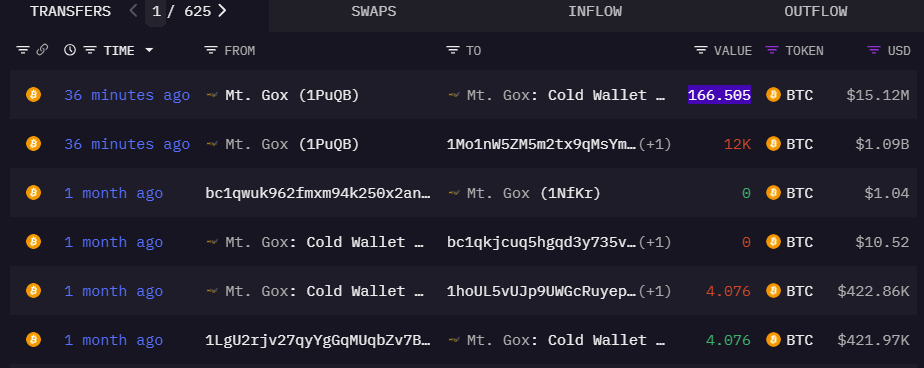
Mt. Gox transferred 12,000 Bitcoin valued over $1 billion after months of silence.
The exchange also moved 166,505 Bitcoin to its internal wallet.
Share this article
A wallet associated with Mt. Gox, the defunct crypto exchange, just sent 12,000 Bitcoin, worth over $1 billion, to an unidentified address in the past hour, according to data from Arkham Intelligence. The transfer came amid Bitcoin’s ascent to the $90,000 mark.
The Mt. Gox-labeled wallet also moved 166,505 Bitcoin worth approximately $15 million to its cold wallet on Wednesday evening.
These transactions broke a long period of being idle, following a transfer of $172 million in Bitcoin last December. The entity still owns more than 36,000 Bitcoin, valued at about $3.3 billion at current market prices.
Mt. Gox has extended its repayment deadline from October 31, 2024, to October 31, 2025, citing ongoing verification and processing requirements for claimants. While some creditors have received fiat currency payments, others are still waiting for compensation in Bitcoin or Bitcoin Cash.
Although Mt. Gox’s Bitcoin movements have historically influenced market sentiment, recent transfers have had minimal impact on Bitcoin prices. However, market participants remain concerned about potential price effects if creditors choose to sell their holdings following full compensation distribution.
Bitcoin is trading at around $90,100, up 4% in the last 24 hours, according to TradingView data.
BlackRock CEO Larry Fink anticipates market volatility and elevated inflation in 2025 due to trade tensions.
Fink remains optimistic about long-term growth through technology transformation and AI advancements.
Share this article
BlackRock CEO Larry Fink expects market volatility and elevated inflation in 2025 but remains bullish about long-term growth opportunities, projecting a “big economic boom” driven by advancements in science and technology.
Speaking today at the RBC Capital Markets Global Financial Institutions Conference, Fink said that this year would be a “rocky” year as markets adjust to trade tensions and policy shifts. He noted that the “next six months” will be marked by increased market volatility.
“In the next six months, I think we’re going to have a lot of volatility and volatility is creeping up quite considerably,” he said.
Yet, Fink anticipates the country will overcome the current social and economic challenges.
“The world’s fine. I mean, a lot of noise. We’ll get beyond — we’ll get by this,” Fink said.
“All of that is going to be just a reorientation. And ultimately, we’ve — we find ways of fixing it. But in the short run, we’re going to have elevated inflation,” he said.
Fink urged investors to buy during the dips, emphasizing his confidence in the enduring strength of the US capital markets.
“For long-term investors, if there’s a big dip, good, good time to buy and I truly believe that. I believe we’re getting set up for a big economic boom,” Fink said, anticipating the boom will largely be driven by new technologies and science.
Addressing the growing anxiety surrounding tariffs and potential deportations, Fink said they could cause immediate economic disruptions they could cause. However, despite the current climate of trade uncertainty, he stays optimistic about the possibility of a positive outcome, suggesting a potential trade agreement between the US and China.
“We expect in the short run volatility, we expect elevated inflation, moderation of the economy in the short run. But over the course of three quarters, four quarters, I think we’re going to be resuming a pretty good trajectory,” he noted.
AI and robotics poised to unleash deflationary wave
Discussing AI, Fink highlighted the potential of the technology to drive innovation, efficiency, and ultimately, deflation.
“The Generative AI is going to transform the science and all the sciences so rapidly,” he said.
The CEO pointed out that AI implementation is currently expensive, limiting its accessibility to large corporations. However, he expressed optimism that the cost of AI models will decrease, allowing for wider adoption and “democratization” of the technology.
Fink believes that the US technology sector, driven by AI, will be a major driver of stock market growth and investment opportunities over the next five years.
Fink also noted the rapid evolution of robotics, where AI and visual technology are enabling robots to perform increasingly complex tasks. He contrasted older, code-driven robots with new AI-powered machines capable of delicate and precise actions.
“The ability to overlay AI with robotics with visual technology is going to be transformational,” Fink said. “And that’s why when you think about so many functions and so many things, it will be ultimately very deflationary.”
Treasury Secretary Bessent plans to lower interest rates to aid struggling Americans with high borrowing costs.
Plans to deregulate banking and expand energy production aim to reduce costs and enhance US export capabilities.
Share this article
Treasury Secretary Scott Bessent reaffirmed the administration’s commitment to tackling inflation and making life more affordable for Americans. Speaking in an interview with FOX News on Tuesday, Bessent detailed the administration’s economic priorities, including efforts to lower interest rates.
🇺🇸 JUST IN: US Treasury Secretary Scott Bessent states, “We are committed to lowering interest rates.” pic.twitter.com/roPcecaL85
Mortgage rates have declined “dramatically” since Election Day and the inauguration, Bessent said. He attributed this trend in part to upcoming bank deregulation.
Bessent emphasized that the administration aims to lower interest rates to help Americans struggling with high borrowing costs, particularly those in the bottom 50% of income earners who have been “crushed by these high interest rates” over the past two years.
According to him, lower interest rates would not only benefit homeowners but also help ease credit card and auto loan costs, which have disproportionately affected low-income Americans.
“So we’re set on bringing interest rates down and I think that’s one of the greatest accomplishments so far,” Bessent said.
While inflation is easing, Bessent noted that costs for essential goods, housing, and insurance remain high, largely due to excessive regulations imposed by the previous administration.
“There’s affordability and then there’s inflation. Inflation is slowing, still not back to the Fed’s target area. Affordability is this massive spike that we saw over the past two and four years,” said Bessent when asked how affordability could affect inflation.
“We’re going to try to bring the prices back down,” said Bessent, noting that deregulation is key to addressing costs across sectors like insurance and housing.
“There’s several thousand dollars of administrative burdens every year, and if we can cut that red tape and bring that down, then that’s an excellent start on the affordability,” Bessent said.
The administration’s tariff policies were another key focus of Bessent’s remarks. New tariffs—10% on all Chinese imports and 25% on imports from Mexico and Canada—went into effect this week, sparking market reactions.
While some analysts fear potential price hikes, Bessent expressed confidence that Chinese manufacturers will absorb the tariffs rather than passing costs onto American consumers.
“On the China tariffs, China’s business model is export, export, export, and that’s unacceptable,” Bessent stressed.
“They’re in the middle of a financial crisis right now that they’re trying to export their way out of it. So with the China tariffs, I am highly confident that the Chinese manufacturers will eat the tariffs. Prices won’t go up,” he explained.
He also pointed to recent moves by companies like Honda, which announced plans to shift manufacturing to Indiana, as evidence that tariffs are successfully encouraging businesses to bring production back to the US.
“With Canada and Mexico, you know, I think we’re in the middle of a transition, and just like you mentioned, Honda moving to Indiana is a great start,” he said.
The Treasury secretary also outlined plans to expand US energy production across crude oil, natural gas, and nuclear power.
“We’re going big in nuclear and we are going to… it’s going to bring down costs, but we’re also going to become major exporters of energy, which will make the world more secure,” Bessent said.
The crypto market lost around $500 billion in reaction to Trump’s tariff announcement.
XRP, ADA, and SOL recorded double-digit losses after their recent rallies.
Share this article
Around $500 billion has been wiped out of the crypto market in the past 24 hours ahead of Trump’s tariff deadline.
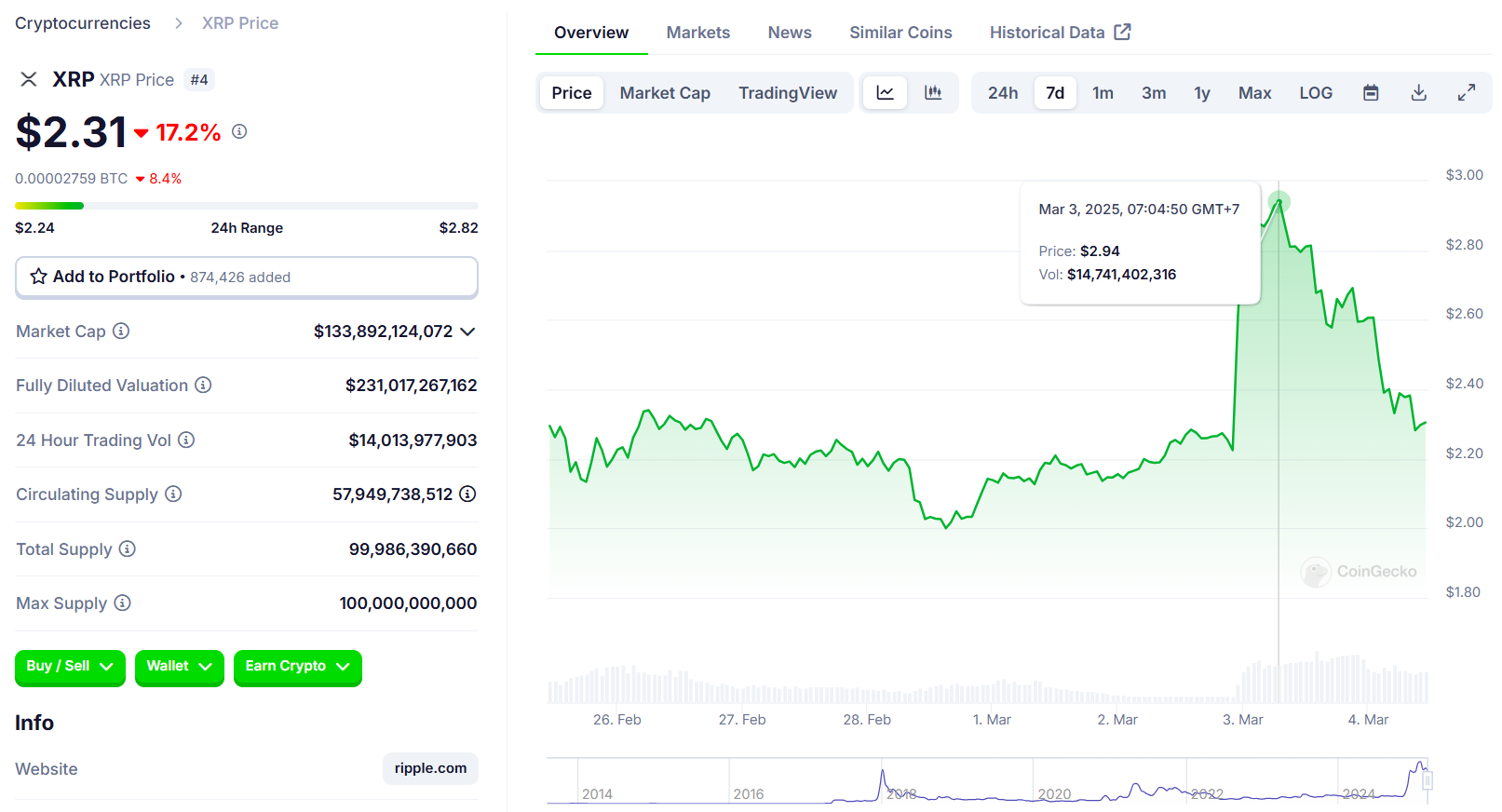
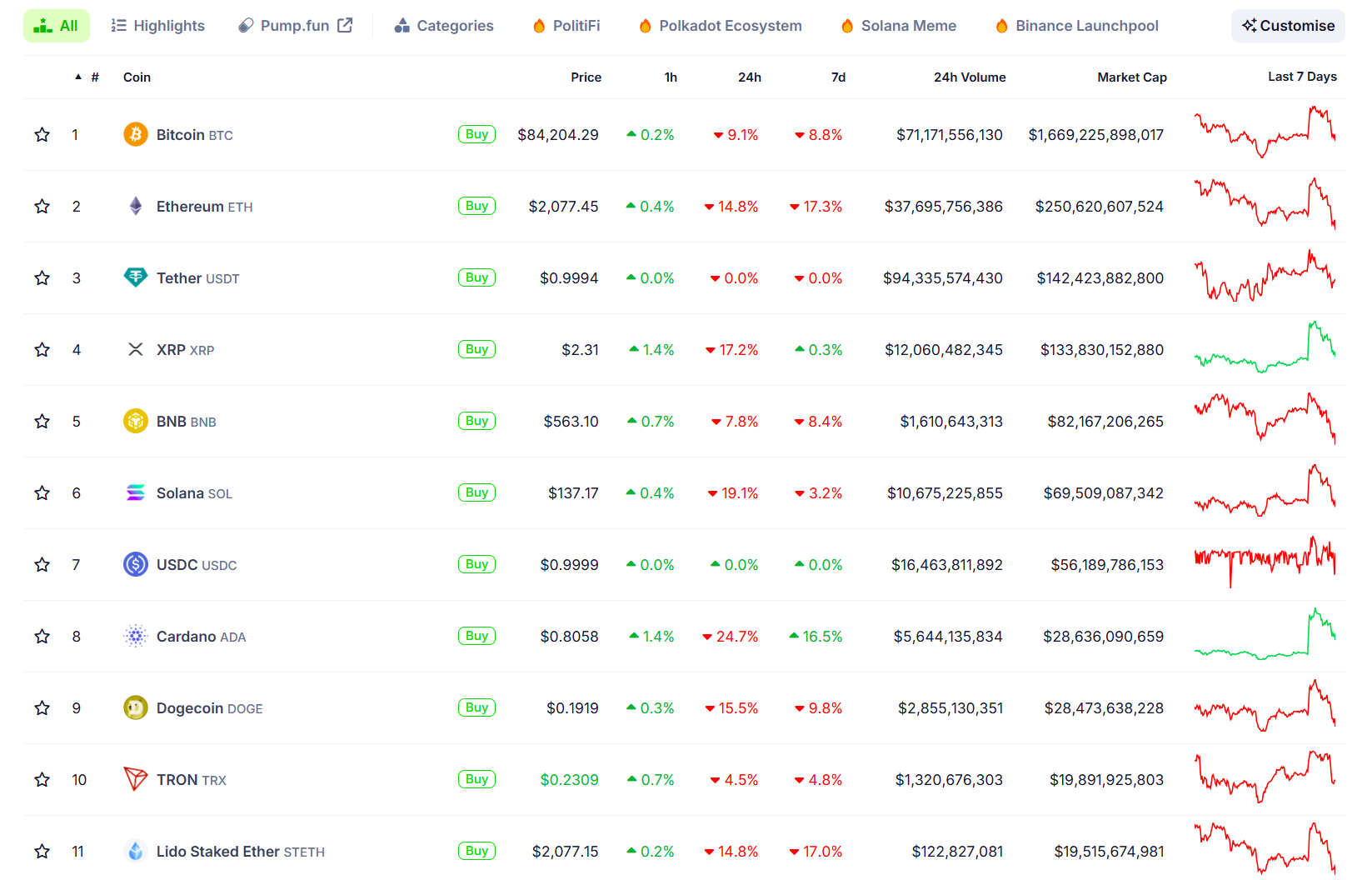
XRP, Cardano (ADA), and Solana (SOL)—the three leading crypto assets that posted major gains on Trump’s proposed crypto reserve—have now suffered steep losses, posting double-digit declines as market sentiment shifts.
According to data from CoinGecko, XRP dropped 17% in the last 24 hours, erasing gains that followed Trump’s earlier statement about including the crypto asset in the US reserve. The asset had previously surged over 25%, reaching nearly $3.
ADA and SOL experienced similar declines, falling approximately 25% and 20% respectively. ADA, which had surged over 75% to above $1 on Sunday, retreated below $0.8. SOL declined from $177 to $135.
The total crypto market cap has shrunk by over 12% over the past 24 hours. Bitcoin, after surging past $94,000 on Sunday, has pulled back. The digital asset is now trading at around $83,700, down almost 10%.
The second largest crypto asset, Ethereum, is down around 15%, while plenty of lower cap coins are down even further.
Tariffs on Canada and Mexico to take effect tomorrow
Trade war fears swiftly extinguished the hype that had built up around the US crypto reserve.
The market downturn intensified after Trump confirmed that 25% tariffs on Canada and Mexico each would take effect on Tuesday.
“They’re going to have to have a tariff. So, what they have to do is build their car plants — frankly — and other things in the United States, in which case they have no tariffs,” Trump stated.
Regarding China, the White House also announced a 20% tariff on Chinese imports. Initially, a 10% tariff was imposed, and as of March 4, 2025, an additional 10% tariff has been added.
This marks a sharp escalation in the U.S.-China trade war, with tariffs increasing much faster than during Trump’s first term.
These tariffs raise the cost of trade between the US, Canada, and Mexico, which could hurt businesses and economic growth.
Economic growth forecasts slashed
The US economy may be contracting at its fastest pace since the COVID-19 lockdown, according to the Federal Reserve Bank of Atlanta’s GDPNow model, which now projects a 2.8% decline in gross domestic product for the first quarter of 2025.
Just a month ago, the same model estimated the economy was on track for nearly four percent growth. While GDP forecasts can be volatile, other economic indicators—such as a record-high trade deficit, falling consumer confidence, and slowing spending—reinforce concerns about a deepening slowdown.
If realized, this contraction could mark the beginning of what some analysts are calling a “Trumpcession,” drawing comparisons to the sharp economic decline of 2020.
How did these affect crypto?
According to The Kobeissi Letter, mounting economic uncertainty and trade war fears have already weighed on financial markets.
The real driver here is the GLOBAL move towards the risk-off trade.
As trade war tensions rise and economic policy uncertainty broadens, ALL risky assets are falling.
This was seen in stocks, crypto and oil prices which all fell sharply today.
— The Kobeissi Letter (@KobeissiLetter) March 4, 2025
The financial markets have experienced a sudden sell-off in the past few hours, and the downturn was largely driven by weakness in the US stock market, triggered by recent announcements from President Trump.
The stock market downturn spilled over into crypto, as investors sold off risky assets in response to economic uncertainty. Higher tariffs could slow economic growth, reducing investor appetite for speculative assets like Bitcoin and altcoins.
Bitcoin has dropped 21% from its all-time high, warned Wolfe Research.
Analysts suggest Bitcoin could fall to $70,000 if the $90,000 level isn’t reclaimed.
Share this article
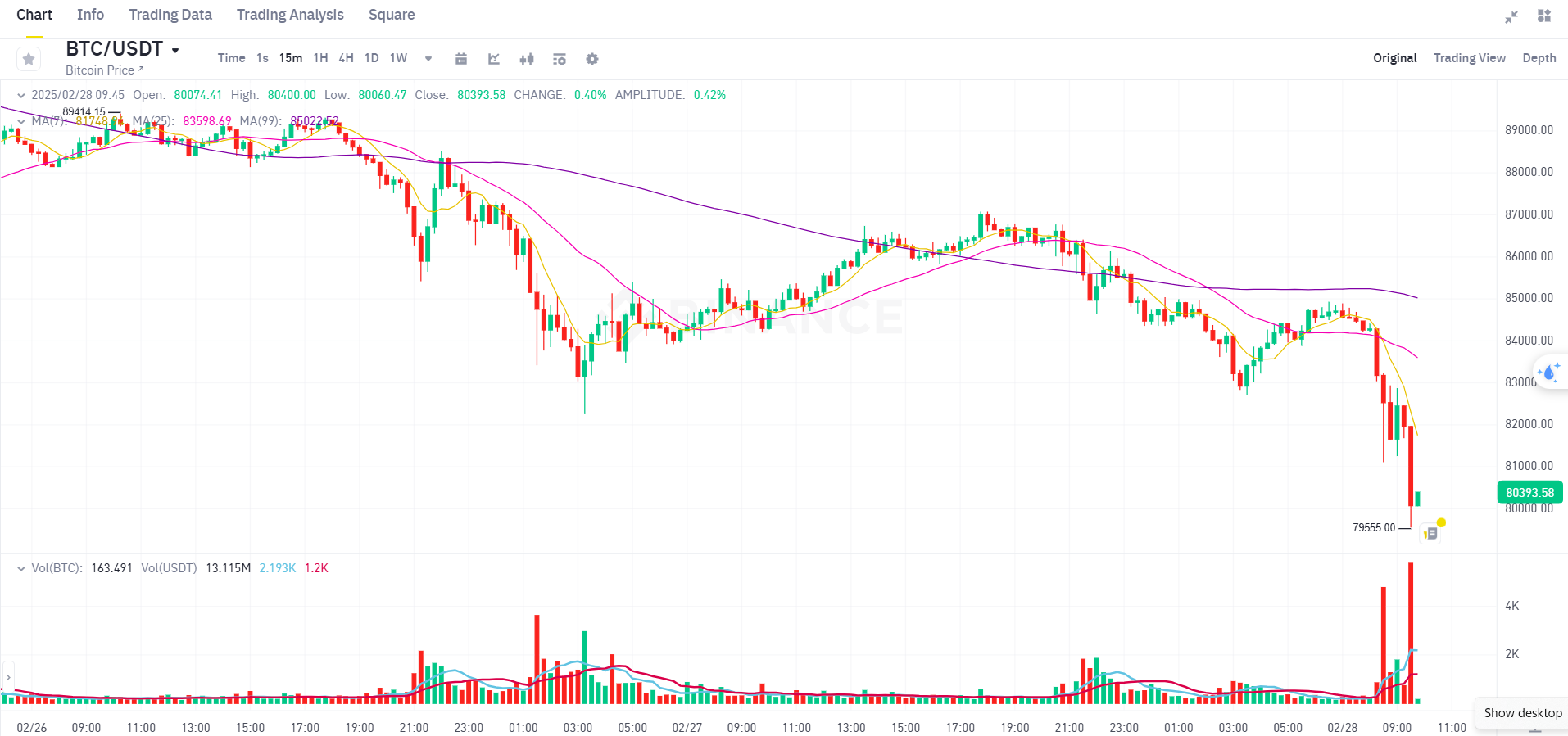
Bitcoin hit a low of $79,500 on Binance on Thursday, marking a 26% decline from its January peak, as broader market risk aversion continues to pressure crypto assets.
The leading digital asset could retreat to $70,000 — a level not seen since Election Day — if it fails to reclaim $90,000, according to Wolfe Research.
A drop to the mid-$70,000 range is possible, Wolfe analyst Read Harvey warned, noting that a break below the key $91,000 support signals a bearish turn, and current price action is concerning.
“$91,000 acted as the floor over the past several months. With that level now decisively taken out, anything less than another V-shaped oversold response would send a very bearish message. So far not so good,” Harvey stated, as reported by CNBC.
If bearish sentiment intensifies, Harvey predicts prices could fully reverse to their pre-election levels.
President Trump’s decision to impose tariffs on major trading partners, including Mexico, Canada, and China, has ignited concerns about an economic slowdown, despite earlier optimism following the election, inauguration, and executive order on crypto.
When investors are feeling uncertain about the economy, they tend to de-risk, with consequences spanning stocks, commodities, and crypto assets, according to Harvey.
“Uncertainty is at the forefront of investors’ concerns and the willingness to take on risk is rapidly waning,” the analyst said.
“The crypto market is feeling the pressure, with both major and altcoins experiencing significant selloffs, and traders are responding by seeking safety over upside gains. In particular, the demand for downside protection has surged,” said Nick Forster, Derive Protocol’s founder, in a Thursday note.
According to Forster, the massive outflows from spot Bitcoin ETFs signal growing risk aversion among institutional investors. The exodus is fueling selling pressure across the crypto market, raising concerns about a potential negative feedback loop where cascading sell-offs further depress prices.
“The fear is that this could create a negative feedback loop, where continued selling drives more selling, further driving prices lower,” he said.
Trust issue
The crypto industry continues to face trust challenges despite regulatory progress and technological improvements, according to Magic Eden co-founder Jack Lu.
Recent weeks have seen positive developments in crypto regulation, including Congressional efforts to establish an industry framework. However, consumer confidence remains elusive amid ongoing security incidents and fraudulent schemes.
The Libra scandal has eroded trust among investors. Kelsier Ventures, led by CEO Hayden Davis, is now seen as a key player in a network of fraudulent schemes. The firm has been allegedly linked to multiple meme coin projects, including tokens like MELANIA and others.
Cybersecurity vulnerabilities are still a major concern, especially in light of the recent attack targeting Bybit. Even with regulation, the regulation itself is seen as less protective than traditional financial regulation, American University Washington College of Law professor Hilary Allen told Bloomberg.
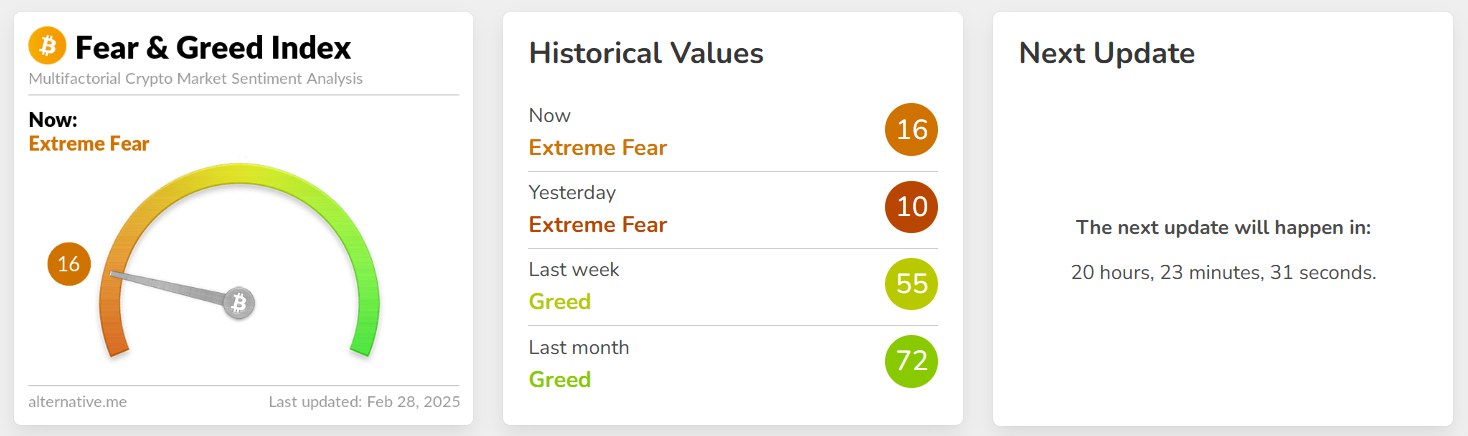
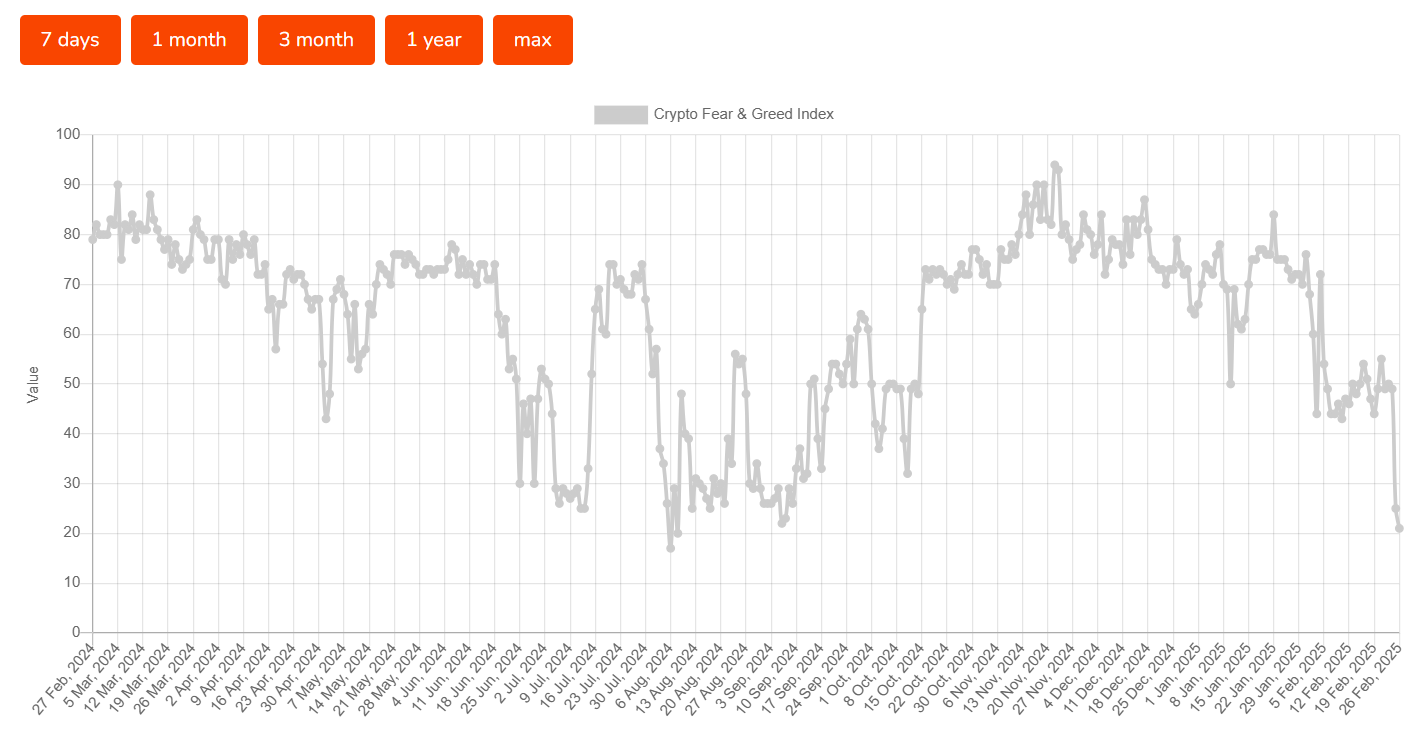
The crypto market’s total capitalization dropped below $3 trillion, a low not seen since November, and market sentiment, as indicated by the Fear and Greed Index, is still deeply pessimistic.
BlackRock moved 5,100 Bitcoin and 30,000 Ether to Coinbase Prime on Thursday.
IBIT has seen $741 million in outflows this week amid Bitcoin price volatility and strategic hedge fund actions.
Share this article
BlackRock moved 5,100 Bitcoin worth approximately $441 million and 30,000 Ether valued at about $71 million to Coinbase Prime within the last hour, as tracked by Arkham Intelligence.
The transfer follows BlackRock’s Tuesday movement of $160 million in Bitcoin and $44 million in Ethereum to Coinbase Prime, amid mounting pressure on BlackRock’s flagship Bitcoin ETF, the iShares Bitcoin Trust (IBIT).
IBIT has experienced negative performance for three consecutive days, with approximately $741 million in net outflows so far this week, based on Farside Investors data. US-listed spot Bitcoin ETFs recorded their largest single-day outflows of over $1 billion on Tuesday, with IBIT accounting for $164 million of the withdrawals.
Given the recent Bitcoin ETF sell-off, with IBIT posting negative performance for three consecutive days, the deposit raises concerns about further liquidations.
The latest transfers come as Bitcoin recovered slightly above $86,000 after dropping to $83,000 on Tuesday, its lowest level since November 2024.
BitMEX co-founder Arthur Hayes previously warned that hedge funds employing an arbitrage strategy—long IBIT and short CME futures for enhanced yield—pose a potential risk to Bitcoin’s price.
He cautioned that if the basis spread narrows during a Bitcoin decline, these funds might sell IBIT and buy back futures, potentially driving the price towards $70,000.
Bitcoin ETFs recorded a record $935 million net outflows amid a sell-off driven by macroeconomic concerns.
The crypto market’s downturn is fueled by investors’ risk aversion due to tariff threats and inflation concerns.
Share this article
US spot Bitcoin ETFs posted around $935 million in net outflows on Tuesday, extending their losses so far this week to approximately $1.5 billion.
The massive withdrawal continued during a sharp crypto market sell-off, with investors retreating from risk assets in dealing with growing macroeconomic concerns after President Trump’s tariff threats.
According to data combined from Farside Investors and Trader T, Fidelity’s FBTC led the exodus with around $344 million in outflows, followed by BlackRock’s IBIT with almost $162 million in redemptions.
Meanwhile, Bitwise’s BITB and Grayscale’s BTC each recorded over $85 million in net outflows.
Franklin Templeton’s EZBC lost $74 million, with Grayscale’s GBTC and Invesco’s BTCO declining by $66 million and $62 million respectively.
Competing funds managed by Valkyrie, WisdomTree, and VanEck also reported net outflows.
Intense outflows eclipsed the previous record set on Dec. 19, when the group of spot Bitcoin ETFs saw nearly $672 million in withdrawals after Bitcoin sank below $97,000.
The withdrawals surpassed the previous record of $672 million set on December 19, marking the sixth consecutive day of outflows for the ETF group, which saw $539 million withdrawn on Monday.
Bitcoin touched $86,000 today, its lowest level since November, and currently trades at $88,000, down 7% over the past week, per TradingView. The total crypto market cap has declined 3.5% over the past 24 hours.
The steep decline across all assets triggered $1.6 billion in leveraged liquidations on Monday, Crypto Briefing reported.
Former BitMEX CEO Arthur Hayes warned of a potential market downturn as hedge funds unwind their basis trades involving Bitcoin ETFs.
“Lots of $IBIT holders are hedge funds that went long ETF short CME futures to earn a yield greater than where they fund, short term US treasuries,” Hayes said. He cautioned that if Bitcoin’s price falls, “these funds will sell $IBIT and buy back CME futures.”
The market turmoil follows President Trump’s reactivation of tariffs on goods from Mexico and Canada, which reignites inflation fears, pushing investors away from risk assets.
The Crypto Fear and Greed Index, a measure of crypto markets’ sentiment, has dropped from 25 to 21, remaining in the “extreme fear zone.”