Wednesday, February 4, 2026
Home Blog Page 78

Bitcoin rebound to $88.5K stirs retail optimism, but there’s a catch: Santiment

0


Key Takeaways

  • Bitcoin surged to $88,500 following a period of fear when prices dipped to $78,000.
  • Arthur Hayes projects Bitcoin will exceed $110,000 due to anticipated US Fed policy shifts.

Share this article

Bitcoin’s resurgence to $88,500 has reignited optimism among retail traders, but blockchain analysis firm Santiment’s analysis of social media predictions suggests caution.

In late February and early March, Bitcoin faced major pressure, with prices dropping to $78,000 twice. The decline was driven by several factors, including President Trump’s economic policies and tariffs, as well as macroeconomic factors.

Concerns about inflation and potential tighter monetary policies by the Fed contributed to risk-off sentiment, making Bitcoin and altcoins less appealing compared to safer assets.

During the same period, gold prices reached new highs, touching $3,057 in March 2025 after hitting $2,956 per ounce in February.

The price decline led to widespread fear among traders and investors. However, the second half of March brought a sharp reversal, with Bitcoin rebounding to $88,500.

The recent price recovery has shifted market sentiment toward mild greed, according to Santiment.

Santiment’s social media analysis shows traders are making bullish price predictions ranging from $100,000 to $159,000 for Bitcoin, while bearish forecasts span $10,000 to $69,000.

Santiment warns that crowd sentiment often signals the opposite of what actually happens next.

History suggests that when the majority of social media users predict soaring prices, the market is more likely to experience a downturn, the firm states. Conversely, when pessimism dominates and predictions turn bleak, prices tend to recover.

Santiment suggests caution during periods of extreme market sentiment. When social media is flooded with posts declaring “to the moon” or “lambo time,” it may be a warning sign of an impending correction.

“When you see “crypto is dead” or “bitcoin is a scam”, this should be music to your ears,” the firm noted.

Bitcoin traded at around $87,200 at press time, showing a 6% gain over the past week, according to CoinGecko data.

Arthur Hayes, co-founder of BitMEX, forecasts Bitcoin will surpass $110,000, propelled by the US Fed transitioning from quantitative tightening to easing. This shift may inject liquidity into the market, bolstering the price of Bitcoin.

Markus Thielen, 10X Research founder, suggests that while easing measures and relaxed tariff discussions could support Bitcoin’s recovery, immediate catalysts for a dramatic surge appear limited.

Share this article


Hyperliquid whale denies cybercrime claims, ZachXBT to release evidence

0


Key Takeaways

  • The Hyperliquid whale is defending against allegations by ZachXBT of using illicit funds.
  • ZachXBT plans to release further evidence detailing the origins of the trader’s funds.

Share this article

An infamous trader known as the ‘Hyperliquid whale’ has publicly defended himself against cybercrime allegations made by on-chain investigator ZachXBT.

ZachXBT on Tuesday accused the crypto whale, now operating under the X handle @qwatio and using the name MELANIA, of cybercriminal activity.

The claim came after the trader opened a massive $445 million short position on Bitcoin using 40x leverage, betting on a price decline. This position drew market attention and led to an attempted “short squeeze” by other traders, which ultimately failed.

The crypto whale avoided liquidation despite being aggressively “hunted” and closed the position with over $9 million in profit on Tuesday.

ZachXBT reported that while the community was intrigued by the so-called ‘Hyperliquid whale’, this individual was merely gambling with illicit funds.

The analyst did not reveal the trader’s identity at the time but confirmed there was no connection to the Lazarus Group.

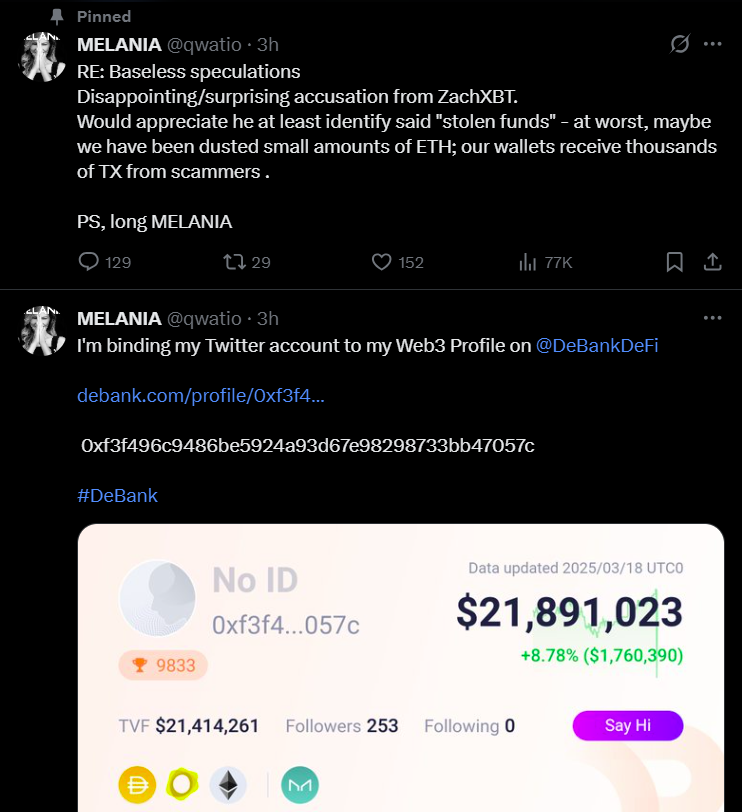
On Wednesday, the Hyperliquid whale took to X to deny these accusations. The trader directly confronted ZachXBT’s claims that he was using stolen funds for high-leverage trades.

“RE: Baseless speculations,” the trader stated, challenging ZachXBT to specify which stolen funds were in question, noting his wallet received thousands of transactions from various dubious sources.

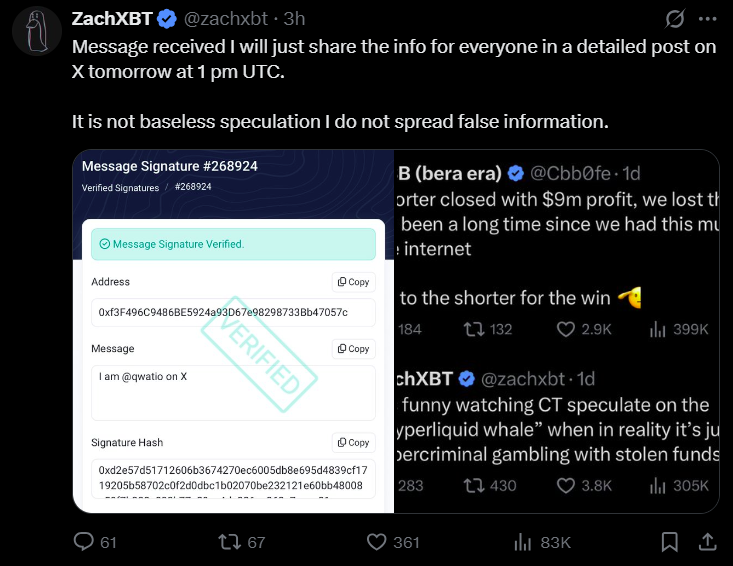
In response, ZachXBT said that he will release detailed evidence at 1 PM UTC tomorrow.

The investigator also shared preliminary evidence indicating that Hyperliquid whale’s X account was recently acquired.

ZachXBT showed some hints suggesting that the trader’s wallet received funds from victims of wallet-draining malware in January 2025.

The wallet also received funds from potentially illicit sources, such as shady exchanges and online casinos, which are often associated with money laundering, according to ZachXBT’s findings.

The infamous trader also opened a 5x leveraged long position on the MELANIA token, and still holds this position, according to Hypurrscan data.

Share this article


Solana futures ETFs go live tomorrow, bringing spot ETF one step closer

0


Key Takeaways

  • After securing a DTCC listing in February, Volatility Shares’ Solana futures ETFs start trading tomorrow.
  • Bloomberg analysts estimate a 75% chance of spot Solana ETFs approval this year.

Share this article

Volatility Shares is launching the first-ever ETFs tracking Solana futures tomorrow, marking a key milestone that could pave the way for a spot Solana ETF.

The move follows the regulatory playbook seen with Bitcoin and Ether, where futures-based products were approved before spot ETFs gained clearance.

According to a Bloomberg report, Volatility Shares will launch two ETFs: The Volatility Shares Solana ETF (SOLZ), which will track Solana futures, and the Volatility Shares 2X Solana ETF (SOLT), which will offer twice the leveraged exposure. The funds will carry expense ratios of 0.95% and 1.85%, respectively.

“Our launch comes at a time of renewed optimism for cryptocurrency innovation in the US,” said Justin Young, the chief executive officer of Volatility Shares.

While the SEC has yet to approve a spot Solana ETF, the debut of these futures-based products signals increasing institutional demand.

Bloomberg Intelligence analysts estimate a 75% chance that a spot Solana ETF will receive regulatory approval this year.

Volatility Shares’ Solana futures ETFs were first listed on the Depository Trust & Clearing Corporation (DTCC) in February, making them eligible for clearing and settlement.

Now, after initially filing with the SEC in December, the funds are ready to begin trading. The firm also submitted a proposal for a -1x Solana ETF, which would allow investors to short Solana futures.

Solana, which has a market value of about $67 billion, initially gained prominence through Sam Bankman-Fried’s endorsement.

Despite challenges following FTX’s collapse in 2022, the asset has rebounded, drawing users with its lower transaction fees. However, Solana is still down about 30% year-to-date.

The news had no immediate effect on price, with SOL trading at $130 at press time.

Asset managers, including Franklin Templeton, Grayscale, and VanEck, have filed for spot Solana ETFs, along with 21Shares, Bitwise, and Canary.

Share this article


Fed keeps interest rates unchanged in March

0


Key Takeaways

  • The Federal Reserve maintained the federal funds rate unchanged between 4.25% and 4.50%.
  • According to BlackRock, a recession could benefit Bitcoin due to increased fiscal spending and monetary stimulus.

Share this article

The Federal Reserve kept interest rates unchanged today, maintaining the federal funds rate between 4.25% and 4.50% for the second consecutive meeting amid growing recession concerns fueled by the Trump administration’s economic policies.

The central bank has adjusted its 2025 economic forecasts, lowering GDP growth projections to 1.7% from the previous 2.1% in December, while simultaneously raising forecasts for unemployment to 4.4% from 4.3%, PCE inflation to 2.7% from 2.5%, and core PCE inflation to 2.8% from 2.5%.

The Fed projects two 50-basis-point interest rate cuts in 2025, consistent with both market expectations and its December forecast.

The decision matched widespread market expectations. The CME Group’s FedWatch Tool indicated a 99% probability of the Fed maintaining its current target interest rates, reflecting near-unanimous market confidence in that outcome.

In its FOMC statement, the central bank highlighted a resilient labor market but voiced concerns about persistent inflation and global economic challenges. The Fed indicated it would carefully monitor inflation and labor market data before adjusting policy.

Fed Chairman Jerome Powell echoed this cautious approach last month, noting a strong economy that doesn’t yet warrant changes.

With his press conference minutes away, markets await clarity on what conditions might prompt future rate moves—and how the Fed views mounting economic risks.

Powell’s speech expected to bring clarity

This Wednesday’s meeting was the first since the enactment of Trump’s trade policies targeting China, Mexico, and Canada.

The Fed had already flagged these tariffs as a source of uncertainty at its January meeting, where rates also held steady.

Economists warn that Trump’s tariffs could reverse recent inflation progress by driving up consumer prices and inviting retaliation, potentially straining the economy.

US inflation data supports a cooling trend—the consumer price index rose 0.2% in February, lowering the annual rate to 2.8% from 3%, with core CPI also up 0.2%—yet tariff fears persist.

In an interview with Fox News’ Maria Bartiromo, Trump did not rule out the possibility of a recession. Treasury Secretary Scott Bessent added to recession concerns on March 10, stating he could not guarantee the US would dodge one.

Powell’s upcoming remarks are poised to address these tensions—tariffs, inflation, and recession risks.

Since the rate decision met expectations, his words will carry extra weight, potentially shaping market sentiment on whether Trump’s policies could tip the economy into downturn territory.

Bitcoin could thrive in a recession despite short-term market fears: BlackRock

As concerns over tariffs and recession mount, talk about Bitcoin heats up.

BlackRock’s Global Head of Digital Assets, Robbie Mitchnick, sees a recession as a potential catalyst for Bitcoin, noting that increased liquidity and monetary stimulus could fuel its rise.

“Bitcoin is long liquidity in the system. It’s catalyzed by more fiscal spending and debt and deficit accumulation. That happens in a recession,” he said during Yahoo Finance’s Market Domination Overtime on Tuesday. “It’s catalyzed by lower interest rates and monetary stimulus.”

Comparing Bitcoin to gold, Mitchnick explained that while Bitcoin is fundamentally an uncorrelated asset, market sentiment sometimes creates short-term price correlations.

He argued that Bitcoin should act as a global, decentralized, and non-sovereign asset akin to digital gold but acknowledged that short-term interest rate expectations and investor sentiment could influence its price.

Despite recent market pullbacks, Bitcoin is still up approximately 15% since the beginning of November.

Share this article


Michael Saylor’s Strategy acquires 130 Bitcoin at an average price of $82,981

0


Key Takeaways

  • Strategy scooped 130 Bitcoin during the week ending March 16.
  • The acquisition was funded by selling series A preferred stock, generating $10.7 million in net proceeds.

Share this article

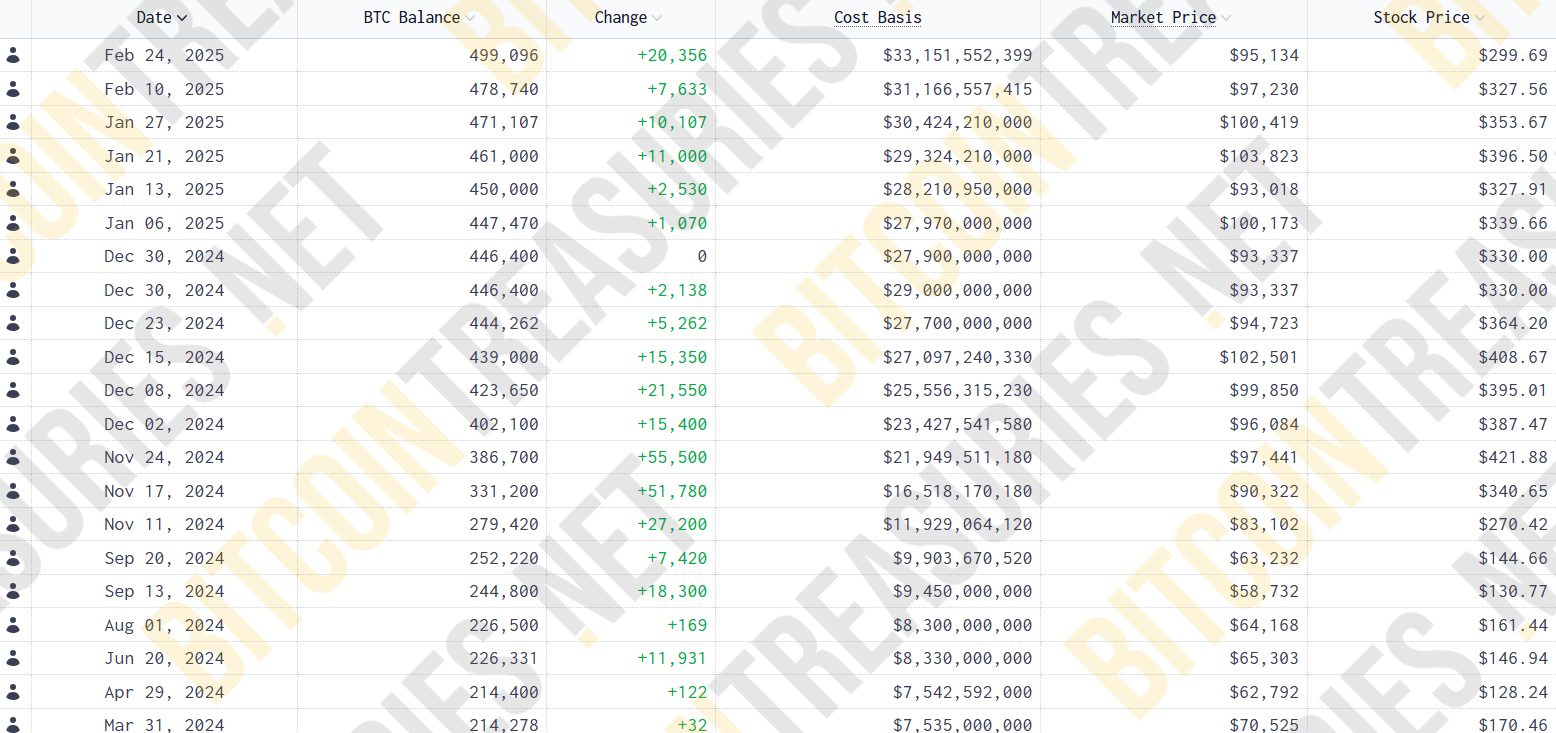
Business intelligence firm Strategy, formerly known as MicroStrategy, said today it had acquired 130 Bitcoin for $10.7 million at an average price of $82,981 per coin between March 10 and March 16.

The company resumed Bitcoin acquisitions after a two-week pause, following the purchase made in the week ending February 23. Last week’s acquisition was the smallest since April, according to data from Bitcoin Treasuries.

MSTR BTC Purchase

According to Strategy’s latest disclosure with the SEC, the purchase was funded by proceeds from the sale of 123,000 shares of Strategy’s 8.00% series A perpetual strike preferred stock (STRK Shares), which generated approximately $10.7 million in net proceeds. The company confirmed that no Class A common stock was sold during the same period.

The company’s total Bitcoin holdings now stand at 499,226 BTC, valued at over $41.6 billion. Strategy’s co-founder and executive chairman Michael Saylor said the company’s total holdings were purchased at an average price of $66,360 per BTC, including fees and expenses. The firm currently holds more than 2% of Bitcoin’s total 21 million supply.

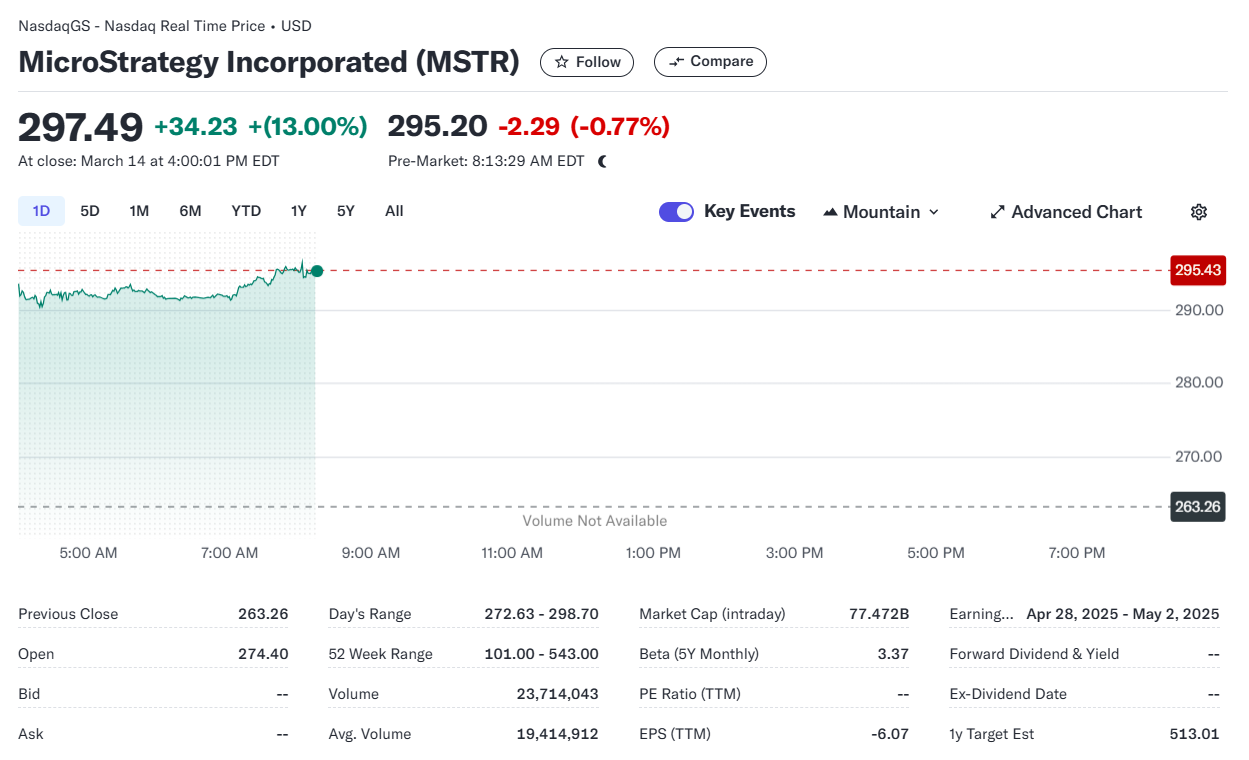
The company’s shares (MSTR) closed Friday up 13% at around $297, having gained more than 77% over the past year, according to Yahoo Finance data. The stock is trading slightly lower in pre-market trading today.

MSTR closed Friday up 13%

Share this article


Standard Chartered slashes Ether’s year-end target from $10K to $4K

0


Key Takeaways

  • Standard Chartered reduced its Ether year-end target to $4,000 due to a structural decline.
  • Layer 2 blockchains have contributed to reducing Ether’s market cap by $50 billion.

Share this article

Standard Chartered predicted that Ethereum could hit $10,000 by the end of 2025 in a forecast made in January. Now the bank has revised its year-end target for the digital asset, reducing it by 60%.

According to a report released today, the adjustment is based on Standard Chartered’s observation that Ethereum is facing increasing competition from layer 2 solutions, prominently Base. Plus, Dencun, Ethereum’s recent upgrade, does not help the network maintain its market dominance.

Standard Chartered stated that Ethereum still leads in many key blockchain metrics, but its dominance has declined over time.

Layer 2 blockchains, originally designed to help Ethereum by improving scalability and reducing transaction fees, have shifted economic value away from Ethereum, the report noted.

Base’s model of sharing profits with its owner, Coinbase, is seen as a particularly effective competitive strategy. Standard Chartered estimates it has caused Ethereum’s market cap to decline by $50 billion and expects this downward trend to continue.

“Ether is at a crossroads,” the report said, noting that while it “still dominates on several metrics,” this dominance has been declining.

Despite ongoing challenges, Standard Chartered sees the tokenization of real-world assets as a potential growth driver for Ethereum.

According to the bank, Ethereum’s strong security framework could allow it to maintain an 80% market share in this emerging sector, which could stabilize or even reverse its structural decline.

Geoff Kendrick, head of digital assets research at Standard Chartered, suggests that “a proactive change of commercial direction from the Ethereum Foundation,” like taxing layer 2 solutions, could help counteract the ongoing loss of value to these networks. However, he believes the EF is unlikely to change its business model.

Standard Chartered forecasts the ETH/BTC ratio to fall to 0.015 by year-end 2027, which would mark its lowest level since 2017.

While the bank expects Ether’s price to recover from current levels due to a broader Bitcoin-led rally lifting all digital assets, it maintains that Ether will continue to underperform.

Last year, Standard Chartered projected that Ethereum would reach $8,000 by the end of the current year and $14,000 by the end of 2025.

Analysts at the bank believed that the primary catalyst for these price increases would be the approval of spot Ethereum ETFs in the US. They also considered the Dencun upgrade as another positive factor contributing to Ethereum’s potential price growth.

Earlier this year, Standard Chartered predicted that Ethereum could reach $10,000 by the end of 2025 as a result of a favorable environment for crypto growth under the new administration.

Ethereum traded at around $1,900 at press time, up slightly in the last 24 hours, per TradingView. The digital asset is down around 42% year-to-date and is still 60% off its all-time high.

Ethereum’s next major upgrade is the Pectra upgrade, which is scheduled to go live on the Ethereum mainnet next month. This upgrade aims to enhance network performance, improve validator participation, and introduce several key features like EIP-7702 and EIP-7251.

Share this article


Coinbase files to launch Cardano, Natural Gas futures contracts

0


Key Takeaways

  • Coinbase is introducing futures contracts for Cardano and Natural Gas, pending CFTC approval.
  • Cardano futures allow traders exposure to price movements without holding the asset.

Share this article

Coinbase is seeking regulatory approval to launch Cardano (ADA) and Natural Gas (NGS) futures contracts—a move that would expand its offerings in the energy and crypto derivatives markets.

Coinbase Derivatives, Coinbase’s futures exchange, said Friday it had submitted documentation to the CFTC to self-certify futures for ADA and NGS.

Self-certification with the CFTC allows Coinbase to assert regulatory compliance with futures contracts, expediting their launch unless the CFTC raises objections. If approved, these new futures contracts are expected to go live on March 31.

The move follows Coinbase’s recent introduction of Solana (SOL) and Hedera (HBAR) futures contracts, and is part of the firm’s ongoing strategy to provide traders access to both crypto and traditional futures trading on a single regulated platform.

Cardano is one of the most prominent blockchain platforms, known for its focus on scalability, sustainability, and security. With a dedicated ecosystem and increasing adoption of DeFi, NFTs, and enterprise blockchain solutions, Cardano is a natural addition to Coinbase’s futures lineup.

The ADA futures would allow traders to gain exposure to Cardano’s price movements without holding the underlying asset, enabling advanced risk management and leveraged trading strategies.

Following Coinbase’s announcement, ADA surged around 2% to $0.75, per CoinGecko.

The Natural Gas futures offering would position Coinbase to compete with traditional futures exchanges in the energy sector, where the commodity plays a crucial role in global markets and economic stability.

The SEC has been cautious about approving crypto ETFs, but the launch of futures contracts may help alleviate some concerns by providing a regulated framework for price discovery and risk management. This could make the SEC more inclined to approve ETFs, especially if futures trading demonstrates market stability.

Grayscale Investments is the only manager that has filed for a spot Cardano ETF. This filing was submitted through NYSE Arca, which proposed to list and trade shares of the Grayscale Cardano Trust on the exchange.

On Tuesday, the SEC postponed its decision regarding the proposed Grayscale’s spot ADA ETF and also extended the review period for other crypto ETFs.

Share this article