Wednesday, September 30, 2026
Home Blog Page 22

Whales move over 44,000 Bitcoin to exchanges ahead of Fed meeting

0


A large volume of Bitcoin was moved to centralized exchanges by major holders yesterday, sparking concerns that prices could face downward pressure ahead of the Federal Reserve’s key policy meeting.

The transfers, reported by CryptoQuant analyst Maartunn, originated from addresses controlling at least 100 BTC. These holders sent 44,459 BTC to exchanges on Tuesday, an amount estimated to be worth $3.2 billion at current market rates.

Whale movements of this scale have historically coincided with periods of increased market activity, as large holders often move assets to exchanges for a range of purposes, including trading, rebalancing, or liquidity provision.

Bitcoin hovered near $73,000 at the time of writing, marking a 1.5% decline in the last 24 hours, per CoinGecko. The asset fell from above $74,000 to around $72,900 over the past hour as traders braced for increased market swings.

It’s not just the Fed decision driving attention today, as several macro developments could influence market direction.

The US Producer Price Index, set for release Wednesday morning, will provide a fresh reading on inflation at the wholesale level, following recent consumer data.

Analysts are focused on whether higher energy prices tied to Middle East tensions are beginning to filter through.

Disclosure: This article was edited by Vivian Nguyen. For more information on how we create and review content, see our Editorial Policy.


Tim Scott expects stablecoin yield compromise proposal by week’s end

0


Senator Tim Scott, chair of the Senate Banking Committee, says he expects to receive a compromise proposal on stablecoin yield provisions before the end of this week. If that timeline holds, it would mark a significant step toward resolving the single biggest sticking point that has stalled US stablecoin regulation for months.

The yield question — whether stablecoin issuers should be allowed to pass interest earnings back to token holders — has been the legislative equivalent of a kitchen renovation that keeps finding new problems behind the walls. Everyone agrees the work needs doing. Nobody can agree on the plumbing.

Why yield is the sticking point

Here’s the thing. Stablecoin issuers like Circle and Tether hold tens of billions of dollars in US Treasuries and other short-term instruments as reserves backing their tokens. Those reserves generate yield. Right now, issuers keep that income — it’s how they make money.

The debate in Congress centers on whether issuers should be permitted to share some of that yield with stablecoin holders, essentially turning stablecoins into something that looks a lot like a savings account or money market fund.

Banks hate this idea, for obvious reasons. If a stablecoin on your phone pays 4% while your checking account pays 0.01%, the competitive dynamics get uncomfortable fast. Traditional finance lobbyists have pushed hard to either ban yield-bearing stablecoins outright or subject them to full banking regulation.

Crypto advocates argue the opposite: blocking yield means protecting bank margins at the expense of consumers. In their view, stablecoin yield is just passing along what the market already generates, and restricting it would hobble the entire value proposition of dollar-denominated digital assets.

The compromise Scott expects to review will presumably try to thread this needle. The details haven’t leaked yet, but prior discussions have floated options ranging from yield caps to requiring issuers to obtain specific licenses before offering interest to holders.

The broader legislative picture

Stablecoin regulation has been Congress’s most promising crypto legislation for the better part of two years. The GENIUS Act, which would create a federal framework for stablecoin issuance, passed out of the Senate Banking Committee earlier this year but stalled on the Senate floor amid bipartisan concerns about anti-money laundering provisions and — you guessed it — the yield question.

The stablecoin market itself isn’t waiting around. Total stablecoin market capitalization sits above $230B, with Tether’s USDT alone accounting for roughly $140B. Circle’s USDC commands about $55B. These are no longer niche instruments. They process more transaction volume than many traditional payment networks.

Scott has made stablecoin legislation a stated priority for this Congress, and the timeline pressure is real. Legislative windows in Washington close faster than they open, and midterm positioning will start consuming oxygen soon enough.

What this means for investors

If the compromise leans toward permitting yield — even in a restricted form — it would be a significant catalyst for stablecoin adoption. A regulated, yield-bearing dollar stablecoin would compete directly with money market funds, savings accounts, and Treasury bills for retail capital. That’s a massive addressable market.

For existing stablecoin issuers, the regulatory clarity alone would be valuable regardless of the yield specifics. Institutional players have consistently cited regulatory uncertainty as their primary barrier to deeper stablecoin integration.

The risk, as always, is that compromise means nobody gets what they actually want. A framework so restrictive that yield-bearing stablecoins become impractical would satisfy banks but potentially push innovation offshore. A framework too permissive could trigger a separate fight with the SEC over whether yield-bearing stablecoins constitute securities.

Watch for the actual text of the proposal. The difference between “issuers may offer yield with a state license” and “issuers may offer yield with a federal banking charter” is the difference between a functioning market and a regulatory moat.

Bottom line: Scott’s timeline suggests real momentum on the most contested element of US stablecoin policy. A compromise landing on his desk doesn’t mean legislation passes tomorrow, but it means the adults in the room have at least agreed on what the argument is actually about. For an industry that’s spent years waiting for Washington to catch up, that counts as progress.

Disclosure: This article was edited by Estefano Gomez. For more information on how we create and review content, see our Editorial Policy.


Bitcoin’s rally ran into a wall — and oil might be stealing its thunder

0


Bitcoin had one of those Monday mornings where everything looked great until it didn’t. The price briefly punched above $76K, giving bulls a fleeting moment of euphoria, then promptly slid back below $74.5K like someone yanked the rug at a house party.

By the time dust settled, BTC was hovering near $74K — still up roughly 5.8% on the week, but well off its intraday highs. The culprit isn’t just the usual crypto volatility. This time, old-economy heavyweights like crude oil and metals are siphoning attention and capital away from digital assets at exactly the wrong moment.

The macro gauntlet ahead

Here’s the thing about this week: it’s not just any week. Both the Federal Open Market Committee and the Bank of Japan are set to deliver interest rate decisions in the coming days, and traders are positioning accordingly.

The FOMC is widely expected to hold rates steady, but the language around future cuts matters enormously. Any hint that the Fed is less dovish than markets hope could drain risk appetite from crypto faster than a memecoin rug pull.

Japan’s central bank adds another layer of complexity. The Bank of Japan has been slowly unwinding its ultra-loose monetary policy, and any hawkish surprise could strengthen the yen and trigger another round of the carry-trade unwinding that rattled global markets last summer.

In English: when two of the world’s most powerful central banks speak in the same week, every asset class holds its breath. Bitcoin, for all its “digital gold” branding, is no exception.

The Fear and Greed Index sits at 28, firmly in “Fear” territory. That’s actually an improvement from last week’s reading of 13, which qualified as “Extreme Fear.” Progress, sure — but the kind of progress where you’ve moved from the emergency room to the regular hospital ward.

Oil and metals are the new shiny objects

Perhaps the most interesting dynamic right now isn’t happening on crypto exchanges at all. It’s happening in commodity markets.

Iran-driven geopolitical tensions have sent crude oil and metals surging, creating what traders call a “real asset bid” — capital flowing toward things you can physically touch, or at least that represent something physical. When bombs are a non-zero probability, investors tend to favor barrels of oil over blocks of code.

This isn’t purely a traditional finance phenomenon either. Onchain commodity platforms are seeing the spillover firsthand. Hyperliquid, the decentralized perpetuals exchange that has become a favorite among DeFi power users, is reportedly processing heavy volume in energy-linked contracts. The crypto-native crowd, it seems, would rather trade oil derivatives on a blockchain than buy more Bitcoin right now.

That’s a telling signal. When even crypto degens are pivoting to commodity exposure, it suggests the narrative momentum has genuinely shifted — at least for this news cycle.

The broader pattern is familiar to anyone who watched markets during the 2022 Russia-Ukraine escalation. Geopolitical risk tends to benefit hard commodities first, safe-haven currencies second, and risk assets like crypto… well, eventually. Bitcoin’s long-term thesis as a hedge against chaos is compelling in theory, but in practice, the initial capital flight almost always goes somewhere more traditional.

Where the rest of the market stands

Beyond Bitcoin, the altcoin landscape tells a mixed story. Ethereum hovered around $2,300, posting a modest 1.8% gain over 24 hours but still struggling to reclaim the psychological $2,500 level that once felt like a floor.

Solana held steady near $94, essentially flat on the day with a marginal 0.2% dip. For an asset that was trading above $250 late last year, “steady near $94” is the kind of stability nobody actually wanted.

XRP was the quiet outperformer, climbing past $1.50. The token has benefited from ongoing positive developments in Ripple’s legal situation, giving it a narrative tailwind that most altcoins lack right now.

One corner of the market did post eye-catching numbers: projects in the Binance Wallet IDO category surged 119.9% over the past seven days. That’s the kind of return that makes headlines, though it’s worth noting these are typically low-cap, high-volatility tokens where a single listing event can move prices dramatically. Not exactly a barometer for the broader market’s health.

What investors should watch

The setup here is genuinely tricky for crypto allocators. On one hand, Bitcoin’s weekly gain of 5.8% and the Fear and Greed Index climbing from 13 to 28 suggest the worst of the recent panic may be fading. Sentiment recoveries from extreme fear have historically preceded meaningful rallies — not always immediately, but often within weeks.

On the other hand, the macro calendar is loaded with potential landmines. If the FOMC signals patience on rate cuts while oil keeps surging on geopolitical fears, the inflation narrative gets resurrected. And nothing kills crypto momentum quite like the market deciding that rate cuts are getting pushed further into the future.

The commodity rotation is also worth taking seriously. When capital has a compelling reason to flow into oil, gold, and metals, crypto often finds itself competing for the same speculative dollars with fewer catalysts. Bitcoin’s correlation with risk assets means it can’t simply declare itself a safe haven and expect flows to follow.

Look, the key level to watch is whether BTC can reclaim and hold above $76K on a daily close. Monday’s rejection at that level suggests there’s meaningful selling pressure — likely a combination of profit-taking from traders who bought the recent dip and macro-driven hedging ahead of central bank decisions.

If Bitcoin breaks convincingly above $76K, the narrative shifts back to “resuming the bull trend.” If it fails again and slides below $72K, the Fear and Greed Index could easily revisit those extreme fear levels from last week.

Bottom line: Bitcoin’s 5.8% weekly bounce is encouraging, but Monday’s $76K rejection exposed a market that’s still nervous, still macro-dependent, and now competing with a geopolitical commodity trade that has its own powerful momentum. The next 72 hours of central bank decisions will likely determine whether this was a healthy pause or the start of another leg down.

Disclosure: This article was edited by Estefano Gomez. For more information on how we create and review content, see our Editorial Policy.


XRP breaks through $1.5 after double-digit weekly growth

0


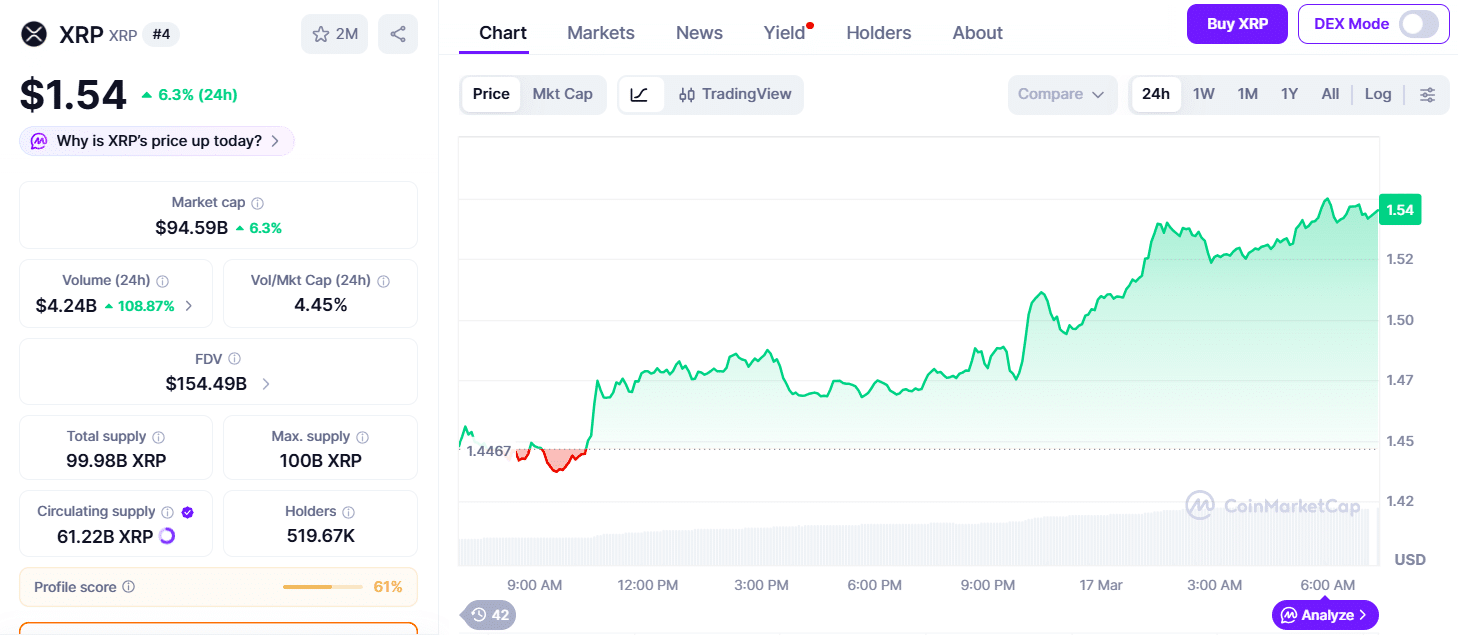
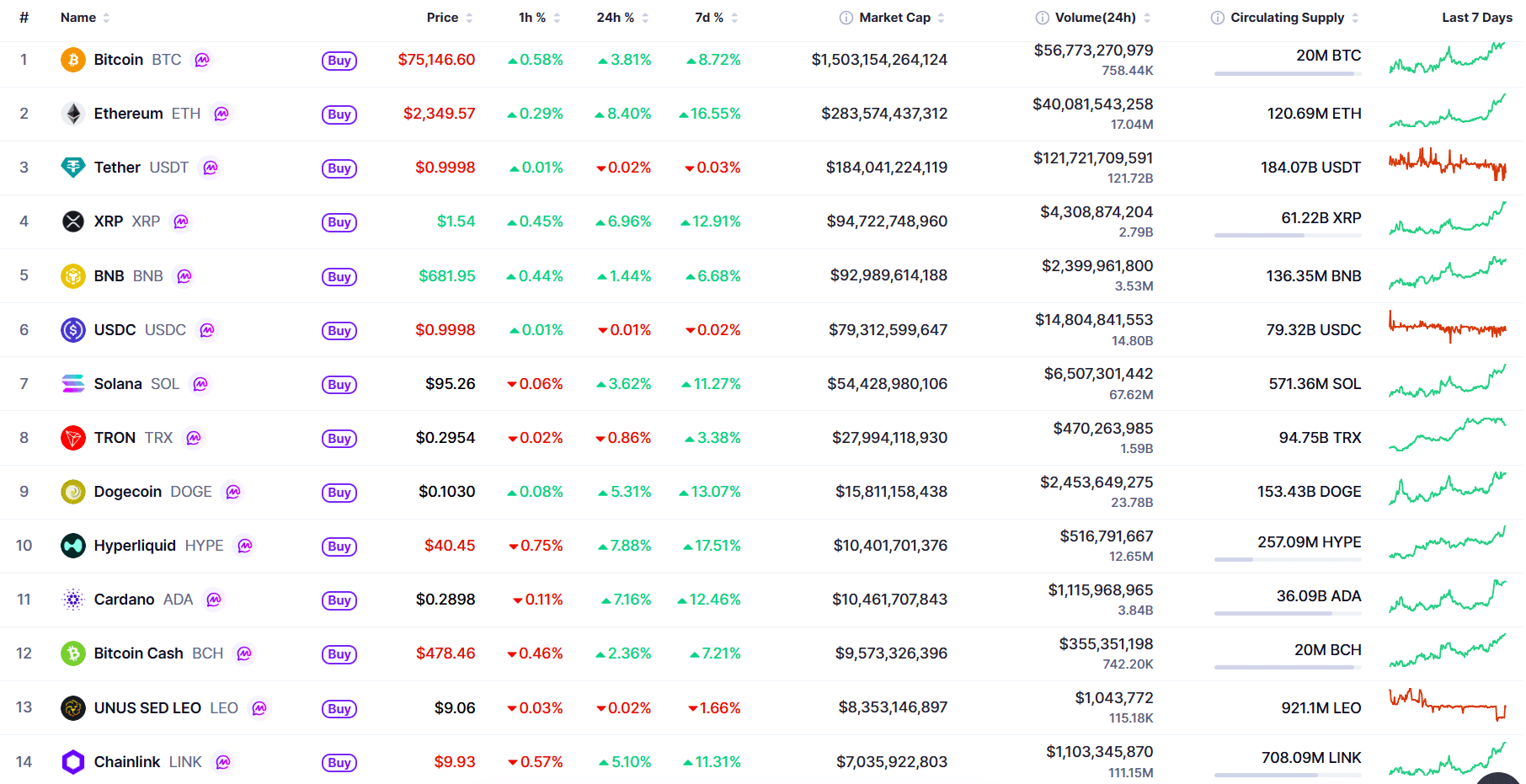
XRP surged past $1.5 on Monday, extending its gains as the crypto market rallied under Bitcoin’s lead. The token has climbed roughly 13% over the past week, driven by renewed investor interest and improving market sentiment, CoinMarketCap data shows.

The digital asset now boasts a market capitalization of $94 billion, surpassing BNB and reclaiming its position as the fourth-largest crypto by market value.

Trading volumes have spiked sharply alongside price movement, rising roughly 109% over the past 24 hours.

Despite these gains, XRP remains roughly 58% below its all-time high set last July.

The market’s upward momentum extends beyond XRP, with major crypto assets climbing higher ahead of a key Federal Reserve policy meeting.

The Federal Open Market Committee will meet tomorrow, and market participants are preparing for potential signals about interest rate trajectory and monetary policy.

Bitcoin has led the charge, climbing back above $75,000, while the total market capitalization has rebounded to $2.6 trillion, a 3.5% increase in the past 24 hours.

Other major tokens, including Ethereum, Solana, Dogecoin, and Cardano, have also posted double-digit gains during the same period.

The price surge comes despite persistent institutional outflows of XRP investment products.

Data from CoinShares shows XRP-focused funds recorded $76 million in net outflows over the past two weeks, lagging behind major digital assets such as Bitcoin and Ethereum, which attracted rising investor inflows.

Disclosure: This article was edited by Vivian Nguyen. For more information on how we create and review content, see our Editorial Policy.


Bitcoin eyes eight straight green days as ETF inflows fuel the rally

0


Bitcoin just posted its best price since early February, touching $74.5K as a sustained wave of institutional buying through spot ETFs continues to power the rally. The asset is now eyeing eight consecutive green daily candles — a streak that hasn’t happened in months.

Here’s the thing: while the price action screams confidence, the broader sentiment landscape is whispering something else entirely. The Fear and Greed Index sits at 23, deep in “Extreme Fear” territory. That’s up from a brutal 8 last week, but still the kind of reading you’d expect during a crash, not a rally.

The ETF engine keeps humming

Institutional inflows into spot Bitcoin ETFs have topped $2.8B over recent weeks. That’s not a trickle — that’s a firehose of capital pointed directly at the asset.

BlackRock’s IBIT has been the standout, pulling in $307M in a single trading day. To put that in perspective, many mid-cap altcoins don’t see that kind of volume in a week. When the world’s largest asset manager is vacuuming up Bitcoin at that pace, the signal is hard to ignore.

The ETF flows represent something structurally different from previous Bitcoin rallies. This isn’t retail traders on leverage chasing green candles at 2 AM. It’s pension funds, wealth advisors, and institutional allocators moving through regulated vehicles. The buyer profile has fundamentally changed since the spot ETFs launched in January 2024.

Bitcoin was trading near $74K at the time of writing, up 3.3% on the day and 7% over the past seven days. That weekly gain alone outpaces what most traditional equity indices deliver in a quarter.

The rest of the market caught a contact high

Bitcoin’s rally didn’t happen in isolation. The broader crypto market joined in, with some assets outperforming BTC by a wide margin.

Ethereum climbed to around $2,300, posting a 9.4% gain over 24 hours — nearly triple Bitcoin’s daily move. Solana pushed toward $94, adding 6.8% on the day. XRP held steady near $1.50.

The real fireworks were in the speculative corners of the market. Meme coin PEPE surged roughly 20%, and Polkadot’s DOT climbed 10%. When meme coins start outperforming blue chips, it usually means risk appetite is returning — or at least trying to.

The top-performing category over the past week was Binance Wallet IDO tokens, which collectively rallied 111.6%. That’s the kind of number that makes you read it twice. It’s also the kind of number that tends to show up right before either a sustained breakout or a spectacular reversal. History doesn’t pick favorites.

Look, the altcoin rally is encouraging for bulls who want to see broad-based participation. A Bitcoin-only move can feel fragile. When capital starts rotating into ETH, SOL, and even meme coins, it suggests the rally has legs — or at least more participants willing to bet that it does.

The fear paradox

Now for the part that should make you pause.

The Fear and Greed Index reading of 23 is genuinely unusual for a market printing seven consecutive green days. Normally, a streak like this would push sentiment into neutral or even greed territory. The fact that it hasn’t suggests a large portion of market participants are either positioned short, sitting in stablecoins, or simply don’t trust the move.

In English: lots of people got burned recently and they’re not ready to believe the rally is real.

That skepticism can actually be bullish. Rallies that climb a “wall of worry” — where participants are reluctant and underinvested — tend to have more room to run than rallies driven by euphoria. When everyone is already all-in, there’s nobody left to buy. When the crowd is still scared, there’s dry powder on the sidelines.

Last week’s Fear and Greed reading of 8 was about as low as the index gets. The jump to 23 represents a meaningful improvement in sentiment, even if the absolute number still looks bleak. Think of it like going from “the house is on fire” to “okay, maybe just the kitchen.” Progress, technically.

The disconnect between price action and sentiment also raises a question about who exactly is doing the buying. If retail is scared, and the price is rising, the math points back to institutions. The ETF flow data supports that interpretation. BlackRock and its peers don’t check the Fear and Greed Index before placing orders.

For investors trying to make sense of this environment, a few things are worth watching. First, whether Bitcoin can close above $74K for multiple consecutive days. Intraday wicks are nice for headlines, but sustained closes above key levels are what matter for trend confirmation.

Second, keep an eye on ETF flow data. The $2.8B in recent inflows has been the primary catalyst. If those flows slow or reverse, the rally loses its main engine. BlackRock’s IBIT in particular has become something of a bellwether — when IBIT buying accelerates, Bitcoin tends to follow.

Third, watch the Fear and Greed Index trajectory. A move from 23 toward 40 or 50 would suggest the broader market is starting to participate. A drop back toward single digits would be a warning sign that the rally is running on institutional fumes alone.

The competitive landscape for Bitcoin has also shifted. With spot ETFs now firmly established, Bitcoin competes not just with other crypto assets but with gold, treasuries, and traditional portfolio hedges for institutional allocation. The $2.8B in recent inflows suggests it’s winning some of those allocation battles, at least for now.

Risks remain real. A sudden reversal in ETF flows, a macro shock, or a breakdown below key support levels around $69K could unwind the rally quickly. The Extreme Fear reading, while potentially bullish from a contrarian perspective, also reflects genuine uncertainty about the macro environment and regulatory landscape.

Bottom line: Bitcoin’s push to $74.5K is being driven by institutional capital, not retail enthusiasm — and that’s actually the more durable kind of rally. Eight straight green days against a backdrop of extreme fear is the market equivalent of someone calmly walking through a haunted house. Either they know something everyone else doesn’t, or they’re about to get spooked. The ETF flows suggest the former, but the smart move is watching those inflows like a hawk.

Disclosure: This article was edited by Estefano Gomez. For more information on how we create and review content, see our Editorial Policy.


Jane Street resumes Bitcoin trading amid scrutiny over alleged insider activity

0


Jane Street, the quantitative trading powerhouse and authorized participant in spot Bitcoin ETFs, has resumed active crypto trading.

According to data tracked by Lookonchain, wallets linked to the firm saw an inflow of 205 Bitcoin, worth about $15 million, from institutional exchanges BitMEX and LMAX Digital on Monday.

Jane Street’s fresh on-chain activity comes as the firm faces accusations over its role in the May 2022 collapse of TerraUSD (UST) and LUNA that wiped out about $40 billion in value.

Todd Snyder, Terraform Labs’ bankruptcy plan administrator, is suing the Wall Street giant for alleged front-running using non-public insider information. Snyder also filed a $4 billion claim against Jump Trading.

Alongside the legal action, a widely circulated theory on X accused Jane Street of systematically influencing Bitcoin price movements.

Crypto traders pointed to a pattern in which Bitcoin frequently dropped around 10:00 a.m. ET, shortly after the US market opened, for months leading into early 2026.

Jane Street is suspected of having leveraged its role as an authorized participant for BlackRock’s iShares Bitcoin Trust ETF to sell Bitcoin, trigger liquidations, and then accumulate ETF shares at lower prices.

Observers later noted that the sell-off pattern appeared to stop in late February 2026, about a few days after the Terraform lawsuit became public.

However, several analysts and market veterans dismissed the allegations that Jane Street manipulated Bitcoin prices.

Rob Hadick, partner at Dragonfly Capital, said the claims show a fundamental misunderstanding of derivatives markets and the role of ETF authorized participants.

A person close to Jane Street also told Fortune in late February that the claims were an “absolutely ridiculous” conspiracy theory.

Disclosure: This article was edited by Vivian Nguyen. For more information on how we create and review content, see our Editorial Policy.


BlackRock says over 90% of Bitcoin ETF investors are long-term accumulators

0


BlackRock’s digital assets chief Robert Mitchnick said that more than 90% of Bitcoin ETF investors, including retail, financial advisors, and institutions, have followed a steady accumulation strategy.

Speaking to CNBC today, Mitchnick said retail investors “are some of the most long-term focused” and have tended to “buy the dip” when markets decline, while hedge funds account for a smaller share of more tactical trading activity.

“The only part of the demand base where we do see some tendency towards short-termism is the roughly 10 or so percent that is actually comprised of hedge funds,” said Mitchnick when asked what ETF flows reveal about crypto investor behavior.

He added that these investors have employed different trading strategies such as basis trades, going long on spot ETFs, and shorting futures contracts. These trades are largely market-neutral but can create temporary inflows or outflows in ETF data.

“But the other kind of 90 plus percent of the investor base,” Mitchnick emphasized, “have tended to be very steady and have been on an accumulation path pretty consistently.”

He noted that despite declines in the price of Bitcoin, BlackRock’s iShares Bitcoin Trust, IBIT, ranked among the top ETF inflows globally in 2025, drawing about $26 billion and placing fourth worldwide by inflows even as the asset posted negative returns.

“There’s clearly been a lot of selling pressure elsewhere in the Bitcoin ecosystem, on crypto exchanges, on these offshore levered perps platforms,” Mitchnick said. “But the ETF investor base has taken a much steadier, longer-term fundamental view of things.”

Bitcoin and Ether dominate crypto ETF demand

Commenting on investor demand for crypto assets, Mitchnick reiterated that it remains overwhelmingly concentrated on Bitcoin and Ethereum.

While BlackRock sees interest in other crypto assets, it takes “a very discerning approach” to expanding crypto offerings within its iShares ETF lineup.

“We continue to evaluate those as conditions evolve and as maturity, liquidity scale, and use cases develop,” he said.

Staking transforms Ether ETF economics

This week, the leading asset manager launched ETHB, its staking-enabled Ether ETF. The fund drew in over $43 million in net inflows on its trading debut, per Farside Investors.

Earlier Ethereum ETFs did not capture staking rewards, leaving investors unable to participate in the network’s native yield.

The new structure addresses that limitation, adding an income component that many portfolio allocators view as a meaningful incentive and one that could help narrow the adoption gap with Bitcoin products.

Despite the constraint, BlackRock’s flagship Ethereum ETF, ETHA, became the third-fastest ETF ever to reach $10 billion in assets under management, following only IBIT and FBTC.

With staking yield now incorporated, the firm expects that ETHB will become a dominant ETF vehicle for Ether exposure.

Mitchnick called the fund a near-silver bullet for investors seeking convenient exposure.

Disclosure: This article was edited by Vivian Nguyen. For more information on how we create and review content, see our Editorial Policy.