Wednesday, September 30, 2026
Home Blog Page 20

Crypto surges on Iran de-escalation hopes, but conflicting reports add uncertainty

0


Geopolitics gave crypto traders whiplash on Monday. Bitcoin surged nearly 6% in a matter of hours on hopes that US-Iran tensions were cooling, only for the foundational claim behind that rally to get publicly disputed by Iran itself.

The result is a market trading near session highs on a narrative that may or may not be real. Which, if we’re being honest, is kind of crypto’s whole thing.

The rally, the claim, and the denial

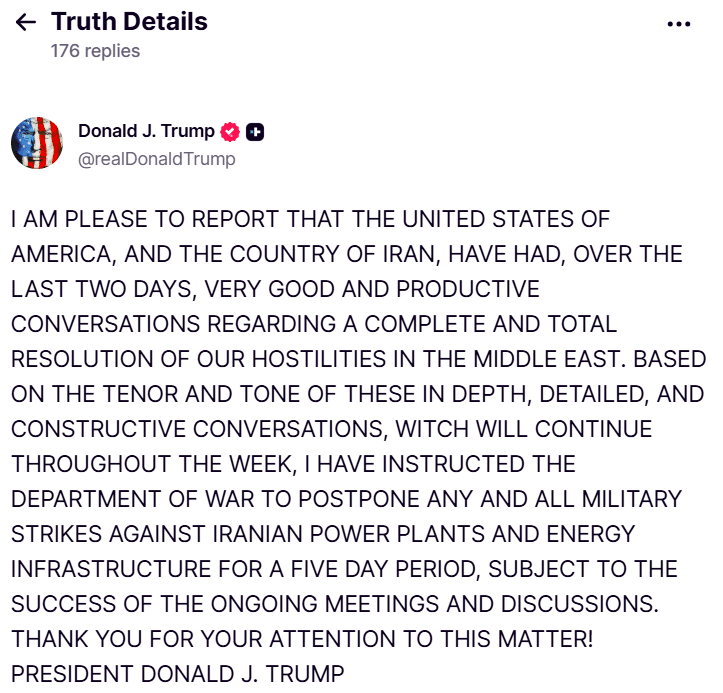
Here’s the sequence. President Trump posted that the US and Iran had held “very good and productive conversations.” Markets — crypto included — took that as a de-escalation signal and ran with it.

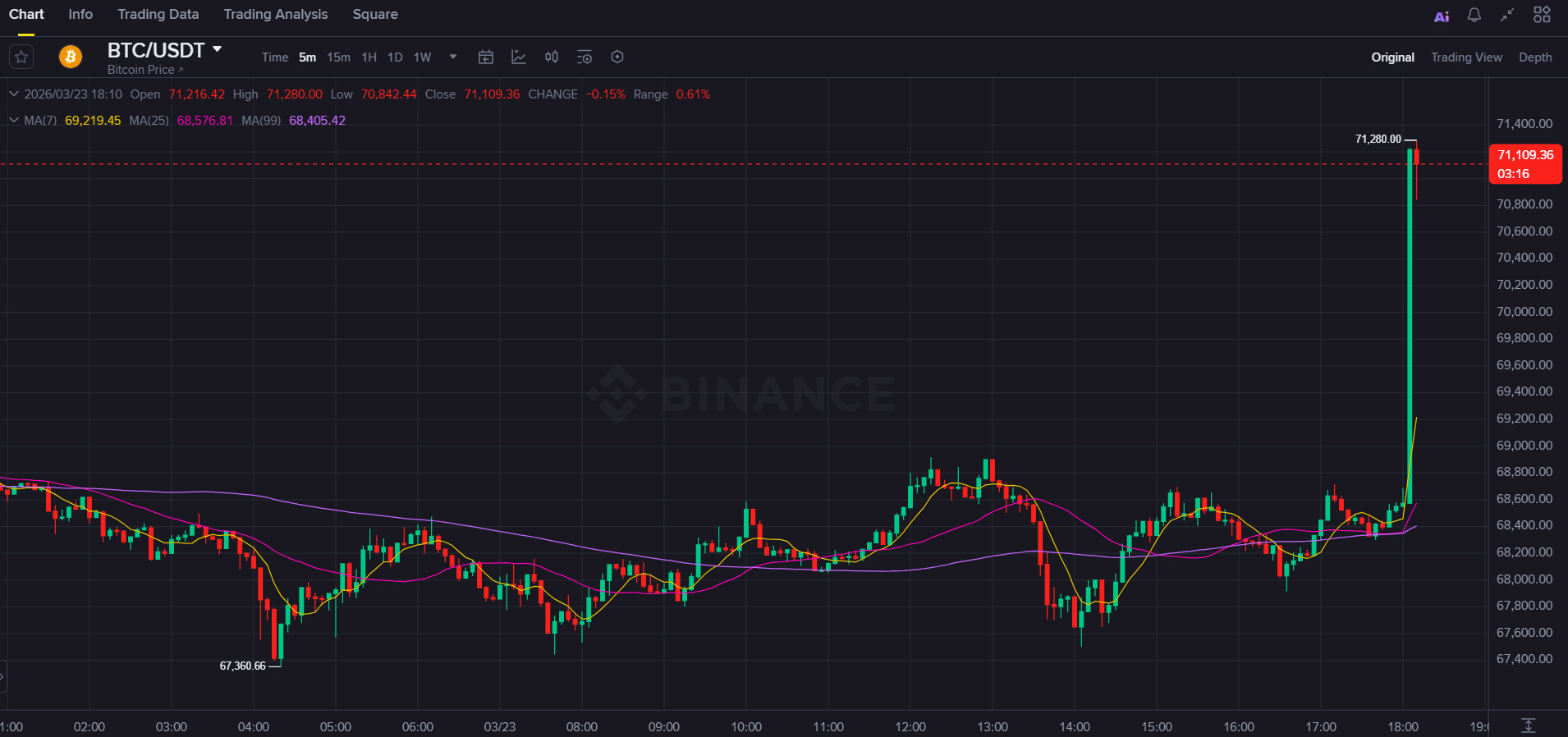
Bitcoin jumped from an early Monday low near $67K to above $71K within hours. Ethereum climbed back above $2,150. Solana pushed toward $91. XRP touched $1.45.

Across the board, risk assets caught a bid. The logic was straightforward: reduced geopolitical tension means less reason to hide in cash, more appetite for speculative assets.

Then Iran’s Fars news agency reported that the cited talks never actually happened. In English: the catalyst for the entire rally was contradicted by the other party supposedly involved in it.

Bitcoin didn’t crater on the denial, though. As of Monday evening, BTC was still trading near $71K, holding most of its gains. That’s either a sign of genuine underlying demand or a market that decided it liked the price move too much to give it back.

The 24-hour numbers tell the story. Bitcoin was up 2.8%, Ethereum gained 3.7%, and Solana led major caps with a 4% move higher. Not bad for a Monday built on disputed diplomacy.

Extreme fear meets institutional conviction

Here’s the thing about this rally: it happened against a backdrop of genuinely terrible sentiment. The Crypto Fear & Greed Index sits at 8 — deep in “Extreme Fear” territory. Last week it was 23, which was also extreme fear. So we’ve gone from scared to terrified.

For context, the Fear & Greed Index runs from 0 to 100. A reading of 8 means almost everyone is bearish. The last time sentiment was this low for this long, it coincided with major market bottoms in previous cycles. That’s not a prediction — it’s a pattern worth noting.

Despite the seven-day picture still being red — Bitcoin is down 3.7% over the past week — the snapback on Monday suggests there’s a floor of buyers waiting to step in on any whiff of good news. Real or imagined.

One entity that clearly isn’t waiting for sentiment to improve: MicroStrategy. Michael Saylor’s firm scooped up another 1,031 BTC for roughly $77M on the same day. That works out to about $74,700 per coin, give or take.

MicroStrategy has become something of a sentiment indicator in its own right. When the company buys during periods of extreme fear, it signals institutional conviction that the current price is a bargain relative to their long-term thesis. Whether you agree with that thesis is a separate question, but it’s hard to dismiss a company that keeps putting tens of millions on the line.

What this means for investors

The conflicting Iran reports create a genuinely tricky setup. If the talks were real and progress continues, the de-escalation trade has legs. Risk assets — crypto especially — could build on Monday’s gains as geopolitical risk premiums come down.

If the talks weren’t real, the market is sitting on gains built atop a sandcastle. The question then becomes whether buyers who entered above $70K have the conviction to hold, or whether they’ll bail at the first sign of renewed tension.

Look, there’s a third possibility too. Maybe partial talks happened, maybe backchannel communications occurred, and both sides are managing the narrative for domestic audiences. Diplomacy is rarely as binary as “happened” or “didn’t happen.” Markets may be pricing in the ambiguity itself — the idea that some form of engagement is occurring, even if the details are disputed.

The broader context matters here. Bitcoin has been caught between macro crosscurrents for weeks now. On one side, institutional adoption continues — spot Bitcoin ETFs, MicroStrategy purchases, corporate treasury moves. On the other, geopolitical uncertainty and persistent rate expectations have kept a lid on sustained rallies.

That tension is visible in the data. A Fear & Greed reading of 8 alongside a price above $70K is unusual. It suggests positioning is light and skepticism is high, but the price itself hasn’t broken down. That’s the kind of setup that can resolve violently in either direction.

One corner of the market that isn’t waiting for resolution: meme coins on BNB Chain. The Four.meme ecosystem surged 175.6% over seven days, a reminder that speculative appetite hasn’t disappeared — it’s just migrated to smaller, higher-volatility corners of the market.

For anyone watching the geopolitical angle, the next 48 hours are what matter. If additional details emerge confirming some form of US-Iran engagement, expect Bitcoin to test the $72K-$73K range. If the denial holds and tensions re-escalate, that $67K Monday low becomes the level to watch on the downside.

Bottom line

Monday’s rally was built on a geopolitical headline that got disputed within hours — and the market mostly shrugged off the contradiction. That tells you something about where sentiment stands. When a market rallies on disputed good news and refuses to sell the denial, it’s either resilient or in denial itself. The Fear & Greed Index at 8 suggests everyone expects the worst, which historically is exactly when markets stop delivering it. Whether that pattern holds depends less on crypto fundamentals and more on whether anyone in Washington or Tehran picks up the phone for real.

Disclosure: This article was edited by Estefano Gomez. For more information on how we create and review content, see our Editorial Policy.


BlackRock CEO Larry Fink pushes tokenization as next phase of markets

0


BlackRock CEO Larry Fink is placing tokenization at the center of the next evolution in financial markets, arguing that digital infrastructure could fundamentally reshape how people access and participate in investing.

In his annual letter, Fink said tokenization has the potential to modernize the financial system by making assets easier to issue, trade, and hold, particularly through digital wallets.

Fink pointed to the growing global adoption of digital wallets as a key foundation for this shift. With billions of people already using mobile wallets, he said the next step is enabling those same tools to provide seamless access to diversified investment portfolios. The goal is to make investing as simple as sending a payment, lowering barriers that have historically kept large parts of the population out of capital markets.

Tokenization, in his view, is not just a technological upgrade but a structural one. By improving the underlying infrastructure of financial markets, it could increase transparency, reduce friction, and expand access to asset classes that have traditionally been limited to institutions, including areas like private markets and infrastructure.

That push comes against a backdrop of growing imbalance in how wealth is created and distributed. Fink noted that over the past several decades, returns from financial assets have significantly outpaced wage growth, meaning those who own assets have benefited far more than those who rely primarily on income.

He warned that artificial intelligence could amplify this dynamic. As AI drives productivity and value creation, the gains are likely to accrue disproportionately to companies and investors positioned to capture them, further widening the gap unless more people gain access to investing.

For Fink, the solution is not short-term trading or market timing, but expanding long-term participation. He framed broader access to investing as essential to ensuring that economic growth is shared more widely, allowing individuals to build wealth alongside the economies they live in.

BlackRock is positioning itself to lead that transition. The firm has been expanding its footprint in digital assets, tokenized funds, and private markets, while building infrastructure that connects traditional finance with emerging digital systems. Fink said these efforts are aimed at creating a more accessible and efficient investment ecosystem that can reach a broader global audience.

Disclosure: This article was edited by Estefano Gomez. For more information on how we create and review content, see our Editorial Policy.


Bitcoin rises, Ether, XRP advance as Trump orders halt to strikes on Iran

0


Bitcoin jumped after President Donald Trump said he had instructed the Department of War to postpone planned military strikes on Iranian power plants and energy infrastructure for five days.

The order was the result of recent diplomatic talks between the US and Iran, which both sides described as productive and constructive, Trump wrote on Truth Social.

Trump orders halt to strikes on Iran energy sites

While the pause is limited in scope, the announcement was enough to send a wave of relief through risk markets that had been beaten down by weeks of escalating conflict in the Middle East.

Bitcoin returned to $71,000 on the back of the announcement, with gains seen across major crypto assets.

Ether gained above $2,100, BNB pushed through $650, and XRP traded above $1.4.

Background: Operation Epic Fury

Today’s rally follows weeks of turmoil triggered by Operation Epic Fury, the US and Israeli military campaign launched on February 28, 2026, which targeted Iranian leadership and resulted in the killing of Supreme Leader Ali Khamenei.

That action set off retaliatory strikes across the Middle East and pushed global markets into sustained turbulence. Bitcoin has been trading in a volatile corridor between $66,000 and $76,000 since the operation began, dropping as low as $63,255 in the days following the outbreak of hostilities.

Energy markets and inflation

Energy markets have taken the worst of the disruption. Brent crude has climbed roughly 60% since the conflict’s onset, from approximately $70 per barrel to above $113 by March 20.

The International Energy Agency characterized the resulting supply shock as the most severe oil disruption in recorded history. The closure and threatened blockade of the Strait of Hormuz (Trump issued a 48-hour ultimatum demanding Iran reopen the shipping lane) amplified fears of a prolonged energy shortage.

The Federal Reserve, meeting in March against this backdrop, revised its 2026 inflation forecast upward from 2.4% to 2.7%, reflecting surging energy costs passing through to consumer prices. Policymakers signaled a “higher-for-longer” posture on interest rates.

Disclosure: This article was edited by Vivian Nguyen. For more information on how we create and review content, see our Editorial Policy.


Worldcoin reportedly sells 117 million WLD through OTC deals

0


Worldcoin, the digital identity and token distribution project co-founded by Sam Altman in 2019, appears to have offloaded 117 million WLD tokens worth about $39 million through over-the-counter sales, according to Lookonchain.

The tokens went to Binance and FalconX, an institutional prime brokerage that handles large-block trades for hedge funds and asset managers. On-chain data shows the project received approximately $35 million in USDC in return, which implies an effective sale price near $0.3 per token.

WLD was trading at approximately $0.32 at press time, a decline of roughly 97% from its all-time high of $11.7 recorded in March 2024, per CoinGecko.

The peak came during a period of strong investor enthusiasm for artificial intelligence narratives. Altman’s role at OpenAI also made WLD a popular proxy bet on AI adoption.

The July 2026 cliff unlock

Worldcoin is set for a major token unlock in July, when over 52% of the total WLD supply is projected to enter circulation at once, according to DeFiLlama. This is among the largest proportional token unlocks expected for any major crypto asset.

Meanwhile, Tools for Humanity team members, investors, and early contributors are still receiving tokens daily under the revised vesting schedule implemented in 2024, under which about 80% of their WLD tokens vest over five years and the remainder over three years, with emissions having been ongoing since July 24, 2024.

Network and identity enrollment

Worldcoin, which rebranded its broader ecosystem under the name “World” in 2024, has continued expanding its identity verification network. The project’s signature hardware device, the Orb, performs iris scans to generate cryptographic proofs of personhood without storing biometric data on-chain.

As of March 2026, over 38 million users had enrolled in the World ID system, with approximately 18 million of those having completed full Orb-based verification.

The project has struck partnerships with consumer platforms including Razer and Tinder, positioning its technology as a defense against bots in gaming, dating, and other online environments.

World and Coinbase recently introduced AgentKit beta to address the growing challenge of trust in the rapidly proliferating agentic internet, where AI agents increasingly handle tasks like bookings, shopping, and price comparisons.

The system aims to complement payment-based access controls by adding identity-level assurance, providing a privacy-preserving trust layer for the emerging agentic web.

Disclosure: This article was edited by Vivian Nguyen. For more information on how we create and review content, see our Editorial Policy.


Coinbase unveils 24/7 stock futures for global traders in derivatives push

0


Coinbase now lets global traders gain continuous, leveraged exposure to major US stocks using perpetual futures, expanding beyond crypto into traditional assets while targeting demand for 24/7 trading.

The new product covers seven technology stocks, including Apple, NVIDIA, Tesla, Microsoft, Amazon, Alphabet, and Meta, along with ETF perpetual futures.

The contracts settle in USD Coin (USDC), a dollar-pegged stablecoin, and offer leverage of up to 10x on single stocks and up to 20x on ETF perpetuals, allowing international traders to take amplified positions in US equity price movements without a traditional brokerage account. They also support cross-margining across perpetual futures and spot positions, improving capital efficiency.

Access is available to retail users via Coinbase’s advanced trading interface and APIs, with institutional trading supported through its international exchange, all within a 24/7 market environment that includes weekends.

Why perpetual futures in stocks?

Traditional US stock exchanges close each weekday afternoon and stay dark on weekends and holidays, creating gaps that global investors have long found frustrating.

Perpetual futures carry no expiration date and continuously track the underlying asset’s spot price through a funding rate mechanism.

The move targets growing global demand for round-the-clock equity trading, especially in regions with limited access to US markets. It also advances the company’s goal of building an “everything exchange,” combining multiple asset classes into one system.

Regulatory and product development

Over the past year, Coinbase has established the groundwork for this move through key regulatory and product milestones. The exchange introduced crypto perpetual futures for US retail customers in mid-2025, primarily under CFTC oversight for commodity derivatives.

The firm then expanded crypto derivatives into Europe under a MiFID II license from the Cyprus Securities and Exchange Commission, secured via its 2024 Bux acquisition, reaching traders across 26 countries in a March 2026 rollout that aligned closely with its stock index futures launch.

Disclosure: This article was edited by Vivian Nguyen. For more information on how we create and review content, see our Editorial Policy.


Nvidia stock falls below 200-day moving average for first time in a year

0


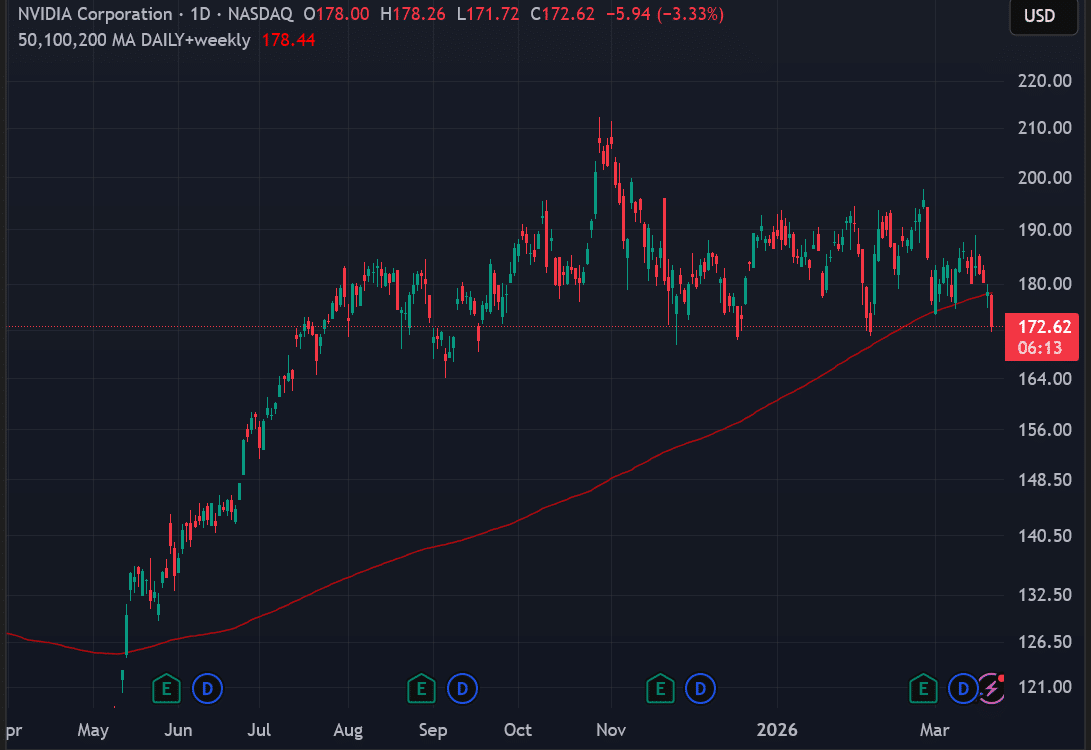
Nvidia shares fell below their 200-day moving average after this week’s GTC event failed to revive the stock, even as CEO Jensen Huang projected that the company’s Blackwell and Rubin product lines could help drive as much as $1 trillion in data center revenue through 2027.

NVDA 1D Chart + 200-DMA

Nvidia was down about 3.5% on the day, trading near $172 and approaching a key support level around $170 that has held since September 2025. The 200-day moving average sits near $178, and Nvidia is on pace to close below that level today, signaling a key shift in trend. A confirmed close below it would mark a technical breakdown after holding above the long-term trend line since its recovery in May 2025 following the tariff-driven selloff.

The weakness is not just about Nvidia. Markets have been rattled for weeks by geopolitical turmoil and shifting monetary policy expectations. The US and Israel’s war with Iran has driven crude sharply higher, with Brent recently trading above $105 a barrel and US crude near $99, while US gasoline prices have jumped more than 30% since the conflict began.

That energy shock is feeding inflation fears at a bad time. US consumer prices rose 0.3% in February from the prior month and 2.4% from a year earlier, while producer prices rose 0.7% in February, the biggest monthly increase in seven months.

The Fed held rates steady on March 18 and warned that the economic outlook remains uncertain, with specific attention to Middle East developments. Interest rate futures now suggest traders see little chance of cuts before mid 2027.

That backdrop has hit equities hard. The S&P 500 is nearing 6,495 on Friday, down about 7% since early February, while the Nasdaq Composite is near 21,535, down nearly 9% from its February highs. Both indexes fell again on Friday as oil rose and investors repriced the rate path.

Disclosure: This article was edited by Estefano Gomez. For more information on how we create and review content, see our Editorial Policy.


Hot inflation and a hot war keep markets on edge

0


Two things that markets absolutely hate showed up at the same time this week: sticky inflation and military conflict near the world’s most important oil chokepoint.

The result has been predictably ugly across every asset class, with crypto’s Fear and Greed Index plunging to 11 — deep into “Extreme Fear” territory — while the S&P 500 tracks its fourth consecutive weekly decline.

The macro picture is getting worse, not better

The Federal Reserve revised its 2026 rate cut outlook down to just a single reduction, citing core inflation running at 2.7%. That’s a meaningful shift from earlier projections that had markets pricing in multiple cuts.

In English: the cheap-money cavalry that risk assets have been waiting for isn’t coming anytime soon.

Meanwhile, US military strikes in the Persian Gulf — aimed at reopening the Strait of Hormuz — have pushed Brent crude above $100 per barrel. Roughly 20% of the world’s oil supply passes through that narrow waterway, so any disruption there sends energy prices into overdrive.

Higher oil means higher input costs for basically everything. Which means inflation stays stickier for longer. Which means the Fed stays hawkish for longer. It’s a feedback loop that nobody asked for.

The S&P 500 is now off more than 5% since late February, a slide that has erased weeks of gains and put the broader equity market firmly in correction-watch mode. Four straight weekly declines is the kind of streak that starts making portfolio managers lose sleep.

For context, the last time equities posted a similar losing streak while oil was above $100 was during the 2022 inflation shock — and that didn’t end well for anyone holding risk assets.

Crypto is holding on, barely

Bitcoin hovered near $70K this week, showing a modest 1.2% gain over the last 24 hours but still nursing a 4.9% loss on the seven-day chart. The world’s largest cryptocurrency has been trading in a tightening range, caught between buyers who see it as an inflation hedge and sellers who treat it like a leveraged tech bet.

Ethereum settled around $2,100, ticking up roughly 1% in a day but following the same general pattern of short-term bounces within a broader downtrend. That price level puts ETH about 57% below its all-time high, which is the kind of distance that makes the “ultrasound money” narrative feel a bit muted.

Solana slipped below $90, a psychologically important level that it had defended for much of the past month. SOL managed a 1.7% daily bounce, but losing that $90 floor suggests momentum traders may be rotating out. XRP held near $1.44, relatively stable by its standards but hardly inspiring confidence.

The Fear and Greed Index reading of 11 is worth pausing on. Last week it was 15 — also “Extreme Fear” — meaning sentiment has actually deteriorated further despite no major crypto-specific blowups. This level of fear is typically associated with capitulation events or major market crises, not garden-variety macro headwinds.

Historically, readings below 15 on the index have preceded significant relief rallies within 30 to 60 days. But that’s a backward-looking observation, not a guarantee — especially when the macro backdrop is actively deteriorating rather than stabilizing.

One curious bright spot: artificial intelligence tokens outperformed the broader market by a wide margin, with the AI category posting a 47.5% gain over seven days. Whether that reflects genuine sector rotation or speculative froth in a fearful market is an open question. When everything else is red and one niche category is up nearly 50%, skepticism is probably warranted.

What this means for investors

Here’s the thing about the current setup: it’s a genuine two-front war for portfolio managers, both literal and figurative.

The inflation front means the Fed’s put — that implicit backstop of rate cuts to rescue falling markets — has effectively been pushed further into the future. A single projected cut in 2026 is barely distinguishable from no cuts at all, from a positioning standpoint. Traders who built strategies around a dovish pivot are now staring at a calendar that keeps getting pushed back.

The geopolitical front introduces a variable that’s almost impossible to model. Oil above $100 has historically been a headwind for risk assets, and military operations in the Persian Gulf carry escalation risk that could send crude significantly higher. If Brent were to test $120 or beyond, the inflationary impact would ripple through every corner of the economy.

For crypto specifically, the next few weeks will likely test a thesis that’s been debated for years: does Bitcoin actually function as a macro hedge, or does it trade like a high-beta version of the Nasdaq? At $70K, it’s holding up better than most altcoins, but it’s also well below the $109K all-time high set in January.

The risk-reward calculus is complicated. Extreme fear readings often mark local bottoms, but they can also mark the beginning of deeper drawdowns if macro conditions continue to worsen. The fact that fear is deepening without a crypto-native catalyst — no exchange collapse, no regulatory crackdown, no major hack — suggests this is primarily a macro-driven repricing.

Watch two things closely: oil prices and the 10-year Treasury yield. If Brent stays above $100 and yields keep climbing, the pressure on risk assets — crypto included — will intensify. Conversely, any de-escalation in the Gulf or a softer inflation print could trigger a sharp short-covering rally, given how heavily pessimism is currently priced in.

Bottom line: Markets are caught between an inflation problem that won’t quit and a geopolitical crisis that could make it worse. Crypto is trading like a risk asset in a risk-off world, and until one of those macro headwinds breaks, the path of least resistance remains lower — no matter what the Fear and Greed Index says about historical patterns.

Disclosure: This article was edited by Estefano Gomez. For more information on how we create and review content, see our Editorial Policy.