Tuesday, September 29, 2026
Home Blog Page 15

US and Iran fail to reach deal after ceasefire, Bitcoin retreats

0


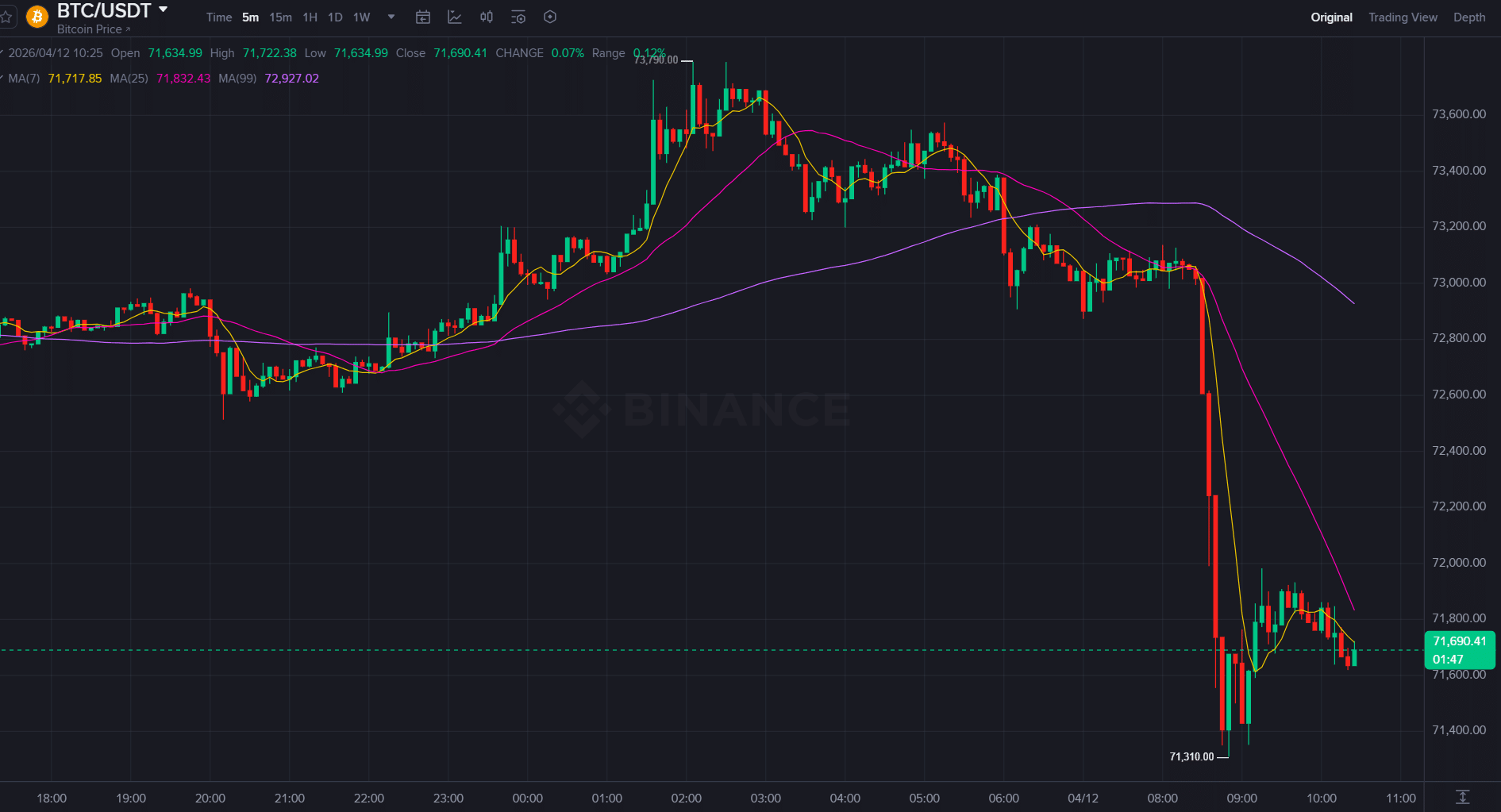
Bitcoin slid 2% on Saturday evening, dropping from above $73,000 to around $71,310, after US and Iran failed to agree on terms during high-stakes negotiations in Islamabad, Pakistan.

Vice President JD Vance, who led the US delegation, confirmed that talks between the US and Iran in Islamabad, Pakistan, concluded without an agreement.

Vance stated that Iran rejected the US position, emphasizing that Washington requires a fundamental commitment from Tehran to abandon its nuclear weapons development.

Vance noted that the negotiations spanned 21 hours and involved frequent consultations with President Donald Trump, who has made halting Iran’s nuclear program a core objective. He added that the US proposal represented its final offer.

In response, Iran’s foreign ministry characterized the talks as intensive and urged the US to abandon “excessive demands and unlawful requests” while respecting Iran’s sovereign rights.

According to IRGC-affiliated media Fars News Agency, an Iranian source accused the US of moving the goalposts during the deliberations.

A key sticking point involves US demands regarding the Strait of Hormuz, which has remained effectively closed since the outbreak of conflict between the US, Israel, and Tehran in late February.

The source suggests Washington is attempting to achieve through diplomacy what it failed to secure during the 40-day war, specifically citing US proposals for tanker protection, shipping insurance, and other military-economic measures.

These negotiations follow a Pakistan-brokered two-week ceasefire reached on Wednesday, after Washington accepted a 10-point proposal from Tehran. While Iran maintains that sending a delegation signals its willingness to negotiate, officials warn that its armed forces remain on high alert.

Disclosure: This article was edited by Vivian Nguyen. For more information on how we create and review content, see our Editorial Policy.


Arthur Hayes doubles down on HYPE as he eyes $150 target by August

0


Arthur Hayes, the BitMEX co-founder and current chief investment officer at crypto family office Maelstrom Fund, purchased 26,022 HYPE tokens worth approximately $1.1 million on Saturday, according to data tracked by Lookonchain.

His total position now sits at 247,334 tokens valued at over $10 million with unrealized gains above $2.2 million.

HYPE was trading at approximately $41, down about 2% in the last 24 hours, CoinGecko data shows.

The native asset of Hyperliquid’s layer 1 blockchain has outperformed leading crypto assets such as Bitcoin and Ethereum in terms of year-to-date returns.

So far this year, HYPE has jumped roughly 61%, while Bitcoin and Ether have dropped 18% and 25%, respectively. Still, the token hasn’t fully recovered, sitting around 31% below its September all-time high.

Hayes has steadily accumulated HYPE over the past few months. On-chain data shows that the prominent investor sold a number of his altcoins to buy $1.9 million worth of HYPE in February.

He has also publcily expressed his support for Hyperliquid and its ecosystem. In a March blog post, he predicted that HYPE could hit $150 by August, a fivefold increase from where it traded in early March at around $30.

The projection, based on Maelstrom’s financial model, pointed to the project’s continued dominance in the on-chain perpetuals futures market and its deeply undervalued revenue machine.

Moreover, the majority of trading fees get funneled directly into HYPE token buybacks, creating constant upward pressure on prices, according to Hayes.

“No other project in all of crypto hands as much money back to token holders as Hyperliquid,” Hayes previously stated.

According to DefiLlama data, Hyperliquid tops the 24-hour perps trading volume rankings with $2.6 billion, ahead of Aster’s $1 billion. It also maintains a clear lead over edgeX, Aster, and Lighter in 30-day volume.

Disclosure: This article was edited by Vivian Nguyen. For more information on how we create and review content, see our Editorial Policy.


US government moves $177K in seized Bitcoin to Coinbase Prime

0


Two wallets associated with US government seized assets on Friday moved 2.4 Bitcoin worth approximately $177,000 to Coinbase Prime, on-chain data shows.

According to Timechain Index, the funds trace back to assets seized in the Glenn Olivio case, which is tracked alongside other major confiscations like Silk Road.

The transfers came after the US government shifted around 0.04 Bitcoin worth over $2,500 last month. The assets are tied to the Miguel Villanueva seizure case.

The transfer comes amid ongoing efforts by US authorities to expand the Strategic Bitcoin Reserve established in March 2025, which has reached about 328,370 BTC through forfeiture-related holdings.

In the past, US agencies periodically sold confiscated Bitcoin rather than holding it.

This is a developing story. Please check back for further updates.

Disclosure: This article was edited by Vivian Nguyen. For more information on how we create and review content, see our Editorial Policy.


March CPI inflation rises to 3.3% as energy shock offsets core stability

0


The US Consumer Price Index rose 0.9% in March 2026, accelerating from February’s 0.3% increase, according to the Bureau of Labor Statistics. Inflation over the past 12 months reached 3.3%, slightly below the 3.4% consensus forecast.

Core CPI, excluding food and energy, increased 2.6%, compared with expectations of 2.7%.

March inflation climbed as shelter and energy kept price pressures elevated.

Energy prices jumped 10.9% in March, marking the largest monthly increase in nearly two decades, driven by a 21.2% surge in gasoline and sharp gains in fuel oil. Shelter increased 0.3%, while food prices were unchanged overall, with mixed movements across grocery and dining categories.

Energy prices have surged following the Iran war, with disruptions to global oil shipping routes contributing to higher costs across commodities. The rise in crude has begun to feed through supply chains, affecting transportation, food, and broader consumer goods.

Expectations of interest rate cuts in 2026 have been largely scaled back.

Federal Reserve officials have signaled in recent FOMC minutes that further tightening remains a possibility depending on inflation dynamics.

Bitcoin rose above $72,000 ahead of the CPI release and was hovering around that level at the time of reporting, according to CoinGecko data.

The crypto market, however, is still under pressure, with sentiment still cautious despite the price holding steady around recent highs.

Bittensor’s TAO led declines over the past 24 hours, falling more than 20% following Covenant AI’s departure. World Liberty Financial, backed by President Trump, also posted double-digit losses.

Disclosure: This article was edited by Vivian Nguyen. For more information on how we create and review content, see our Editorial Policy.


Covenant AI exits Bittensor over centralization concerns, TAO falls 15%

0


TAO, the native token of Bittensor, dropped by double digits on Thursday after Covenant AI announced its departure from the decentralized network due to concerns over centralized control and governance.

CoinGecko data shows that TAO dropped over 15% from around $337 to $284 following Covenant AI’s announcement. The token was trading at $292 at press time, down 9% in the last 24 hours.

Covenant AI, which built the large-scale Covenant-72B model using decentralized contributors, alleged that the Bittensor network’s governance structure is not fully decentralized in practice.

The team said key decisions and operational controls remain concentrated among a small number of actors despite the network’s stated decentralization principles.

Covenant AI accused Jacob Steeves, Bittensor’s founder, of exercising unilateral control over key aspects of the network.

“These actions include the suspension of emissions to our subnets, the removal of our moderation capabilities over our own community channels, the unilateral deprecation of our subnet infrastructure, and direct economic pressure applied through large, visible token sales timed to moments of operational conflict,” the team pointed out.

Covenant AI said it could no longer continue building on Bittensor under these conditions and that it would continue its research and development efforts outside of the network.

“Decentralized, permissionless AI training is not a Bittensor feature. It is a technological capability that our team is eager to advance. Our research, our team, our models, and our vision go with us,” the team added. “We have very exciting projects and news underway and will be sharing announcements with the public very soon.”

“This will prove to birth the first subnets on Bittensor that run headless and as true commodities,” Steeves said in response to claims about centralization within Bittensor.

TAO jumped roughly 90% in March, while subnet tokens, mechanically linked to TAO through staking-backed automated market makers, posted amplified returns of up to 400%.

The rally was supported by Subnet 3’s Covenant-72B model. High-profile endorsements from Jensen Huang and Chamath Palihapitiya added credibility to Bittensor, strengthening investor confidence in the ecosystem.

Disclosure: This article was edited by Vivian Nguyen. For more information on how we create and review content, see our Editorial Policy.


Bitcoin flirts with $72K while a whale bets $80M it won’t last

0


Bitcoin pushed above $72K this week, notching an 8% gain over seven days. Normally, that kind of move would have the market doing a victory lap. Instead, the vibe is something closer to a horror movie where the characters celebrate too early.

One anonymous whale just placed an $80 million bet that this rally is living on borrowed time. And the Fear and Greed Index, sitting at 14, confirms that almost nobody actually feels good about any of this.

The whale’s $80M short

Here’s the play. A single unidentified trader opened $80 million in short positions, split evenly between Bitcoin and Ethereum. That’s $40 million betting BTC drops and $40 million betting ETH drops.

The kicker: they’re using 20x leverage. In English, every 1% move against this trader costs them 20% of their margin. It’s the financial equivalent of tightrope walking in a windstorm.

The Ethereum side of the trade is especially aggressive. The liquidation price reportedly sits just 3% above the entry point. If ETH ticks up by that amount, the short gets automatically closed and the trader eats the loss. Three percent in crypto is a Tuesday afternoon.

This isn’t some small fish making a reckless gamble on a meme coin. An $80 million position with 20x leverage implies someone with deep pockets and, presumably, a thesis. Whether that thesis is correct is another matter entirely.

Whales have been wrong before, spectacularly so. But they’ve also been right at moments when the broader market was blinded by optimism. The fact that this bet exists at all tells you something about the current state of conviction.

Where the market actually stands

Bitcoin hovered near $72K at the time of writing, up roughly 0.5% over the past 24 hours and 8% on the week. That weekly gain is notable, but the daily action has been sluggish, suggesting the initial burst of buying pressure may be fading.

Ethereum slipped below $2,300, down 0.7% in the past day. Solana traded near $84, essentially flat. XRP held around $1.35.

The Fear and Greed Index reads 14, which falls squarely in the “Extreme Fear” category. For context, it was 12 last week. So sentiment improved, technically, but going from “terrified” to “slightly less terrified” isn’t exactly a ringing endorsement.

Look, Extreme Fear readings have historically been contrarian buy signals. Warren Buffett’s famous “be greedy when others are fearful” line gets trotted out every time this index dips below 20. But the index can stay in fear territory for weeks or even months during prolonged downtrends. It’s a thermometer, not a crystal ball.

Derivatives markets are telling a similar story. Positioning remains cautious, with traders reluctant to pile into aggressive longs despite the price recovery. When the leveraged crowd isn’t chasing a rally, it usually means they don’t trust it to stick around.

Analysts can’t agree on what comes next

The expert class is split right down the middle on this one, which is about as helpful as a weather forecast that says “it might rain, or it might not.”

Tom Lee, the Fundstrat co-founder who has been one of Wall Street’s most persistent Bitcoin bulls, believes the bottom is already in. His view: the worst of the selling pressure has passed and the market is building a base for the next leg higher.

On the other side, Bloomberg Intelligence’s Mike McGlone is more guarded. His line in the sand is $75K. If Bitcoin can reclaim and hold that level, the bull case strengthens. If it can’t, the current bounce could be just that: a bounce, not a reversal.

Here’s the thing. The macro backdrop isn’t making the call any easier. Weakening consumer data has introduced fresh uncertainty about the trajectory of the US economy. Softer spending numbers could eventually push the Federal Reserve toward rate cuts, which would be bullish for risk assets including crypto. But in the short term, weak economic data tends to spook investors before it helps them.

The result is a market stuck between two narratives. One says the worst is over and this is the accumulation phase. The other says the rally is a dead cat bounce with a very expensive haircut waiting on the other side.

What this means for investors

The $80 million whale short is a useful data point, not a roadmap. Large leveraged positions blow up all the time in both directions. If Bitcoin rips past $75K, this trader could face a liquidation cascade that actually accelerates the move higher. Shorts getting squeezed is one of the oldest fuel sources for crypto rallies.

Conversely, if the whale is right and this rally fades, the unwind could get ugly. Thin conviction means thin liquidity, and thin liquidity means bigger price swings. The 8% weekly gain could evaporate faster than it appeared.

The Ethereum trade is the one to watch most closely. With a liquidation price only 3% above entry, it’s essentially a binary bet that ETH stays flat or drops in the very near term. If ETH pushes toward $2,370 or so, that position gets blown out. The resulting forced buying could drag ETH higher and shift short-term momentum.

For anyone sitting on the sidelines, the extreme fear reading is worth noting but not worth blindly acting on. Historically, buying during extreme fear has produced strong returns over 6-to-12-month windows. But “historically” is doing a lot of heavy lifting in that sentence. Each cycle has its own character, and this one is being shaped by macro forces, like tariff uncertainty and slowing consumer spending, that weren’t factors in previous crypto winters.

The prudent move is watching the $75K level McGlone flagged. A sustained break above it would validate the recovery thesis. A rejection there would give the whale’s bearish bet a lot more credibility.

Bottom line: Bitcoin’s 8% weekly rally looks encouraging on the surface, but an $80 million leveraged short from a whale, extreme fear across the market, and a divided analyst community all point to the same conclusion. This is a market that doesn’t trust itself yet. The next few days around the $72K to $75K range will determine whether the bulls or the whale had the better read.

Disclosure: This article was edited by Estefano Gomez. For more information on how we create and review content, see our Editorial Policy.


Fartcoin plunges 28% as shorts rake in fat profits

0


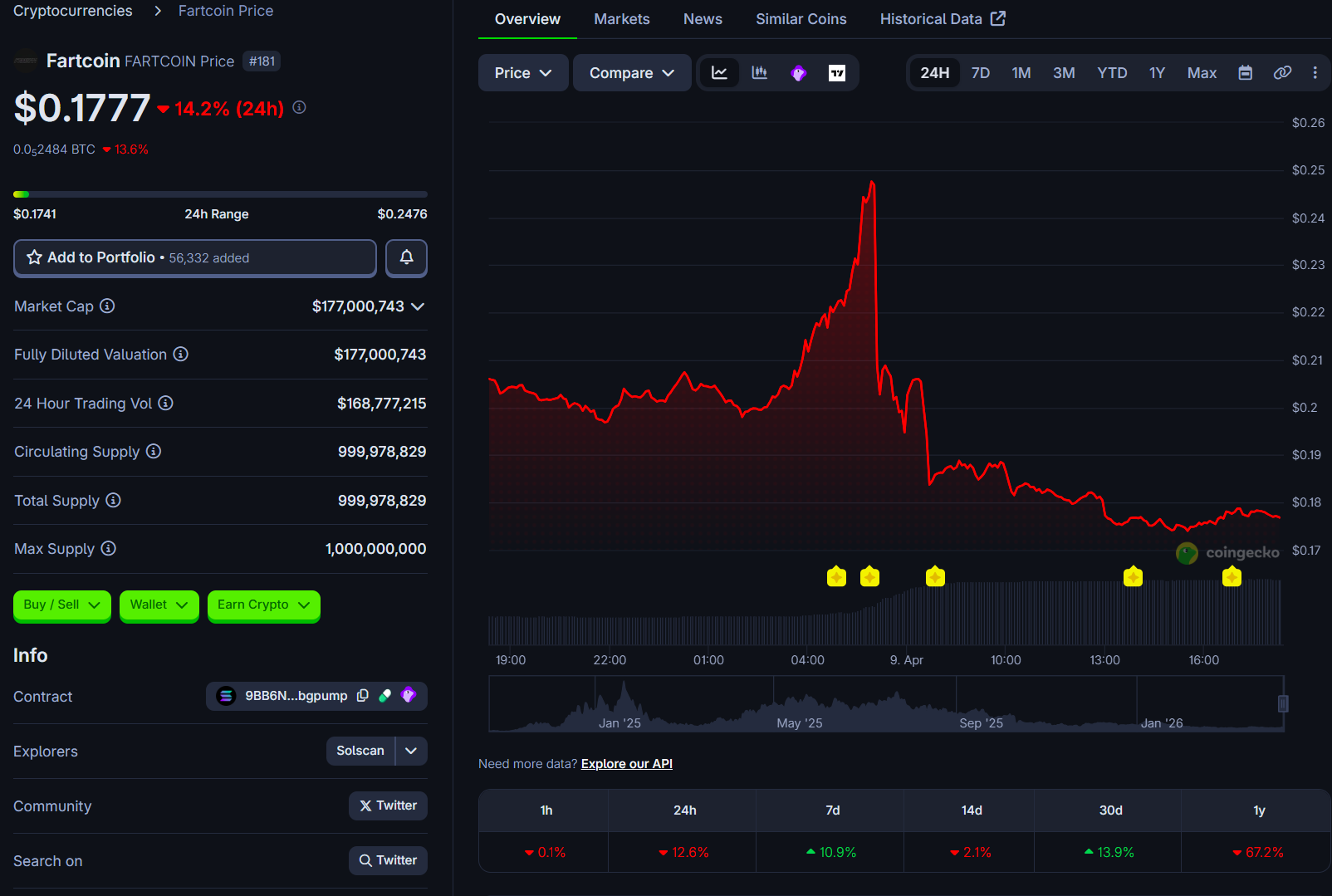
Fartcoin (FARTCOIN), a Solana-based meme coin born from an AI experiment called Truth Terminal, tanked 28% in the last 12 hours, sliding from about $0.25 to $0.17 after a mega-long liquidation blew up $3 million.

Data tracked by Lookonchain shows a trader opened a 145 million FARTCOIN long across four wallets in an attempt to manipulate the market but the plan appeared to backfire, resulting in a $3 million liquidation.

On the flip side, FARTCOIN shorts profited from Auto-Deleveraging (ADL), with two wallets collectively earning $849,000 in profits.

Coordinated trade sent FARTCOIN up 20% before liquidation event

Some crypto traders speculate that the FARTCOIN crash was caused by a group of traders on Hyperliquid associated with the same wallets behind the earlier XPL squeeze.

These traders first built a large long position in FARTCOIN, pushing the price up 20%. Hyperliquid’s HLP, which acts as the market maker of last resort, had to take the other side of trades when there were not enough buyers. This left HLP short on FARTCOIN.

The traders then triggered their own liquidation. Auto-deleveraging automatically closed opposing positions to balance the system.

One of the wallets that profited from the event, identified as 0x06ce, made $512,000 from it, continuing a six-day winning streak and bringing its all-time PnL to more than $15 million.

The event exposes a known risk for automated market makers in low-liquidity assets: while Hyperliquid is fully transparent and on-chain, that same transparency allows sophisticated actors to anticipate and exploit its positions.

The wider meme coin collapse

The meme coin market has been in freefall since July 2025, with total market capitalization falling 65% to roughly $29 billion.

Fartcoin, launched in October 2024 at $0.0029, soared over 9,300 percent to an all-time high of $2.5 in January 2025. Since then, the token has lost around 93 percent of its value.

Disclosure: This article was edited by Vivian Nguyen. For more information on how we create and review content, see our Editorial Policy.