Saturday, March 21, 2026
Home Blog Page 100

Argentina’s president Javier Milei says he did not promote $LIBRA token, just shared it

0


Key Takeaways

  • President Javier Milei clarified he merely shared information about $LIBRA, not actively promoting it.
  • Milei met with Hayden Mark Davis for developing financing for entrepreneurs but denies extensive investor impact.

Share this article

Argentine president Javier Milei is defending himself amidst accusations of fraud and calls for impeachment following his promotion of the $LIBRA token. Speaking during an interview with Jonatan Viale on TN’s “¿La Ves?” on Monday, Milei claimed he simply shared information about the project rather than actively promoting it.

“I didn’t promote it, I shared it,” Milei explained. “I did it because I’m a fanatical techno-optimist.”

“I acted in good faith and I got slapped,” Milei said, addressing the controversy. He maintained that the incident affected only a small number of Argentines, with most investors being Chinese and American.

Explaining the reason for sharing, Milei stated that he shared the $LIBRA token information because he is enthusiastic about such projects and discovered it shortly after its creation.

“I shared this like I shared hundreds of things. My tweet was three minutes after the coin was created because I am a fan of this stuff,” he mentioned.

Milei claimed that those who invested in $LIBRA were well aware of the risks involved. He disputed claims of widespread impact, insisting that the actual figure was far less than 44,000.

“The claim that 44,000 people were affected is simply wrong. The real number is closer to 5,000, at most. And it’s highly unlikely any Argentinians were involved. These are sophisticated traders, volatility traders who knew what they were getting into,” he asserted. “…they did it voluntarily.”

The president revealed he met Hayden Davis, who facilitated the token launch, at Casa Rosada in October 2024. He said that Davis proposed creating a financing structure for entrepreneurs lacking traditional funding options.

“When the Libra thing became public, I spread the word,” Milei said, explaining that his first tweet was to help Argentines who do not have access to traditional financing.

When asked why he deleted the tweet, Milei said he removed it due to negative feedback.

“When people started saying my account was hacked, I pinned the tweet to show it was really me. But then the negative comments piled up, so I took the tweet down to avoid confusion. I never actually deleted it, though – I just hid it,” he said.

He denied government involvement in the operation but warned that “if the justice system determines otherwise, heads will roll.”

Share this article


FTX wallet moves Bitcoin ahead of creditor repayments

0


Key Takeaways

  • FTX has begun testing Bitcoin transactions ahead of creditor repayments scheduled for tomorrow.
  • Initial creditor repayments will prioritize customers with claims under $50,000.

Share this article

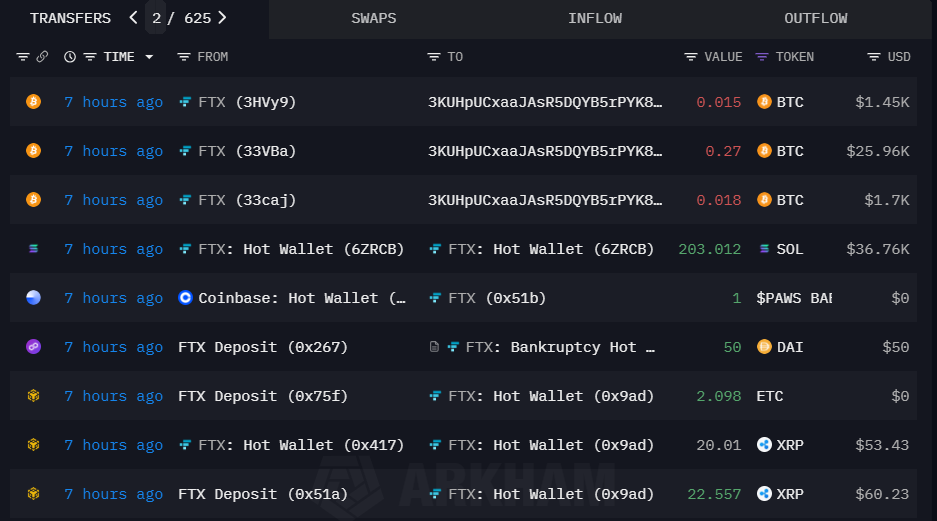
A wallet associated with the now-bankrupt crypto exchange FTX moved 0.3 Bitcoin, worth around $29,000, in three separate transactions early Monday, according to Arkham Intelligence data. The move comes as the FTX estate is set to begin repaying its first creditors on Feb. 18.

The motive behind these small Bitcoin transfers is unclear. Ethem Ozturk, co-founder of Muhabbit who first spotted them, speculates that they may be test transactions to make sure things go smoothly when the bigger payouts start.

According to the latest update from Sunil Kavuri, who represents the largest group of FTX creditors, FTX will initiate distributions to “convenience class” creditors, those with claims under $50,000.

Eligible creditors can expect to receive 100% of their adjudicated claim value, plus 9% annual interest calculated from November 2022, the month FTX declared bankruptcy.

Repayments will be based on crypto values converted to US dollars at the time of FTX’s November 2022 bankruptcy. While FTX has recovered more than $16 billion in assets, customers may face losses due to the recent appreciation of Bitcoin and Ethereum.

The exchange projects that approximately 98% of users will receive 119% of their claim value.

FTX’s reorganization plan officially took effect on Jan. 3, and repayments will soon begin. The first group of creditors is expected to receive their reimbursements by early March.

FTX will announce its plans for how the rest of its creditors will be repaid in the future.

Share this article


Sonic Launches $1M Mobius Hackathon

0


Sonic SVM, the first chain extension for Solana, has launched a hackathon to incentivize development of native decentralized applications and invited judges to assess the submissions. The Mobius Hackathon offers prizes to teams creating dapps on the gaming-optimized Sonic chain, whose mainnet goes live on February 27.

Sonic’s first dedicated hackathon features a prize pool worth $1M to reward builders of novel applications spanning a range of onchain verticals, from gaming to DeFi. The first-of-its-kind online hackathon commences on February 17 and will run until March 14, by which time the Sonic mainnet will be live.

Four hackathon tracks have been selected, with teams expected to develop applications that fall into one of the following categories:

Attention capital market: User acquisition, content tokenization across social media platforms such as Tiktok, Instagram, Whatsapp, Rednote.

DeFi: Asset launchpad, trading bot, yield generating, lending, MEV.

AI: Agent aggregators, tooling, initial agent offerings, and other infra.

Gaming: Mini games, social games, FOCG, high-ARPU games.

Sonic is seeking a panel of judges to evaluate submissions based on a range of criteria, including technical depth and practical application to determine real-world viability. They will also provide constructive feedback to ensure that all teams gain value from the experience and are able to optimize their applications.

By highlighting areas of excellence as well as areas for improvement, the judges will foster a positive learning environment in which all participants benefit from the hackathon. In addition to demonstrating a willingness to engage with builders and serve as mentors, judges are expected to be active on social media. 

By sharing updates on social media, engaging with participants, and promoting standout projects, judges will raise awareness of the caliber of applications being developed on Sonic SVM. In the process, they will help to spotlight the industry’s most promising up-and-coming developer teams.

Upon completion of the month-long event, the panel of judges will appraise the submissions before announcing the winner on April 2. The $1M Mobius Hackathon will catalyze development of Sonic applications while highlighting the network’s ability to scale Solana by providing a dedicated layer for high performance decentralized applications.

About Sonic SVM

Sonic is the first SVM network extension to launch on Solana for games and applications. Built with Sonic HyperGrid, a framework for orchestrating optimistic Solana rollups, Sonic aims to power the web3 TikTok App Layer to onboard the next one billion users.

Learn more: https://www.sonic.game/

Hackathon registration form for builders: https://sonicsvm.typeform.com/mobiushackathon

Builder group (for finding teams or sharing info): https://t.me/+S_eelN_07xswYTdl

Developer doc: https://docs.sonic.game/developers/additional-resources

Contact us for more info: https://t.me/derMondder


Hedge fund giant Millennium discloses $2.6B Bitcoin ETF and $182M Ethereum ETF holdings

0


Key Takeaways

  • Millennium Management disclosed $2.6 billion in Bitcoin ETFs and $182.1 million in Ethereum ETFs holdings.
  • Institutional crypto investment is on the rise, with entities like Abu Dhabi’s sovereign fund and Goldman Sachs increasing their Bitcoin ETF holdings.

Share this article

Millennium Management disclosed holdings of $2.6 billion in Bitcoin ETFs and $182.1 million in Ethereum ETFs in its latest 13F filing with the SEC.

The hedge fund’s Bitcoin ETF portfolio is spread across multiple funds, with BlackRock’s IBIT representing its largest position at over $844 million, followed by Fidelity’s fund at just over $806 million.

Other holdings include the ARK 21Shares Bitcoin ETF, the Bitwise Bitcoin ETF, and the Grayscale Bitcoin Trust.

The filing reveals a broader trend of institutional crypto investments, with Abu Dhabi’s sovereign wealth fund purchasing $436.9 million of BlackRock’s spot Bitcoin ETF in the quarter. Goldman Sachs also increased its Bitcoin ETF holdings to $1.5 billion.

In May 2024, Millennium Management’s investment in Bitcoin ETFs reached nearly $2 billion across five major funds, representing only 3% of their total assets.

Share this article


Argentine President-backed LIBRA token tanks 85% as team reportedly dumps $87 million

0


Key Takeaways

  • The LIBRA token crashed 85% as developers liquidated $87million in USDC and SOL.
  • 82% of the token’s supply is concentrated, leading to centralization concerns.

Share this article

The LIBRA token, promoted by Argentine President Javier Milei on his official X account, crashed 85% after its development team removed $87 million in USDC and SOL from liquidity pools, according to data tracked by blockchain analysis firm Bubblemaps.

The token, which reached a fully diluted valuation of $4.5 billion within hours of its launch, saw its top 100 holders face average losses exceeding 56% from their initial purchase price of $1.6.

On-chain analyst EmberCN reported that suspected insiders profited around $20 million from trading LIBRA tokens. At least three addresses executed a similar trading pattern, including pre-tweet fund withdrawals from CEXs, immediate post-tweet purchases, and sales as the price climbed.

Data shows 82% of LIBRA’s supply is concentrated in connected addresses, raising centralization concerns. The project is linked to KIP Network Inc., developer of the KIP Protocol web3 framework for AI applications, which is backed by Animoca Ventures.

“Assume this is a scam, account funded by a nokyc exchange, usually these sorts of large launches are planned in advance and have multisigs and such,” said Conor Grogan, Coinbase’s head of product.

The token is claimed to be part of the Viva La Libertad Project, aimed at supporting Argentina’s economy by funding local businesses and startups. KIP Protocol has been active in Argentina, joining the Buenos Aires City Government’s blockchain committee and meeting with President Milei in October 2024.

The launch of LIBRA came after the Central African Republic (CAR) launched a $CAR memecoin as a national experiment to unite people and support national development, said President Faustin-Archange Touadéra on his official X account last Sunday.

Following President Touadéra’s statement, the token blew past $1 billion in market cap but quickly crashed to below $20 million, according to GeckoTerminal data.

Share this article


Argentina’s president withdraws support for LIBRA token, admits to skipping due diligence

0


Key Takeaways

  • President Milei withdrew support for LIBRA token after it lost 85% value.
  • Previously, Milei promoted CoinX, alleged as a Ponzi scheme impacting investors.

Share this article

Argentina’s President Javier Milei has withdrawn his support for the LIBRA meme token after initially endorsing it, stating he had no connection to the project. Milei also admitted that he did not do his due diligence before tweeting support, but deleted his tweets once he became aware of the details.

The token, which claimed to be part of the Viva La Libertad Project supporting Argentina’s economy, dropped 85% in value amid reports of the project team’s liquidation.

“A few hours ago I posted a tweet, as I have so many other times, supporting a supposed private enterprise with which I obviously have no connection whatsoever,” Milei said. “I was not aware of the details of the project and after having become aware of it I decided not to continue spreading the word (that is why I deleted the tweet).”

Analysis shows that 82% of the token supply is concentrated among a small number of addresses, suggesting centralized control.

In addition to clarifying his stance, Milei pushed back against critics seeking to capitalize on the controversy.

“To the filthy rats of the political caste who want to take advantage of this situation to do harm, I want to say that every day they confirm how vile politicians are, and they increase our conviction to kick them in the ass,” he said.

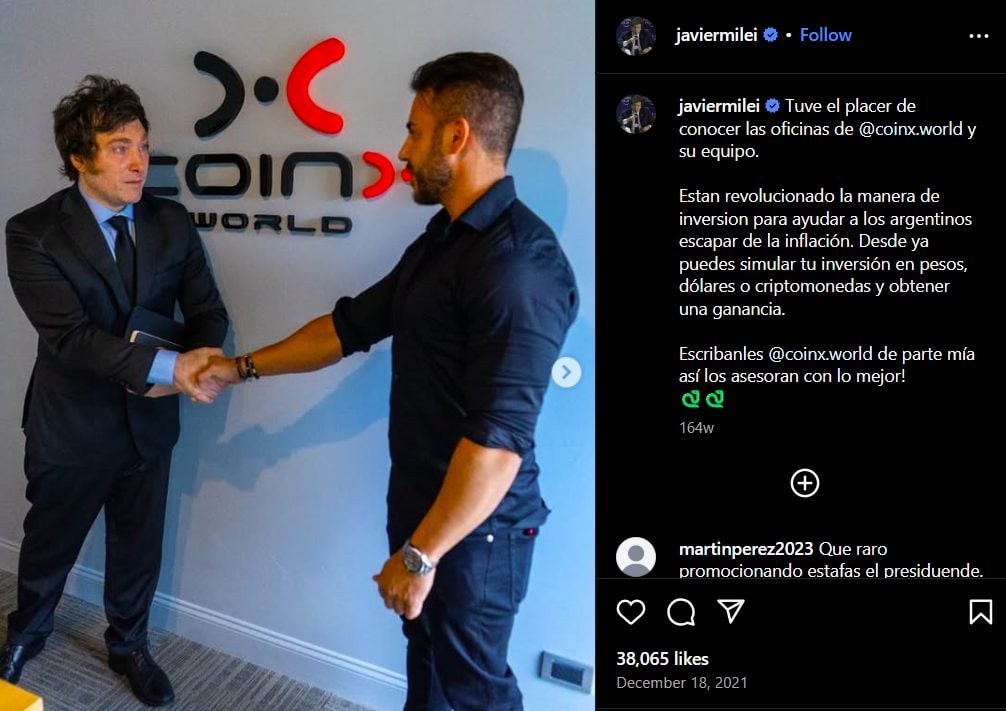
This isn’t Milei’s first controversy involving crypto projects. In late 2021, he promoted CoinX, an alleged crypto Ponzi scheme, on Instagram, claiming it could help Argentinians fight inflation, Protos previously reported.

CoinX promised high profits through AI-powered automated trading and expert traders, but investors reported not receiving the expected returns. The National Securities Commission subsequently ordered CoinX to cease operations.

Investors sued Milei, seeking damages for losses estimated at between 30 million and 40 million pesos (approximately $300,000).

Share this article


Bitcoin’s Coinbase premium index turns red as US January CPI looms

0


Key Takeaways

  • Bitcoin’s Coinbase premium index is negative, indicating selling pressure from US investors.
  • US Bitcoin ETFs saw negative flows for two days, but BlackRock’s IBIT fund logged $59 million in inflows.

Share this article

Bitcoin’s Coinbase premium index flips negative, as US traders brace for this morning’s January CPI release, according to Coinglass data.

The most recent negative reading on the index occurred on February 3 when Bitcoin’s value bottomed out at $92,000 following President Trump’s announcement of tariffs on imports from Canada, Mexico, and China, which stoked inflation fears.

The premium index tracks the spread between Bitcoin’s dollar-denominated price on Coinbase and the tether-denominated price on Binance. When it is negative, Bitcoin is trading at a higher rate on Binance than on Coinbase, indicating selling pressure from US retail investors since Coinbase serves as one of their go-to crypto platforms.

Bitcoin briefly dipped below $95,000 on Tuesday afternoon before recovering. Overnight, prices fluctuated between $95,000 and $96,000. At press time, BTC was trading around $95,800, down 2% over the past 24 hours, per CoinGecko data.

Offshore traders also led the price recovery from overnight lows near $94,900 to $96,000 according to the premium indicator.

The negative Coinbase premium is consistent with the trend of outflows from US spot Bitcoin ETFs, which have now registered two days of net withdrawals, according to Farside Investors data.

Over the first two trading days of the week, approximately $243 million was withdrawn from these funds. Despite the negative performance, BlackRock’s IBIT is still on its buying spree, netting around $59 million so far this week.

Inflation data are in the spotlight.

Economists anticipate January’s CPI to show a headline inflation rate of 2.9%, matching December’s annual increase. Core inflation, excluding food and energy prices, is expected to rise 3.1% year-over-year, potentially marking the lowest level since April 2021.

The Federal Reserve maintained the fed funds rate at 4.25%-4.5% during its January 2025 meeting, following three consecutive rate cuts in 2024.

According to Chair Powell, the Fed is not in a hurry to lower interest rates and has paused to see further progress on inflation. The Fed seeks to achieve maximum employment and inflation at a rate of 2% over the long run.

Share this article